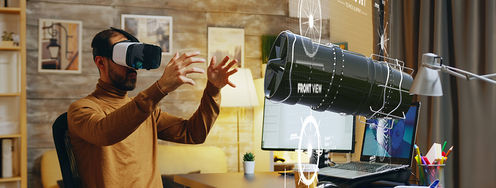
Surgeon in a virtual-reality headset works over a patient amid holographic medical displays and robotic surgical arms

Less is (Also) More in Virtual and Augmented Reality Design

by Frank Spillers and Ditte Mortensen • • 14 min read

535 Shares
Save

One of the most exciting things about designing virtual and augmented reality experiences is all the things you’re able to do as a designer. You can take advantage of all of the user’s senses in design, you can create first-person stories, and you can overlay reality with any virtual object you can come up with. To a large extent, only your imagination sets the limit for how you can provide the users with affordances, action possibilities and information. While all the options create wonderful design opportunities, they also mean that the true art of creating virtual and augmented reality experiences lies in limiting yourself to only giving the users as much information as they need – in the most elegant and subtle way. Here, we’ll give you five tips for what you need to consider in order to keep your virtual and augmented experience designs as simple and pleasurable as possible.

Transcript

The Takeaway

When you design for virtual and augmented reality, you need to consider:

  • Discovery. You should ensure that discovery is easy and simple. Users typically don’t enjoy searching for interaction opportunities and affordances.
  • Menu Density. Make sure your menus can be understood at first glance and that they’re easy to interact with.
  • Movement. Ensure that your experience doesn’t require so many gestures and head movements that the user gets tired.
  • Visual Input. In virtual reality, you have to consider the user’s field of view and ensure that visual input doesn’t become cumbersome or overwhelming.
  • Multi-tasking. Make sure your design gives the user a clear focus. Too much multi-tasking can become overwhelming.

Because virtual and augmented reality are still developing as relatively new technologies and becoming increasingly sophisticated, you as the designer are probably more comfortable with them than your users are; they might be encountering VR or AR for the first time. That means it’s even more vital that you test and validate your designs with users. Only when you’re sure they enjoy the experience as much as you do will you be able to confirm your design’s success.

Where to Learn More

You can learn more about designing for virtual and augmented reality in this book: 3D User Interfaces: Theory and Practice by LaViola et.al.

References

Hero Image: Copyright holder: Brother UK Copyright terms and license: CC BY 2.0

Learn More in This Course:

Learn Design and AI From the Best

Get one powerful email each week, like 313,901 others.

Next email in:

What You Should Read Next

  • Read full article
    Beyond AR vs. VR: What is the Difference between AR vs. MR vs. VR vs. XR? - Article hero image

    Beyond AR vs. VR: What is the Difference between AR vs. MR vs. VR vs. XR?

    There is a fair amount of confusion about the differences between the terms virtual reality (VR), augmented reality (AR), mixed reality (MR), and extended reality (XR). While most people have stuck with AR and VR to describe the different technologies, these terms are not enough to fully comprehend

    Social shares
    1.2k
    Published
    Read Article
  • Read full article
    Augmented Reality – The Past, The Present and The Future - Article hero image

    Augmented Reality – The Past, The Present and The Future

    Augmented reality has come a long way from a science-fiction concept to a science-based reality. Until recently the costs of augmented reality were so substantial that designers could only dream of working on design projects that involved it – today things have changed and augmented reality is even

    Social shares
    1.1k
    Published
    Read Article
  • Read full article
    Healthcare UX: Design that Saves Lives - Article hero image

    Healthcare UX: Design that Saves Lives

    UX (user experience) design has the potential to improve people’s everyday lives. The stakes are even higher if you work as a UX designer in the healthcare industry. The health-tech sector is among the fastest-growing in the world, with expected revenue of USD 1,305.1 billion in 2030, according to G

    Social shares
    844
    Published
    Read Article
  • Read full article
    How to Design Gesture Interactions for Virtual and Augmented Reality - Article hero image

    How to Design Gesture Interactions for Virtual and Augmented Reality

    Gesture interactions have become an easy and convenient form of interaction on touch devices largely because we have developed conventions for how gestures should be performed. In virtual and augmented reality, gestures are also a very natural way to interact with digital artifacts and menus, but we

    Social shares
    692
    Published
    Read Article
  • Read full article
    Learn the Role of Perception and Memory in HCI and UX - Article hero image

    Learn the Role of Perception and Memory in HCI and UX

    Have you ever wondered how your brain makes sense of the world? It's a fascinating process! If you want to design helpful products and services that people love, you must first understand how they think. A large part of human interaction relies on perception, our ability to see, hear and feel our su

    Social shares
    675
    Published
    Read Article
  • Read full article
    Revolutionize UX Design with VR Experiences - Article hero image

    Revolutionize UX Design with VR Experiences

    Is the future of user experience design (UX design) going to exist on screens or will it find immersive, three-dimensional spaces as its main home? You can design for both views—and interactions—within a digital environment that’s boundless in virtual reality (VR), so read on to find five fundamenta

    Social shares
    649
    Published
    Read Article
  • Read full article
    The Past, Present, and Future of Virtual Reality - Article hero image

    The Past, Present, and Future of Virtual Reality

    Virtual Reality (VR) has come a long way since its humble beginnings—with stereoscopic images back in the 1800s—“astronomically” far, in fact! Twenty-first century VR catapults users into immersive and interactive 3D environments, ones that let them experience something far beyond what they find in

    Social shares
    644
    Published
    Read Article
  • Read full article
    Innovate with UX: Design User-Friendly AR Experiences - Article hero image

    Innovate with UX: Design User-Friendly AR Experiences

    What if your favorite video game characters could come to life or your online shopping could appear right in your living room? Augmented reality (AR) transforms how we interact with digital content. Imagine creating immersive experiences where users can explore 3D models, overlay information on real

    Social shares
    640
    Published
    Read Article
  • Read full article
    The Journey of the UX Design Process in VR - Article hero image

    The Journey of the UX Design Process in VR

    VR’s design process isn’t that far off from a typical user-centered design approach. It’s all about continuous discovery and iterative improvements. Here you’ll discover the key stages of the design process, how to define, make and learn, so that you can create successful experiences from the get-go

    Social shares
    612
    Published
    Read Article
  • Read full article
    How to Use Voice Interaction in Augmented Reality - Article hero image

    How to Use Voice Interaction in Augmented Reality

    The user experience with augmented reality applications is at its best when it’s multimodal. As much as possible, users should be able to use gaze, gesture and voice in a seamless blend to create an interaction with the digital world that’s as natural as interaction with the physical world -but with

    Social shares
    609
    Published
    Read Article

Top Articles

Top Topic Definitions

39% of Today's Skills Will Change by 2030

The World Economic Forum expects 39% of today's skills to be transformed or become outdated by 2030.

The good news is that jobs in UX / UI design and AI are among the fastest-growing professions globally.

Build Skills That Keep You Relevant

Privacy Settings

By using this site, you accept our Cookie Policy and Terms of Use.
Customize
Accept all

Be the One Who Inspires

People remember who shares great ideas.

Share on:

Academic Credibility — On Autopilot

Don't waste time googling citation formats. Just copy, paste and look legit in seconds.

Learn Design and AI From the Best

Get one powerful email each week, like 313,901 others.

Next email in: