The Key Principles of Contextual Design

• 4 min read

613 Shares

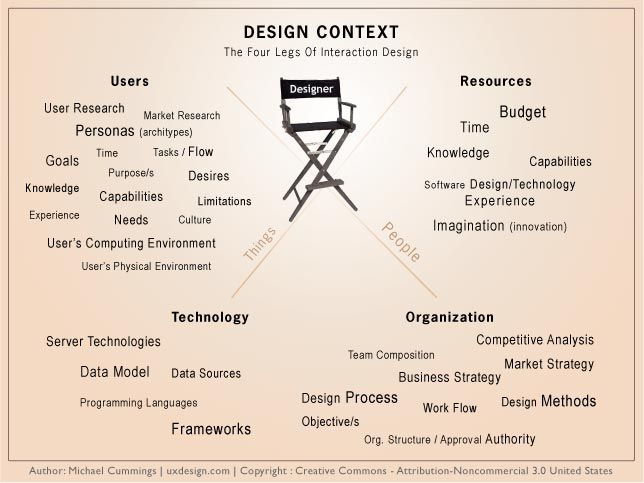
Contextual design is a reflection of the idea that no design exists in a vacuum. That one technology or perhaps system will interact in a much larger context; one of its environment and that that environment will not necessarily remain static (unchanging). Thus contextual design places a design in “context” and seeks to maximize its usefulness.


There are some key principles of contextual design:

System Design Should Support/Extend User’s Current Work Practices

This should be obvious; if you want design to fit easily into a user’s context – it shouldn’t be looking to shake up their world but rather to complement it. If you can do that; then you are a long way to getting your product accepted and liked by a user. If you can’t… well the user may prefer to throw it out the window than take the time to grips with it.

Expertise Does Not Equal the Ability to Articulate Current Work Practices

This is rather less obvious. People tend to be experts at the things that they do regularly; “their current work practices”. However, holding expertise does not necessarily make them experts at communicating what it is they do. Many of us struggle to articulate the concepts, practices and ideas we are most familiar with. This means that the contextual designer must observe those work practices rather than relying on oral accounts of what is being done.


Design Must Take Place in Partnership with Users

If you engage with users in the design phase there is a substantially higher chance that you will design products that suit those users. This is the key concept of all design disciplines; the idea that the user’s experience is critical to developing great products and systems. Contextual designers should not approach their users with forms to fill and boxes to tick but instead should adopt a larger curiosity that involves asking users what they want, need and feel rather than making assumptions on any of these details.

Good Design Should Be Systemic

Even the greatest idea in the world can fall flat on its face if it fails to consider the larger system in which the user operates. Design features must conform to the larger design aesthetic; a giant sized purple button in the middle of your iPhone’s case, for example, is simply not going to work for the iPhone owner – no matter how wonderful the effect of pushing that button. Designers should be looking for coherence in their systems rather than to break the mould.

Design Depends on Explicit Rendering

If you build it, they will come. Well… not always but you can be certain if you build something that people can tell you if they’d come or not. Contextual design requires sketches, prototypes, working models, etc. designers can work with users and vice-versa easily and simply from this perspective. They can talk about what they like and what they don’t and the design can be revised until it finally delivers on its promise.

Of course, these principles apply widely to many design disciplines as well as to contextual design. If you want to better understand contextual design; why not check out our complete text by Karen Hotzblatt on Contextual Design – it’s completely free to read it online.

Header Image: Author/Copyright holder: PionSoft LLC. Copyright terms and licence: All rights reserved. Img

Topics in This Article

Learn More in This Course:

AI for Designers

9 days
18 % booked
View Course

What You Should Read Next

  • Read full article
    Use Circular Design To Reverse Harm - Article hero image
    Interaction Design Foundation logo

    Use Circular Design To Reverse Harm

    Nature is circular. Nothing ever goes to waste. The banana peel we discard degrades into nutritious compost for plants. Even the remains of deceased animals and humans disintegrate into the soil. Human engineering and design, on the other hand, are linear processes. And that has put us on a one-way

    Social shares
    425
    Published
    Read Article
  • Read full article
    Recycling is Not Enough. Let's Design for Reuse - Article hero image
    Interaction Design Foundation logo

    Recycling is Not Enough. Let's Design for Reuse

    “We live in the age of technology and luxury, but we also live in the age of waste,” Don Norman explains. In this video, the grandfather of User Experience Design, Don Norman unpacks the world of waste we have collectively generated. He examines aspects of our daily lives that we take for granted an

    Social shares
    458
    Published
    Read Article
  • Read full article
    Tree Testing: A Complete Guide - Article hero image
    Interaction Design Foundation logo

    Tree Testing: A Complete Guide

    Tree Testing reveals where users lose their way in your navigation. It’s a focused approach to evaluate a site's navigational structure. But it’s more useful in certain scenarios—so, you need to understand where you’ll benefit from tree testing the most. Learn about the pros and cons of testing tool

    Social shares
    687
    Published
    Read Article
  • Read full article
    How to Design Ethically: Expert Advice from Guthrie Weinschenk - Article hero image
    Interaction Design Foundation logo

    How to Design Ethically: Expert Advice from Guthrie Weinschenk

    As UX designers, we wield immense power to influence our users’ lives. We have the dual responsibility of catering to the interests of our users, as well as that of our sponsors (employers, clients and other business stakeholders). This can sometimes put designers in uncomfortable situations and rai

    Social shares
    546
    Published
    Read Article
  • Read full article
    Anything Artificial We Can Design Better - Article hero image
    Interaction Design Foundation logo

    Anything Artificial We Can Design Better

    If you look out the window, you’ll realize many things you see are artificial—buildings, cars, parks, electricity posts, water pipes, etc.—and most of those things were designed by humans. Founding father of UX, Don Norman introduces you to artificiality and how designers shape the world.[[video:142

    Social shares
    411
    Published
    Read Article
  • Read full article
    Stop the Generic Portfolio Trap! Design a Stand-Out Portfolio for Your UX/UI Niche - Article hero image
    Interaction Design Foundation logo

    Stop the Generic Portfolio Trap! Design a Stand-Out Portfolio for Your UX/UI Niche

    Your UX/UI portfolio is your ticket to your dream job, brief or client. It’s your opportunity to show off your expertise, creativity, and the tangible impact of your work. No matter your niche, your portfolio should be as innovative and polished as the projects it represents.Think of your portfolio

    Social shares
    292
    Published
    Read Article
  • Read full article
    Enter the World of Social VR - Article hero image
    Interaction Design Foundation logo

    Enter the World of Social VR

    Our metaverse is big—as in massive and expanding, to be more exact—and there’s plenty of room to trailblaze inside of all of that digital space, so if virtual reality (VR) can teleport, catapult, and integrate human users into brand-new worlds of excitement, discovery, and learning (which it can, by

    Social shares
    561
    Published
    Read Article
  • Read full article
    8 Talks by Women to Inspire UX Designers - Article hero image
    Interaction Design Foundation logo

    8 Talks by Women to Inspire UX Designers

    User Experience design, like so many other disciplines, has a lower representation of women as compared to men. Things are changing now, though. Slowly, but surely. From strategy to tactics and from ideas to actionable tips, here is a curated playlist of talks by, and stories of just some of the mos

    Social shares
    658
    Published
    Read Article
  • Read full article
    UX Storyboards: Ultimate Guide - Article hero image
    Interaction Design Foundation logo

    UX Storyboards: Ultimate Guide

    In user experience design, we use techniques like workshops and interviews to understand users. We turn our research into user stories and process flows. We use personas and wireframes to share our ideas with our teams.But it’s important to remember the real people we design for. We need to know wha

    Social shares
    782
    Published
    Read Article
  • Read full article
    Top 6 Tips to Make Your UX Portfolio Stand Out - Article hero image
    Interaction Design Foundation logo

    Top 6 Tips to Make Your UX Portfolio Stand Out

    Whether you’re a UX designer looking for your first UX job or a seasoned designer looking to further your career, your UX portfolio is arguably one of the most important projects you’ll work on. Your portfolio is the first touchpoint you have with the recruiters; it’s your chance to make an impactfu

    Social shares
    708
    Published
    Read Article

Top Articles

Top Topic Definitions

Feel Stuck?
Want Better Job Options?

AI is replacing jobs everywhere, yet design jobs are booming with a projected 45% job growth. With design skills, you can create products and services people love. More love means more impact and greater salary potential.

At IxDF, we help you from your first course to your next job, all in one place.

See How Design Skills Turn Into Job Options
Privacy Settings
By using this site, you accept our Cookie Policy and Terms of Use.
Customize
Accept all

Be the One Who Inspires

People remember who shares great ideas.

Share on:

Academic Credibility — On Autopilot

Don't waste time googling citation formats. Just copy, paste and look legit in seconds.

Feel stuck? Want Freedom?

Get one powerful email each week, like 322,597 others.

Learn to design a life you love.

Next email in: