whiteboard with strategy illustrations

Understanding Your Business To Get Your UX Strategy Right

• 7 min read

614 Shares

In order to get your UX strategy right, you need to dig a little deeper than just into your user’s wants, needs, dreams and desires. One of the key elements, for getting your UX strategy just right, is understanding the business itself.

You must deliver on the overall business strategy to succeed. You cannot be a “user champion” without being a “corporate champion” too. It’s easy to get carried away with the former and neglect the latter – so how do we better understand the business we work for in order to develop our UX strategy holistically.

A Question or Two

What does your company do to earn profits?

  • You make/design products and services and sell them, right?

  • Then why is it that so many UX designers struggle with this next question?

  • What do you need to do to beat your competitors and how can User Experience deliver real impact on this?

The Core of User Experience Strategy

Yet, the answer to that question is what defines the core of your UX strategy. If you don’t know which buttons to push or levers to pull within the organization to achieve external results; you’re shooting in the dark. You can’t control the way your competitors behave, of course, but you can control the way you approach your market and position for advantage.

Much of the knowledge that you need to do this is already available to you. Your colleagues, team members, stakeholders, management, etc. have access to the information you want. You just have to ask for it.

You need to ask questions like:

  • How are our offerings currently positioned in the market?

  • What are the operating and ongoing costs of the business?

  • How does the pricing model work? Why was it chosen over the alternatives?

  • What are the key factors that influence our overall margin?

  • What might make a competitor more or less successful in any given year than we are?

  • What do you think our potential customers prefer in the current competitive offerings?

  • What are the company’s plans for strategic growth this year, next year and in the longer future?

  • What categories of product are key to that growth?

It is answers to questions like these that allow you to start asking UX questions that support the answers provided.

For example; if you’re told that category X is the key strategic category for the business. You can then examine how you can draw attention to that category via your app or website without relying on the time tested “giant banner ad”.

Or you might want to examine how you can improve profitability through the user experience by increasing “add on” sales to the same volumes sold in retail stores, thus supplementing a low margin leader product with higher margin support.

The link between the core user experience and the business needs is a vital part of UX becoming a serious contributor to business objectives.
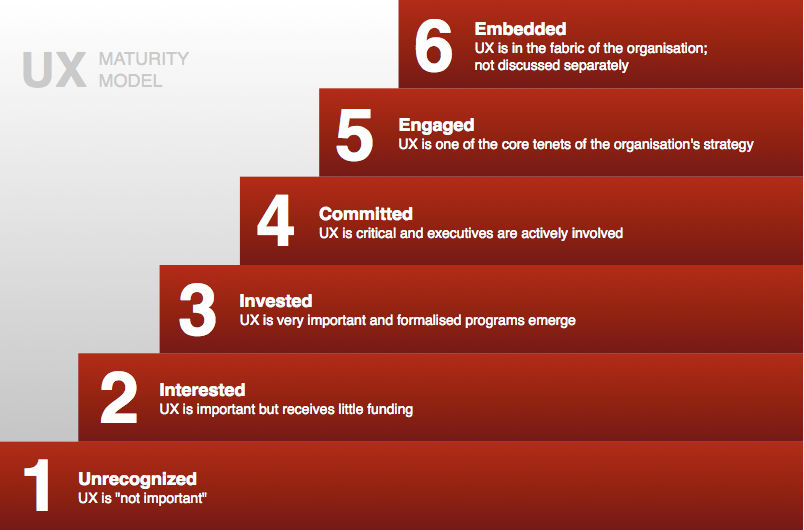

Johnny Holland's UX Maturity Model ranks organisations into 6 categories based on how well UX is integrated in the business. From the bottom up, the ranks are: 1. Unrecognised: UX is 'not important'. 2. Interested: UX is important but receives little funding. 3. Invested: UX is very important and formalised programs emerge. 4. Committed: UX is critical and executives are actively involved. 5. Engaged: UX is one of the core tenets of the organisation;s strategy. 6. Embedded: UX is in the fabric of organisation; not discussed separately.

© Johnny Holland, All rights reserved.

Exploring Business Strategy

Businesses have a tendency to produce a fair number of documents that elucidate the strategic direction the business is taking. The smart UX pro will do a fair amount of running around to lay hands upon this documentation and use it wisely to develop their understanding of business strategy to tune the UX strategy to complement and support it.

Look for marketing plans, competitive analysis reports, the operating plan, the 5 year plan (don’t take this too seriously but do look at the near future), supply-chain management plans, industry reports, etc.

You may need a little help working through some of these reports. There’s probably nothing drier and more difficult to tackle at first glance than a company’s annual reports. However, in our experience – there’s always someone in finance just dying to explain these to the layman. In particular, they can point out financial pain points and help you make sense of the headline objectives for the next year.

If you have a dedicated strategy unit in house – go and talk to them too. You may find that there’s somebody there who has been waiting a long time for a UX team member to come and see how they can join minds and come up with valuable strategic output that works in tandem rather than at loggerheads.

Check The Company Vision Too

Vision statements are often taken as marketing BS and treated with a certain amount of sniggering behind the hands when they’re brought out in the light. Yet, the company’s vision provides an excellent means of “sense checking” your UX strategy. If your company has a strategic vision, it’s likely that the senior management team (at a minimum) spent quite a bit of time and effort creating that vision.

Microsoft’s “A PC on every Desktop and in every home” was a classic and easy statement to use. Unfortunately, that vision has been remodelled along with Microsoft’s strategy and it’s a less easy to remember; “to create a family of devices and services for individuals and businesses that empower people around the globe at home, at work and on the go, for the activities they value most.”

However, while the statement may not be as punchy as before – it’s still pretty easy to work out whether your UX strategy aligns with such a vision.

Highlighting where the business strategy and the UX strategy are in harmony and support the company vision will make it much easier for you to promote your work within your company.

During the process, you’ll start to communicate in the language of the business rather than just in the language of UX. This linguistic transformation will also aid your quest to raise the profile of UX – when the executive team fully understands how your work benefits their objectives; they’re much more likely to see the value in that work.
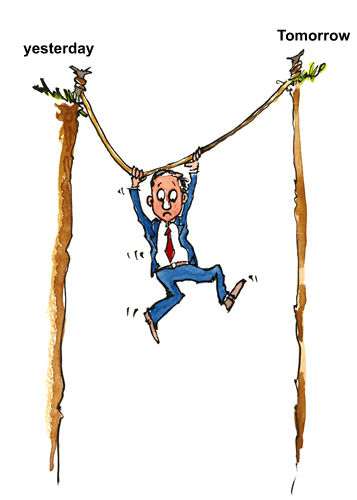
A cartoon of a man crossing a gorge on a rope. One side of the gorge is labeled 'yesterday', the other, 'tomorrow'. The man crossing the gorge is nervously hanging on to the rope at the middle, looking down at the empty space between the two sides of the gorge.
© Frits Ahlefeldt-Laurvig, CC BY-ND 2.0

Summary

Aligning the UX strategy with the Business Strategy is an essential part of getting UX to the forefront and winning support for the work you do. It’s not too complicated to achieve either.

Header Image: © Sebastiaan ter Burg, CC BY 2.0


Learn More in This Course:

AI for Designers

9 days
18 % booked
View Course

What You Should Read Next

  • Read full article
    Use Circular Design To Reverse Harm - Article hero image
    Interaction Design Foundation logo

    Use Circular Design To Reverse Harm

    Nature is circular. Nothing ever goes to waste. The banana peel we discard degrades into nutritious compost for plants. Even the remains of deceased animals and humans disintegrate into the soil. Human engineering and design, on the other hand, are linear processes. And that has put us on a one-way

    Social shares
    425
    Published
    Read Article
  • Read full article
    Recycling is Not Enough. Let's Design for Reuse - Article hero image
    Interaction Design Foundation logo

    Recycling is Not Enough. Let's Design for Reuse

    “We live in the age of technology and luxury, but we also live in the age of waste,” Don Norman explains. In this video, the grandfather of User Experience Design, Don Norman unpacks the world of waste we have collectively generated. He examines aspects of our daily lives that we take for granted an

    Social shares
    458
    Published
    Read Article
  • Read full article
    Tree Testing: A Complete Guide - Article hero image
    Interaction Design Foundation logo

    Tree Testing: A Complete Guide

    Tree Testing reveals where users lose their way in your navigation. It’s a focused approach to evaluate a site's navigational structure. But it’s more useful in certain scenarios—so, you need to understand where you’ll benefit from tree testing the most. Learn about the pros and cons of testing tool

    Social shares
    687
    Published
    Read Article
  • Read full article
    How to Design Ethically: Expert Advice from Guthrie Weinschenk - Article hero image
    Interaction Design Foundation logo

    How to Design Ethically: Expert Advice from Guthrie Weinschenk

    As UX designers, we wield immense power to influence our users’ lives. We have the dual responsibility of catering to the interests of our users, as well as that of our sponsors (employers, clients and other business stakeholders). This can sometimes put designers in uncomfortable situations and rai

    Social shares
    546
    Published
    Read Article
  • Read full article
    Anything Artificial We Can Design Better - Article hero image
    Interaction Design Foundation logo

    Anything Artificial We Can Design Better

    If you look out the window, you’ll realize many things you see are artificial—buildings, cars, parks, electricity posts, water pipes, etc.—and most of those things were designed by humans. Founding father of UX, Don Norman introduces you to artificiality and how designers shape the world.[[video:142

    Social shares
    411
    Published
    Read Article
  • Read full article
    Stop the Generic Portfolio Trap! Design a Stand-Out Portfolio for Your UX/UI Niche - Article hero image
    Interaction Design Foundation logo

    Stop the Generic Portfolio Trap! Design a Stand-Out Portfolio for Your UX/UI Niche

    Your UX/UI portfolio is your ticket to your dream job, brief or client. It’s your opportunity to show off your expertise, creativity, and the tangible impact of your work. No matter your niche, your portfolio should be as innovative and polished as the projects it represents.Think of your portfolio

    Social shares
    291
    Published
    Read Article
  • Read full article
    Enter the World of Social VR - Article hero image
    Interaction Design Foundation logo

    Enter the World of Social VR

    Our metaverse is big—as in massive and expanding, to be more exact—and there’s plenty of room to trailblaze inside of all of that digital space, so if virtual reality (VR) can teleport, catapult, and integrate human users into brand-new worlds of excitement, discovery, and learning (which it can, by

    Social shares
    561
    Published
    Read Article
  • Read full article
    8 Talks by Women to Inspire UX Designers - Article hero image
    Interaction Design Foundation logo

    8 Talks by Women to Inspire UX Designers

    User Experience design, like so many other disciplines, has a lower representation of women as compared to men. Things are changing now, though. Slowly, but surely. From strategy to tactics and from ideas to actionable tips, here is a curated playlist of talks by, and stories of just some of the mos

    Social shares
    658
    Published
    Read Article
  • Read full article
    UX Storyboards: Ultimate Guide - Article hero image
    Interaction Design Foundation logo

    UX Storyboards: Ultimate Guide

    In user experience design, we use techniques like workshops and interviews to understand users. We turn our research into user stories and process flows. We use personas and wireframes to share our ideas with our teams.But it’s important to remember the real people we design for. We need to know wha

    Social shares
    782
    Published
    Read Article
  • Read full article
    Top 6 Tips to Make Your UX Portfolio Stand Out - Article hero image
    Interaction Design Foundation logo

    Top 6 Tips to Make Your UX Portfolio Stand Out

    Whether you’re a UX designer looking for your first UX job or a seasoned designer looking to further your career, your UX portfolio is arguably one of the most important projects you’ll work on. Your portfolio is the first touchpoint you have with the recruiters; it’s your chance to make an impactfu

    Social shares
    708
    Published
    Read Article

Top Articles

Top Topic Definitions

Feel Stuck?
Want Better Job Options?

AI is replacing jobs everywhere, yet design jobs are booming with a projected 45% job growth. With design skills, you can create products and services people love. More love means more impact and greater salary potential.

At IxDF, we help you from your first course to your next job, all in one place.

See How Design Skills Turn Into Job Options
Privacy Settings
By using this site, you accept our Cookie Policy and Terms of Use.
Customize
Accept all

Be the One Who Inspires

People remember who shares great ideas.

Share on:

Academic Credibility — On Autopilot

Don't waste time googling citation formats. Just copy, paste and look legit in seconds.

Feel stuck? Want Freedom?

Get one powerful email each week, like 322,594 others.

Learn to design a life you love.

Next email in: