Your constantly-updated definition of Critical Mass and collection of videos and articles. Be a conversation starter: Share this page and inspire others!
Critical mass is the idea that you need a certain number of users for a product for that product to be successful. It is easier to sell more of a product once critical mass has been reached than it is to sell the product before reaching critical mass. Designers will want to ensure that their products reach critical mass as quickly as possible in order to ensure the long-term commercial viability of their products.
Learn More About Critical Mass
Make learning as easy as watching Netflix: Learn more about Critical Mass by taking the
online IxDF Course Design Thinking: The Ultimate Guide.
Why? Because design skills make you valuable. In any job. Any industry.
In This Course, You'll
Get excited to learn one of the most powerful problem-solving methods in the world. Design thinking is how you turn messy, ill-defined problems into products and services people love. It's how Apple entered the crowded MP3 player market and redefined the industry with the iPod. It's how Airbnb went from near-bankruptcy to an $86.5B market debut. Whatever your role, design thinking gives you a clear, structured way to solve real-world problems, from everyday challenges like launching a product or improving a service to complex, societal problems like sustainability or healthcare access. And as AI handles more of the routine work, your ability to frame the right problem, understand people in context, and turn raw data into testable ideas will matter even more. Whether you want to land your first design role, raise the quality of the work you deliver every day, or step into leadership, this course gives you the toolkit to get there. No previous design experience required.
Make yourself invaluable when you learn the methods to empathize deeply with your users, ideate, prototype, test and iterate to solve complex problems. These are timeless, human-centered design skills you can use in any role across all industries. Research from Forrester found that 3 out of 4 design thinking projects at least double their investment, with a median ROI of 229% per project. In this course, you'll bring structure to your empathy, intuition, creativity, and problem-solving skills with the five stages of design thinking: Empathize, Define, Ideate, Prototype, and Test. You'll learn research andempathy techniques such as user interviews, the 5 Whys, and the What-How-Why method. Your team will stay focused and aligned with synthesis tools like affinity diagrams, personas, and empathy maps. And you'll apply ideation methods like brainstorming, SCAMPER, and Worst Possible Idea to generate solutions you can validate before you invest in building them. You'll know when to use each method and why, and apply them immediately to your daily work with downloadable templates, including interview guides and "How Might We" sessions, ready to use on your next big project.
Gain confidence and credibility as you run effective workshops, back your decisions with evidence, and get buy-in from stakeholders. You'll map influence and interest across your stakeholder group, write Point of View statements to frame the design challenge around real user needs, and use prototypes to test your ideas before committing to a full build. These are the same methods IBM, Google, and other major companies use to innovate and turn rough ideas into successful products. You'll learn that design thinking isn't just a set of techniques. It's a way of caring about people that puts empathy at the heart of every solution you design.
Craft a personal portfolio with optional hands-on activities. You'll interview real participants, design cultural probes, and map their behaviors. Then, with your problem defined, you'll ideate solutions, storyboard the user journey, and paper-prototype an app interface ready to test on users. You'll finish with a complete case study that shows how you approach a problem, what you learn from users, and how your ideas evolve through the design thinking process. By the end of this course, you'll have the design thinking skills you need to drive your long-term career growth and create solutions people genuinely need and want.
Learn From Industry Leaders
Master complex skills with proven best practices and toolkits directly from industry leaders. Meet your experts for this course:
Don Norman: Father of User Experience (UX) Design, author of the legendary book “The Design of Everyday Things,” and co-founder of the Nielsen Norman Group.
Alan Dix: Author of the bestselling book “Human-Computer Interaction” and Director of the Computational Foundry at Swansea University.
Mike Rohde: Experience and Interface Designer, author of the bestselling “The Sketchnote Handbook.”
Earn Industry-Recognized Certificates
Industry giants trust our courses to train their teams, and prestigious universities integrate our content into their curricula. Add your certificates to your LinkedIn profile, résumé, and job applications.
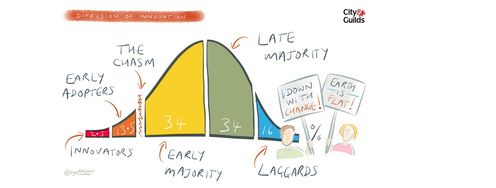
The Diffusion of Innovation – Strategies for Adoption of Products
The diffusion of innovation is the process by which new products are adopted (or not) by their intended audiences. It allows designers and marketers to examine why it is that some inferior products are successful when some superior products are not.The idea of diffusion is not new; in fact it was or
The concept of critical mass originates in physics; it refers to the volume of a nuclear product required to sustain a chain reaction in a nuclear explosion. However, critical mass in marketing requires a very different product – users – to ensure a “chain reaction” of sales.
The idea of critical m
Social shares
763
Published
Read Article
39% of Today's Skills Will Change by 2030
The World Economic Forum expects 39% of today's skills to be transformed or become outdated by 2030.
The good news is that jobs in UX / UI design and AI are among the fastest-growing professions globally.