Game mechanics are the rules and interactions that define what a player can do and what the game does in response. You swing your sword, and the enemy takes damage. You collect a coin, and gain a point. You run out of time, you lose a life. Every consistent, repeatable interaction between a player and a game is a mechanic at work.
In this video, Celia Hodent, PhD, Game UX Strategist and Author of the best-selling book The Gamer’s Brain, explains what game mechanics are and why they’re essential in game UX design.
Game Mechanics Are the Foundation of Great Player Experience
A game can have breathtaking visuals and a rich story, but if the moment-to-moment actions feel unclear or arbitrary, the experience collapses. Players stop trusting the system.
Umbrella Corps proved this. It had the Resident Evil license, competent gunplay, and a built-in audience. So why did players quit within hours? Reviewers and players widely reported that the movement system fought them at every step: the crouch-sprint felt like the only viable option, enemy behavior seemed inconsistent, and the game's responses to input felt random. No amount of brand recognition survives that kind of breakdown.
© Nintendo / The Tetris Company. Fair use. Modified by Interaction Design Foundation.
Tetris has sustained genuine engagement for four decades; it has no characters, no story, and no progression, but one brilliant mechanic, falling blocks and clearing rows, has stolen players hearts.
Tetris has remained genuinely engaging for decades because that one mechanic generates pressure, demands spatial judgment, and delivers a satisfying response when a row clears. The feedback is immediate, the system never lies, and the mechanic never leaves players guessing.
The gap between those two games isn't budget or ambition. It's whether the mechanic communicates honestly. A well-conceived mechanic that lacks clear feedback frustrates players just as much as a poorly conceived one, and a poorly communicated mechanic will cost you players before they ever see what your game is capable of.
How Mechanics Talk to Players (and What Breaks That Conversation)
Every mechanic has two functional layers. The first is the player's action: a button press, a swipe, or a choice. The second is the game's response, and that response must be consistent. If two ingredients always produce a sword, that relationship must hold every time, because players build their mental model of the system on that predictability.
Many mechanics also involve multiple states that modify how that response plays out. A ranged weapon might behave differently across states of standard fire, enhanced fire, overheat, and no ammunition. Each state changes what the game returns in response to the same player action.
But a mechanic that works at the technical level can still fail completely if players can't see it. That's where signs and feedback come in.
Signs and Feedback: Make the Invisible Visible
What makes the action, response, and state visible to players is signs and feedback:
Signs tell players what they can do and what state the system is currently in.
Feedback confirms that an action registered, a state changed, or a consequence followed.
Without them, a mechanic that works perfectly at the technical level is still invisible to the player, and an invisible mechanic is effectively broken.
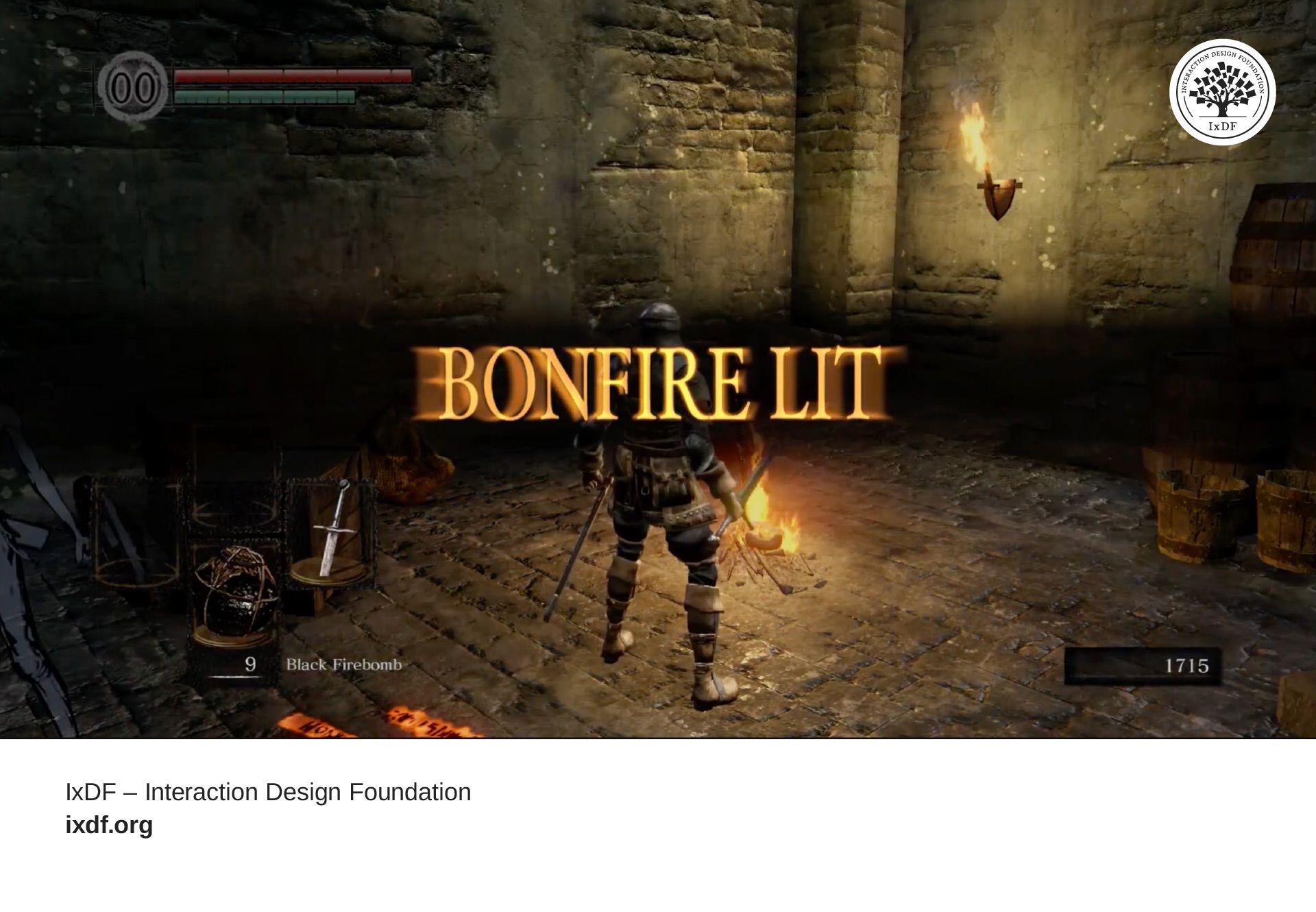
CC BY KimC_86. Modified by Interaction Design Foundation.
Dark Souls uses a full-screen message, a sound cue, and a visual state change all at once to confirm that a bonfire mechanic has triggered. Three feedback channels for one action.
This matters because players don't experience mechanics in isolation. They track enemies, manage resources, read environments, and make rapid decisions at the same time. A new mechanic introduced mid-combat competes for attention with everything already in motion.
Mechanics, Dynamics, Systems, Features: Why the Distinction Matters
When a game designer says, "the mechanic feels off" and a UX designer hears "the system needs work," they're solving different problems. Knowing the difference between a mechanic, a dynamic, a system, and a feature is what lets you diagnose the right problem and propose the right fix. Let’s break these concepts down:
A mechanic is a rule or action. A dynamic is the behavior that emerges when multiple mechanics interact during play. In StarCraft, the mechanic of resource collection and the mechanic of base construction are separate rules. The dynamic of strategic scarcity that emerges when those two mechanics interact is something players experience as tension, not something any single mechanic controls. Mechanics are designed; dynamics are what arise from design.
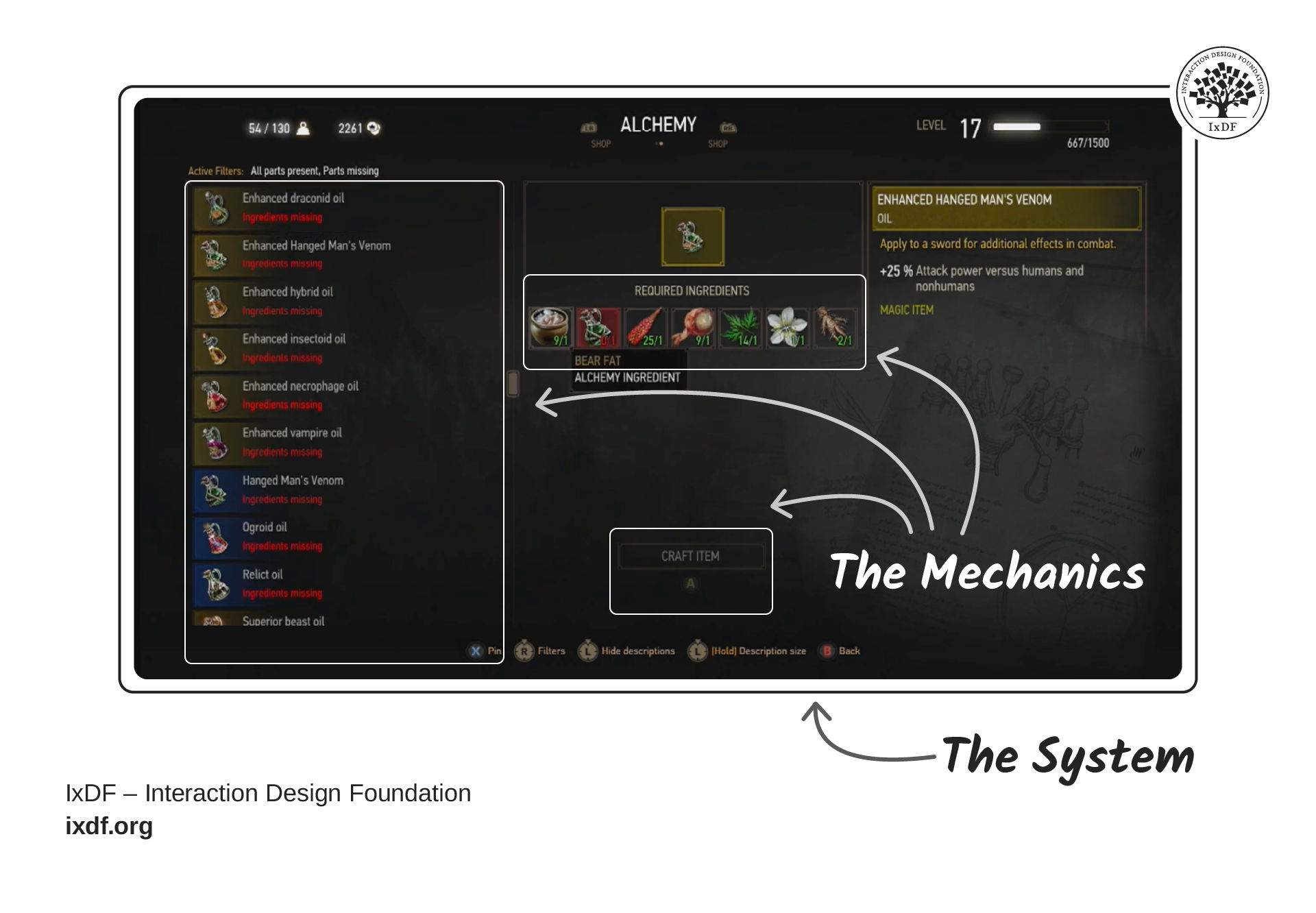
CC BY RabidSquirrel Gaming. Modified by Interaction Design Foundation.
The Witcher 3's alchemy system contains three distinct mechanics, each with its own rules, all drawing from the same shared resource pool. The screen shows the system, and the rules underneath it are the mechanics.
A game system is a broader cluster of interconnected mechanics, often with shared states and logic. The Witcher 3's alchemy system contains separate mechanics for ingredient collection, formula discovery, and potion creation, all sharing the same resource state. The system is the structure, and each mechanic is a rule inside it. The mechanic is the smallest unit; the system is the structure those units form.
A game feature is a higher-level description, common in production and marketing, that covers what a game offers. In Elden Ring, "New Game+" is a feature. The specific rule that enemies scale in difficulty and drop more runes in each subsequent playthrough is a mechanic.
What Game UX Designers Need to Know About Game Mechanics
Game UX designers don't design game mechanics. That work belongs to game designers. But game UX designers work directly and constantly with mechanics, because their job is to ensure that every mechanic makes sense to the player.
When a game UX designer examines a combat system, the core question is whether players can read it. Can they identify the available actions at a glance? Does the feedback for each input arrive fast enough to feel connected to it? Do distinct states stay distinguishable when everything else on screen competes for attention?
Each question is a version of the same concern: does the mechanic function for the player who has to use it under real conditions?
These are questions about communication, cognition, and player experience. They require a deep understanding of what mechanics are and how they function, because you can'tdesign clear feedback for a system you don't fully understand.
Why Game Mechanics Matter Beyond Games
The principles behind game mechanics don't stay inside games. They describe something fundamental about how people engage with any interactive system.
Duolingo uses streak mechanics, the rule that consecutive days of practice build a visible chain worth protecting, to turn language learning into something people return to daily. The mechanic isn't decorative. It uses the same predictability principle that makes any game mechanic work: a consistent rule that players, or in this case learners, can build behavior around.
Fitness apps like Strava use state-based mechanics to make progress visible. Your activity shifts between states, active streak, rest day, personal best, and each state communicates something different and prompts a different response. That's the direct application of mechanic design to behavior change, not gamification as a marketing term.
Understanding mechanics gives you a precise vocabulary for a problem that most industries are still solving imprecisely.
Why do users return?
Why do they drop off at a specific point?
Why does one interaction feel satisfying and another feel arbitrary?
These are mechanic questions, and the people who can answer them fluently have a genuine advantage in product design, education technology, health applications, and anywhere else engagement is the actual goal.
When mechanics work, they disappear. Attention shifts to the decision itself: attack or retreat, keep the streak or let it go, push through the next level or stop here. That shift, from input to intention, is what every mechanic exists to make possible. It happens in games, and it happens everywhere else too.
References and Where to Learn More
Want more? If you haven't already, sign up for Game UX Design: The Ultimate Guide to learn directly from Celia Hodent, PhD, former Fortnite UX Director, and author of the best-seller The Gamer's Brain.
Read The Gamer's Brain by Celia Hodent.
Watch the How to Design for the Human Mind: Cognitive Science for UX Master Class by Celia Hodent.
Watch the How to Become a Games User Researcher Master Class by Steve Bromley, Games Researcher and Author.
Watch the AI for Game UX: Speed Up Research, Ideas, and Prototypes Master Class by Om Tandon, UX Design Leader at Nordeus (Zynga/Take-Two).
Watch the Level Up Your Career: How to Land a Job in the Game Industry Master Class with Om Tandon, UX Design Leader at Nordeus (Zynga/Take-Two).
Watch the UI Design for Games: Starter Edition Master Class with Stéfano Girardelli, Senior Visual Designer at Wildlife Studios.
Signs and feedback only work if players can perceive and remember them. Read our article Learn the Role of Perception and Memory in HCI and UX to understand why.
Every state change in a mechanic needs a signal. Our article The Role of Micro-interactions in Modern UX shows you how designers make those signals land.