Your constantly-updated definition of Market Orientation and collection of videos and articles. Be a conversation starter: Share this page and inspire others!
For example, if your business’s philosophy is about customer satisfaction, then your market orientation will revolve around assessing and measuring the market in terms of customer satisfaction.
Why? Because design skills make you valuable. In any job. Any industry.
In This Course, You'll
Get excited to discover what people truly need so you can create products and services they love. In this course, you'll be guided by industry experts, including renowned Professors Alan Dix and Ann Blandford. They'll teach you how to plan research, fit it into real-world design work, and translate raw findings into deliverables that influence design decisions. Whether you're transitioning into design or stepping into a senior role, this course builds your research toolkit with four essential qualitative techniques: semi-structured interviews, contextual inquiries, observational studies, and usability testing. All four are just as applicable to reducing abandoned carts in online shopping as to improving patient outcomes in healthcare. As AI speeds up research synthesis, your real advantage comes when you build timeless, human-centered design skills to frame the right research question, read between the lines of what users say and do, and translate your findings into insights stakeholders can understand and act on.
Make yourself invaluable when you can plan, conduct, and analyze research to discover who your users are, what they need, and what gets in their way. PwC found that customers will pay a 16% premium for great experiences, and great experiences start with knowing your users deeply. By the end of this course, you'll know which qualitative method to use based on the product development stage and how to prepare a comprehensive project plan. You'll write interview questions drawing on Kvale and Brinkmann's nine question types and analyze data through a six-step thematic analysis. Whichever method you use, you'll apply research ethics and obtain informed consent, avoid pressuring participants, and handle vulnerable populations with appropriate safeguards.
Gain confidence and credibility when you can prove the ROI of user research to decision-makers. You'll articulate research's three core purposes and translate them into the language of revenue, cost, and risk to secure resources for research work. You'll map stakeholders across business, engineering, and UX using Tomer Sharon's framework and conduct interviews to surface constraints, history, and expectations. To turn raw research into shared understanding among stakeholders, you'll learn to run a five-part workshop that produces well-framed How Might We questions and a team aligned on what to do next. And because words alone rarely move design forward, you'll produce affinity diagrams, empathy maps, and user journey maps that turn research data into something stakeholders can connect with and build on.
Craft your personal portfolio with optional hands-on projects and gain experience with user interviews, contextual inquiries, and observations. You'll translate your findings into concrete design deliverables that serve as visual artifacts in your case studies, ready to prove your research abilities to hiring managers. Plus, with ready-to-use templates like interview guides and customer journey maps, you'll implement your new skills immediately in your work.
Learn From Industry Leaders
Master complex skills with proven best practices and toolkits directly from industry leaders. Meet your experts for this course:
Frank Spillers: Service Designer and Founder and CEO of Experience Dynamics.
Ann Blandford: Professor of Human-Computer Interaction at University College London.
Alan Dix: Author of the bestselling book “Human-Computer Interaction” and Director of the Computational Foundry at Swansea University.
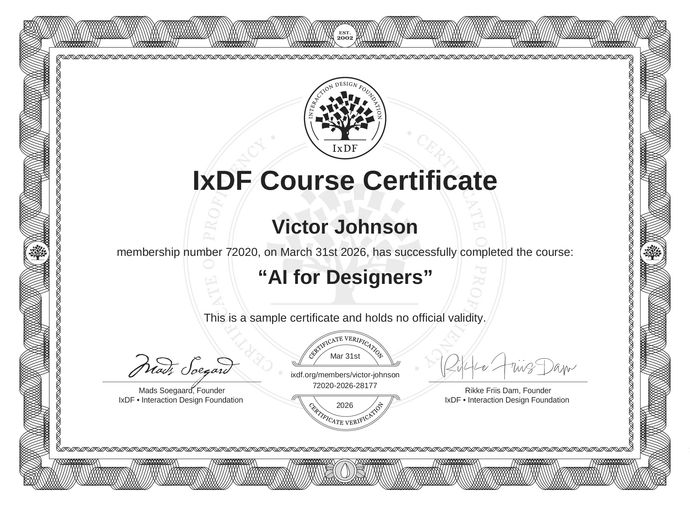
Earn Industry-Recognized Certificates
Industry giants trust our courses to train their teams, and prestigious universities integrate our content into their curricula. Add your certificates to your LinkedIn profile, résumé, and job applications.
User Personas vs Customer Personas: What's the Difference?
Personas drive both the products users love and the campaigns buyers trust. But mix them up—using a customer persona to solve a UX challenge—and you'll build solutions that miss the mark. Both personas have names, photos, and stories; both seem to represent your audience. Yet, confusing them leads t
Social shares
459
Published
Read Article
39% of Today's Skills Will Change by 2030
The World Economic Forum expects 39% of today's skills to be transformed or become outdated by 2030.
The good news is that jobs in UX / UI design and AI are among the fastest-growing professions globally.