





Pierleone Loreti
Product designer
Thanks for this course: I find it really stimulating and it gives lots of insights in what human expects from machines and objects.
Master complex skills with proven best practices and toolkits directly from industry leaders. Meet your expert for this course:
Alan Dix: Author of the bestselling book “Human-Computer Interaction” and Director of the Computational Foundry at Swansea University.
Industry giants trust our courses to train their teams, and prestigious universities integrate our content into their curricula. Add your certificates to your LinkedIn profile, résumé, and job applications.

Thanks for this course: I find it really stimulating and it gives lots of insights in what human expects from machines and objects.

I love it. And Alan is so great. It is my first time to take his course, but I will dig for more of his courses. He takes so simple examples...

The instructor (Alan Dix) is animated, clear, engaging and entertaining.

The content was presented in a very natural way and I felt like a student participating in a modern class about design. I loved the teaching...

Alan's explanations are organic conversations, making it easy to understand the topic.

I think the instructor was very engaging, and his delivery kept me interested.

I loved his storytelling and examples! At first, I did think the videos were a bit long, and maybe even a little bit of repetitive info, but...
Industry leaders from companies like Adobe, Google, and NASA teach you real-world skills grounded in industry practice and research.
Learn both AI and the human-centered design skills that AI can't replace.
Add IxDF Course Certificates to your LinkedIn profile and résumé to show you've completed an evidence-based curriculum taught by industry leaders.
Use your new skills to take on higher-value work, qualify for promotions or find a role that fits you better.
Connect with designers in 496 cities across 107 countries. Learn together, get mentored, and build relationships that open doors.
High-impact design and AI skills
Learn from 209 industry leaders
42 evidence-based courses
161 one-hour Master Classes
Industry-recognized certificates
$2,189 worth of toolkits
11,144 active design jobs
10 structured career programs
Global community in 496 cities
$6,649 worth of premium tools
276 ready-made templates
and much more
Design skills are valuable for both you personally and for your company.
For you personally, design skills are important because:
Design roles are growing faster than average. The World Economic Forum ranks human-centered design among the fastest-growing skill areas through 2030.
Employers increasingly expect design skills across roles, not just from designers. Knowing design thinking, user research, or UX principles makes you more competitive in any field.
Designers who combine human-centered skills with AI expertise are in especially high demand.
For your company, design skills are important because:
Design skills help your team increase sales, retain customers, and improve customer satisfaction. Better customer experiences lead directly to better business results.
Companies that invest in design outperform the S&P 500 Index by 228% (Design Management Institute, Design Value Index).
Design is more than aesthetics. It's how teams make products easier to use, services more efficient, and technology more human. These skills create value across every department.
Design and tech skills can open up career opportunities.
For example, if you’re in a field such as:
Marketing, communication, HR, software development, customer service, business management, healthcare, teaching, and many more.
Why can design skills make you valuable in these jobs and industries?
That's because:
Design skills help your team increase sales, retain customers, and improve customer satisfaction. Better customer experiences lead directly to better business results.
Companies that invest in design outperform the S&P 500 Index by 228% (Design Management Institute, Design Value Index).
Design is more than aesthetics. It's how teams make products easier to use, services more efficient, and technology more human. These skills create value across every department.
Yes!.
You'll gain fluency in design processes and get job-ready, hands-on skills you can apply immediately.
This course makes it easy for you with templates and step-by-step guides, so you can easily present to managers and clients. All licensed for commercial use.
You’ll also learn to build an impressive portfolio.
Yes!
You’ll always have time for career growth because our course are self-paced and designed to fit into your busy life.
You can learn at your own pace. Anytime and anywhere, whether you're working full-time or juggling life and kids.
You can progress at a speed that feels just right for you.
Yes.
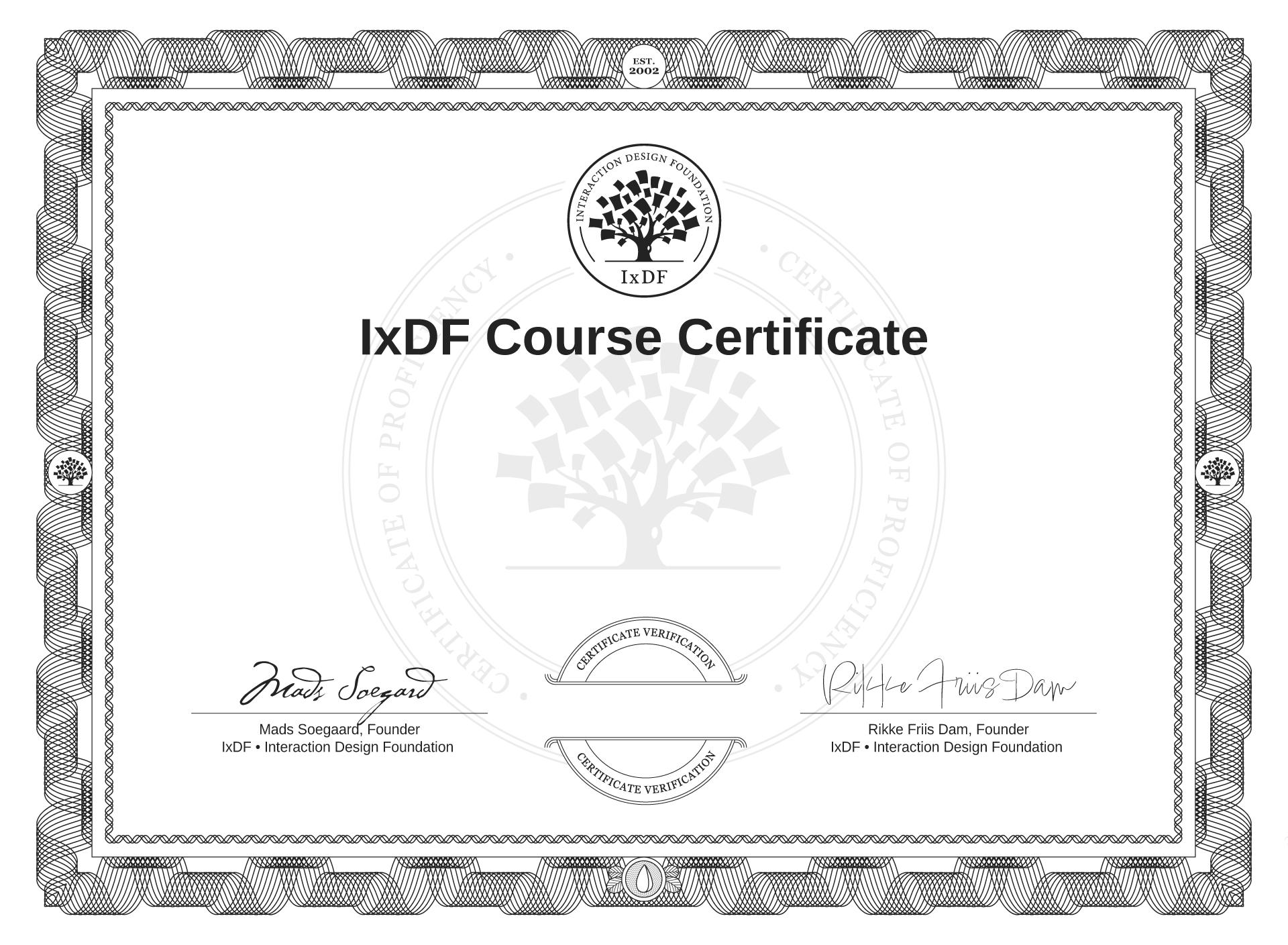
After you finish, you’ll receive an industry-recognized IxDF Certificate to prove you've completed an evidence-based curriculum taught by industry leaders.
Add IxDF Certificates to your LinkedIn profile, resumé and job application in a few easy steps.
You can download your certificates as .jpg files, so they are easy to share. Certificates are always valid.
Our grading is done by experts, not machines.
We make sure you receive feedback and maximum benefit from the entire process.
That’s also one of the reasons IxDF Course Certificates are credible and industry-recognized.
Yes.
You get unlimited access to all IxDF courses at no extra cost.
For example, if there are 40 courses open for enrollment, you can enroll in all 40 courses at the same time and move from one to another as you prefer. Use our IxDF Career Programs to help you choose the very best courses for you.
If you’re a student member, you can take a maximum of two courses at the same time. You can still take as many courses as you would like – free of extra charges – just as long as you finish them so that you don’t have more than two ongoing courses.
Yes.
You get unlimited access to all IxDF courses at no extra cost. Take as many courses as you want without paying extra. You can literally save thousands of dollars.
That's easy.
Add your IxDF Certificates to your LinkedIn profile, resumé and job application in a few easy steps:
Click “Add profile section” on your LinkedIn
Tap “Recommended”
Select “Add licenses or certifications”
Enter your IxDF Certificate details
Hit “Save”
You can download your IxDF Certificates as .jpg files, so they are easy to share. IxDF Certificates are always valid.
You can see the estimated total learning time just above.
But remember, it’s entirely up to you! You can learn at your own comfortable pace. Anytime and anywhere, whether you're working full-time or juggling life and kids.
Don't worry, we will re-run the course soon.
One reason we open and close courses is to achieve an optimal classroom size. That way, your networking opportunities and learning experience are optimal.
We display the "XX% booked" status on our courses to be transparent about the course availability.
Stay tuned for the next enrollment period. Be sure to sign up early! Meanwhile, you can sign up for another course you find interesting. Remember, you can take as many courses as you want without paying extra.
Our courses, master classes, and career programs cover everything from the fundamentals to advanced topics.
Whether you're completely new to design or an experienced professional, you'll find courses, master classes and career programs at your level.
We can help you in several ways.
Join meet-ups in your city: Join the regular meet-ups in your city in a nearby cafe or office building to have fun and learn with people just like you. You get full access to IxDF Local Groups where you can build your network, find new opportunities, or simply enjoy yourself in the company of people who are passionate about design. The meetings are completely optional and are spread across app. 500 cities worldwide.
You can also get instant help and career advice in the IxDF online members-only forums. Here, you can build your global network through our supportive community.
Yes.
Simply retake the course and keep moving forward!
Everyone's learning journey looks different and it’s about progress, not perfection.
To retake a course, just follow these steps:
Go to your profile and click on the course you'd like to retake.
Scroll down until you see the "Drop This Course" section.
Tap the button that says, “Drop My Course Now.”
Head back to our Courses page page and re-enroll yourself in the course.
You're all set to try again!
NB: Please note that when you drop a course, you’ll lose your progress and any answers you’ve already submitted in the course.
We’d love to hear from you and help you!
Reach out to us at [email protected] or use the online contact form.