Action Research is an important part of Human-Computer Interaction research and design. Yet, it’s one of those curiously academic fields that most of us haven’t encountered in the “wider world”. Action Research is underpinned by the idea that no (technological) development has any value without action.
This is a simple enough principle; theory without practice does not make any difference to the world around us. Once something is in practice (or action is being taken) then we can see what changes it has wrought.
What does an Action Researcher Do?
Author/Copyright holder: Unknown. Copyright terms and licence: Unknown
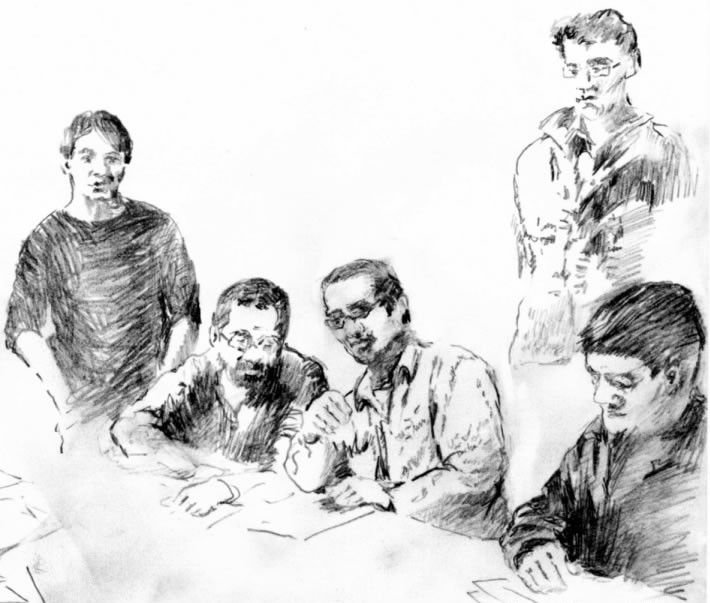
Action Researchers tend to work for clients to deliver a service that expands the overall body of knowledge; whilst offering insight which can be applied in practical terms on a project. Action Research is not solely concerned with technological fields but for the purposes of this article, we shall act like it is.
So for example, an Action Researcher, might be involved with a religious organization looking to ensure that more if its congregation attend sessions of worship. They might try an automated system to reach out to that congregation. The action research will try and predict the effects of such an action or to measure their impact following the introduction of such technology.
The Roots of Action Research
Author/Copyright holder: Tieteestä Toimintaa. Copyright terms and licence: CC BY 2.0
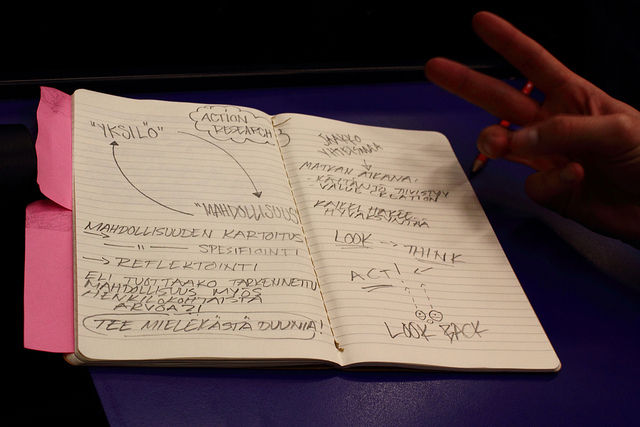
Action Research appeared as an academic discipline in the 1940s. The field originated with the Tavistock Institute of Human Relations in London. Action Research emerged here specifically to deal with psychological issues relating to World War II.
Action Research is a truly multi-disciplinary approach; it combines information systems, clinical psychology, sociology and even bilingual education. Rather uniquely for an academic discipline; practitioners are involved with two outcomes – a direct improvement in circumstances for those being studied and developing human knowledge as a whole.
So for example; if a city were to commission a study on the differences between rich people and poor people’s access to the Internet. That is not Action Research. It would become Action Research if the study were also to deliver a report on how to address any inequalities and that report was then to be put into action (in fact the ideal Action Research here would also follow up this action to see if it succeeded or not).
Action researchers thus have “two masters”; the subject(s) of their research and the broader research community. It is often seen to be much more difficult to appease the demands of the research community than to deliver results for the subject of the research.
This may be because as a discipline; research tends to involve observing and interviewing the subjects and seeing how actions affect their reports of their experience. This is harder to deliver a “control” that will satisfy standard scientific methodologies. After all, it’s going to be impossible to deliver results for a subject(s) that has been isolated from the actions identified in your research.
Want to Find Out More?
If you want to know how Action Research affects Human Computer Interaction and User Interface work; you should check out Action Research: Its Nature and Relationship to Human-Computer Interaction by Ned Kock.
Header Image: Author/Copyright holder: New Mexico State University. Copyright terms and licence: All rights reserved. Img