Cognitive maps in UX show how users think about a product or service. Designers use these visual representations so they can understand the user's mental model—something that helps them make intuitive designs that match the user's expectations and improve their overall experience.
Think about the last time you found yourself trying to use a confusing app or website—how frustrating was it? Maybe, you even gave up. As UX designers, we want to avoid that experience—our users should be able to easily navigate our products and achieve their goals.
Cognitive maps are powerful tools that help us understand how users think about our designs. Imagine if you had a map of your user's mind—perhaps it sounds far-fetched or too good to be true? Happily, there are such things and—with one—you can see how a user connects different ideas and what they expect to find. This knowledge is yours to access with a cognitive map—and it will allow you to create a wide range of designs that feel intuitive and natural.
Let's explore cognitive maps in UX and learn how to use them to improve our designs.
What are Cognitive Maps?
Cognitive maps are visualizations of user mental models. They describe how users perceive things and their expectations of them. They typically contain concepts, ideas or facets of the product that users connect with and how they relate to them.
“Cognitive map” is a broad term that embraces many types of visualizations of mental models. These research tools are incredibly versatile as there are no rules or rigid formats. Designers and researchers create and analyze cognitive maps to understand a user’s line of thinking, to uncover frustration points, confusion and spots for potential optimization. If you design in line with the user’s mental model, you can make your products more intuitive for them.
User research is crucial for product and service success in the real world. Watch Frank Spillers, CEO at Experience Dynamics, speak about target users understanding and implementation of research methods to design appropriate products and services.
Take the example of Apple; they might use a cognitive map to understand how users perceive their products. The map would likely include concepts like "innovation," "design," "premium" and "user-friendly" and show how these concepts connect.
For instance, some users might link "innovation" to "new features" and "design" to "sleek aesthetics." Apple recognizes these connections and anticipates that many people will likely draw such links in their minds. So, Apple accommodates them and tailors its marketing messages and product features to match its audience's preferences.
Another way in which Apple might use a cognitive map is to identify potential areas for improvement. And if the map should reveal that users find a particular feature confusing, Apple can redesign it to make it more intuitive for them—and many other users. These maps empower brands, designers and researchers to cater to their target audiences that much more through the insights they deliver, so designers can fine-tune things and make a positive impact. Likewise, you can create successful products if you understand the user's mental model and adapt the design to make it meet them better on their terms.
Types of Cognitive Maps
Let's talk about the two types of cognitive maps: mind maps and concept maps.
Mind maps are the simplest form of cognitive maps—and they’ve got a structure like a tree, with a central topic that branches into subtopics. This clear hierarchy makes them easy to create and understand. Mind maps are fine tools around which you and your design team can organize information and brainstorm ideas around a single topic.
Concept maps are more complex than mind maps—not least since they emphasize the relationships between concepts and allow nodes to have multiple parents. This makes them ideal to visualize complex ideas with interconnected relationships. Concept maps help understand complex systems, processes or problems from multiple perspectives.
Why Are Cognitive Maps Important?
Cognitive maps are crucial in UX design for several reasons:
1. Knowledge Externalization
Cognitive maps help you visualize and understand complex systems or processes. When you do this, it enables you to collect and enhance your thoughts so you can better communicate your knowledge with other team members involved in the research project, long before you and your team get to final user testing. That's particularly useful—as well as saving time—when you need to onboard new team members, do problem solving in real time or explain complex features to stakeholders.
2. Identify Patterns and Connections
When you visualize concepts through cognitive maps, it's easy to reveal hidden patterns and connections you mightn’t have noticed otherwise. That’s because cognitive maps visually represent the relationships between different ideas—and so, you can easily see how they connect and interact. When you’ve got things set out in front of you so clearly, it can lead to new insights and innovative solutions.
3. Understand Users' Mental Models
Cognitive maps are excellent tools for UX research—principally since they’ll help you understand how your user perceives and navigates your product. They get really deep into things, and when you explore your users’ thought patterns and evaluate their mental model, you’ll achieve a sharper perspective—one where you can identify areas of friction and opportunity and generate ideas that align with user expectations. Then, in turn, you can design and iterate your product so that it’ll be so much more intuitive for users, who will be more likely to take to it as something that really speaks to them and their needs.
4. Diverse Nature and Purpose
One of the biggest benefits is that you can use cognitive maps in many areas. You can use them to brainstorm ideas, plan projects or make decisions. They fit different fields like business, education and design.
In business, cognitive maps help teams understand complex problems and find solutions.
In education, they help students learn and remember information in their research studies and beyond—be it in social sciences, market research or other spheres.
In design, they help creators visualize ideas and plans—so users can get behind the product or service that comes out because it’s more about them.
Cognitive maps are flexible. They work with any concept or situation. You can use them to solve problems and make decisions in many areas.
5. No Restrictions on Structure or Form
Yet another superb plus is that—unlike other visualization methods—cognitive maps don’t have to follow a specific format. That may sound a little challenging at first—given the potential for where things can go—but it’s something that allows for greater creativity and flexibility to represent complex ideas. You can tailor the structure and form of the map to a very high degree—and so best suit your needs and goals.
When to Use Cognitive Mapping?
You can find cognitive mapping valuable for certain research scenarios:
1. Exploratory Research
Cognitive mapping can be a great starting point for when you're in the early stages of research and you want to explore a topic without a clear hypothesis. Especially when things are nice and fluid on the research front, it allows participants to share their thoughts freely. And, from that, it’s a handy way for you to uncover unexpected insights and new avenues to explore.
The open-ended nature of cognitive mapping is the key to the enterprise at this point—it really encourages participants to think aloud; they can reveal their natural thought processes and uncover hidden connections between concepts.
2. Complex Topics
Another great plus is how you can use cognitive mapping to tackle complex topics with intricate relationships or process components. With such complexity at play, things can get fuzzy-edged and the “waters” a little muddy at times. You may have to deal with ambiguous aspects that users may find hard to articulate. But if users visualize these concepts through cognitive maps, you can understand their connections and make them easier to understand for others on your design team.
For example, cognitive mapping can help you map out the different components and their interactions whenever you need to research a complex system like healthcare or finance.
3. Participatory Action Research
In participatory action research (PAR), researchers and participants collaborate to identify and solve problems—a powerful way to reach loftier heights from which to get invaluable insights. The visual nature of cognitive maps makes it easier for participants to contribute their knowledge and perspectives. They can feel more involved—and invested—and it creates a sense of ownership over the research process, something that can lead to more relevant and actionable findings.
How Do You Create a Cognitive Map?
You create cognitive maps through a structured interview process. Here's a breakdown of the steps involved:
1. Prepare and Communicate with Participants
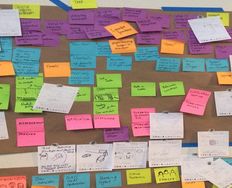
We always suggest that before the interview, you should inform participants about the purpose of the study and how you’ll be using the data. You should explain that you'll ask them to write, draw and arrange sticky notes—but don’t use the term "cognitive mapping"; you’ll want to keep them from researching the topic beforehand and being ready for specific questions.
2. Plan and Practice the Interview
Cognitive mapping interviews are less structured than traditional ones, so it's important to practice. Decide whether to use a free-form approach—where participants create their maps—or a structured approach, where participants fill in a given template. Plan an introduction, like a word association exercise, to get the ideas flowing.
Practice the interview with colleagues. This helps you refine your approach and identify potential challenges.
The right interview setting sets the tone for the whole interview. Watch Educator Ditte Hvas Mortensen and Ann Blandford, Professor of HCI at University College London, discuss the right interview settings.
3. Assign Roles and Coordinate Logistics
An observer can help you record, take notes and set up tech. If you plan to involve multiple team members, assign clear roles. The facilitator is the one who guides the interview, while the note-taker focuses on documenting the participant's words—as well as their non-verbal cues—and the placement of items on the map.
It’s important to choose a room with ample space to help participants create the cognitive map. Plus, it's ideal to have a large table and a whiteboard. Limit the number of people in the room to the facilitator and participant—while observers and note-takers can participate remotely so they won’t crowd the space.
4. Involve Remote Observers
If more than two team members participate, then it’s best to use a live stream for remote observation. That way, they can take notes alongside the in-room note-taker. One remote observer can handle logistics like they can welcome participants and prepare materials.
5. Choose the Right Environment and Materials
Pick a location with ample table space and a whiteboard if possible. Gather materials like multicolored sticky notes, markers, large-format paper and dry-erase markers. Set them up to subtly encourage the participant to use them as intended.
6. Record the Session
No matter who conducts interviews, it's better to video record the session—as long as you’ve secured the consent of the participants. It helps you review insights later, clarify any ambiguities and educate others on the method. The closing phase will help you get final insights and feedback. The facilitator should make sure the participant shares everything they can offer—it’s something that helps create a comprehensive understanding of their mental model. For example, you might ask, "Is there anything else you want to share or add to your map?"
What’s more, use this time to seek feedback on the cognitive mapping method, and—for instance—you can ask, "What did you think of our current approach?" Their input can help you refine the process for future interviews—and it’ll make it more effective and comfortable for participants.
7. Streamline Note-Taking and Documentation
Create a shared document where everyone watching can take notes at the same time. They can even use a shared system to label their observations as they happen, and—this way—you can spot patterns early and guess what they mean.
Things to Keep in Mind When You Conduct a Cognitive Mapping Interview
You’ve got to plan carefully and pay attention to detail if you’re going to conduct a successful cognitive mapping interview. It’s a form of research design, so here are some key points to keep in mind:
1. Open the Interview Well
How you start sets the tone for the whole interview. Introduce yourself and your team. Mention the purpose of the research and the participant's value to it. Assure them of confidentiality and emphasize that there are no right or wrong answers. Then, introduce the cognitive mapping method. Explain the duration, activities and materials. Allow time for questions to ease any concerns.
2. Facilitate the Session
Start with a warm-up question—such as a word-association exercise—to get the participant thinking. As they build their map, ask open-ended questions to encourage them to elaborate and make connections between concepts.
Use prompts like "How would you group these terms?" or "What comes to mind when you say...?" Prepare a list of topics and research questions or probing questions in advance, but be flexible and adapt to the participant's flow.
3. Close the Interview
Give the participant a chance to add any final thoughts or ideas. Thank them for their time and emphasize the value of their contribution. Ask for feedback on the cognitive mapping method to inform future sessions if appropriate.
4. Analyze the Data
Now, it’s time for data analysis. Cognitive mapping creates three main things: what the person said in the interview, the map they made and notes from observers. These are qualitative data. It means they are not numbers. We need to look at this data to find themes and patterns. Coding and sorting the data will show the person's thoughts and help us make design choices.
Advantages and Disadvantages of Cognitive Mapping in User Research
Cognitive mapping is valuable for understanding how users perceive and interact with products, services or systems—and it provides a few advantages in user research:
Advantages of Cognitive Mapping
Flexibility: Unlike other research methods, cognitive mapping is less structured, which means that it lets people share their thoughts freely. It reveals their natural thinking patterns and may help to furnish unexpected insights.
Visual aid: Participants write down ideas on a piece of paper. This creates a visual reference throughout the interview—something that allows the participant and researcher to refer to previous points for better understanding.
Participant value: Participants understand the topic more clearly as they visually organize their thoughts. Connecting ideas can lead to new insights and a greater sense of ownership over the research.
Rich data: Cognitive mapping produces various data types. It may include transcripts, recordings, the map itself and a video of its creation. This rich dataset offers multiple perspectives for analysis.
Disadvantages of Cognitive Mapping
Not a standalone tool: Cognitive maps shouldn’t replace other research methods. They offer valuable insights. Even so, you should use them with other data for a complete picture.
Facilitator's skill: The data collection quality depends on the facilitator's skill. Good facilitation calls for practice and adaptability to guide participants while keeping a comfortable environment going.
Potential for wandering: Because of the open-ended nature of cognitive mapping, participants may stray from the topic. If they go off the track, the facilitator will need to guide them back to the main focus.
Participant discomfort: Some people might feel unsure about the writing and drawing involved in cognitive mapping. The facilitator should tell them there are no right or wrong ways to make the map. The focus is on their ideas, not their artistic ability.
The Take Away
Cognitive maps offer a unique window into the minds of users. They visually represent how people think, feel and interact with products, services and systems—and these mental models allow you to create more intuitive, user-friendly and successful experiences.
Cognitive mapping may have some challenges, but its benefits far outweigh the drawbacks. It gives you the flexibility, actionable insights and potential to uncover hidden patterns making it a valuable tool in any UX researcher's toolkit. You can include cognitive mapping into your research process to better understand your users. It'll help you create products that resonate with their needs and expectations.
References and Where to Learn More
Read our topic definition of mind maps.
Learn how to make compelling and user-friendly visuals in our comprehensive course on Information Visualization.