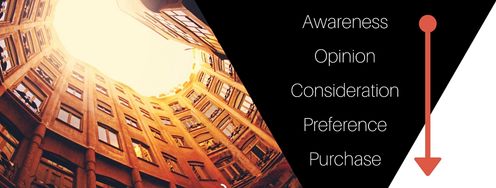
Path from NO USE to USE marks the endpoint as easy to focus on while urging attention to the whole path

Managing the Path of Use

• 7 min read

462 Shares
Save

The path of use is simple and straightforward; it begins with “no use” and ends in “use”. It was first described by Alan Dix, the HCI expert and University Professor, in his 2008 presentation to the University of Technology in Berlin.

The purpose of the path of use is not to state the obvious; which if you give a couple of seconds thought to the idea of use it is. But rather to get designers to focus on the idea that “use” isn’t something that occurs by magic. Your users will not wake up one morning and think; “I need your product!” and then go out and find it.

There is a process that users follow to get from a state where they are:

  • Unaware that they need the product

  • Unaware that the product exists

  • Unaware that your product is best suited to their needs

To a state where they begin to use your product.

User and Market Research
Author/Copyright holder: gdsteam. Copyright terms and licence: CC BY 2.0

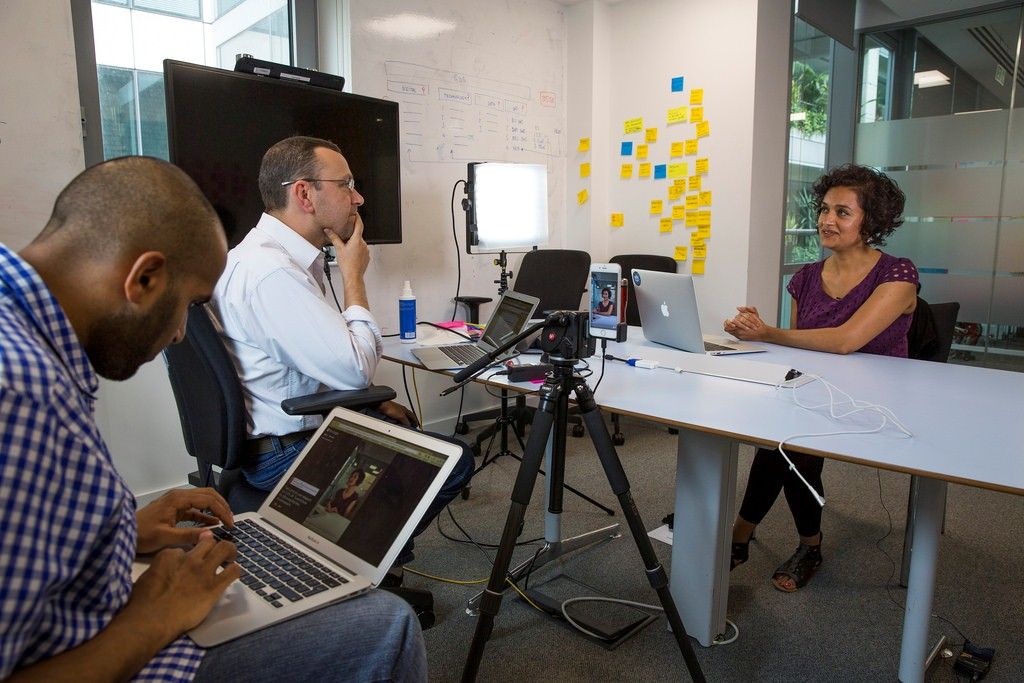
User research and market research are often separate activities within an organization. User research is focused on working out what users need from a product and testing products to see if they meet those needs. Market research is about determining customer bases and how to reach those customers.

Yet, for many organizations the terms “user” and “customer” are nearly interchangeable in the majority of instances. Someone who buys a camera, for example, is very likely to be the person who uses the camera. If someone wants to download a mobile app and pay for it; there’s a pretty good chance that they are the person who will use it too.

If you are to manage the path of use; it’s important to recognize that there is little distinction between users and customers in the majority of instances. Combining market research and user research will offer the best insight into how to manage that path.

User research will reveal:

  • What users want

  • How to deliver what they want

  • Whether or not that expectation has been met through design

And as Jakob Nielsen, one of the pre-eminent user researchers says; “…pay attention to what users do, not what they say.”

Market research will reveal:

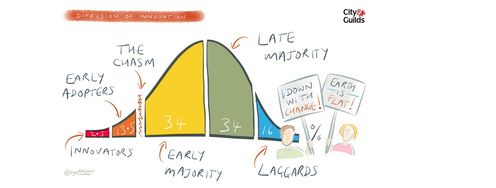
  • Which communities of users should be involved in user research – in particular innovators and early adopters can be identified early and brought into user research

  • How to communicate effectively with innovators and early adopters

  • How best to educate users that the product exists and what benefits it will bring

  • How to achieve rapid adoption of successful designs

The overlap between these two spheres enables design and marketing for adoption. A product is only a success if it is being used. Moving from a potential user from a state of no awareness of a product to a user requires careful thought and action from both design and marketing.

Just Think

Author/Copyright holder: the Skinny. Copyright terms and licence: CC BY-SA 4.0

In his talk, to the University of Technology in Berlin, Alan Dix encourages designers to “just think” when it comes to managing the path of use. He says that if you are aware of the path and that you consider it when performing the design of a product – you are more likely to design for adoption.

A conscious effort to build products which are not just useful or usable but which are aimed at being adopted by an audience is more likely to bring about the objective of adoption than a process which excludes such conscious effort.

The Power of Size

Big companies can leverage their existing power to overcome the need to manage the path of use. For example Microsoft was able to turn Internet Explorer into the world’s most popular Internet browser simply by putting it into their operating system. Apple, which doesn’t quite have the reach of Microsoft, achieved dominance on the Apple platform with the Safari browser in a very similar manner.

When Google, for example, wants to drive the adoption of a new product it can simply add it to its website and marry the functionality to an existing service or product such as Gmail.
Author/Copyright holder: Vova Serg. Copyright terms and licence: Fair Use.

When You’re Not a Business Giant

Alan Dix also offers some simple advice for managing the path of use when you cannot leverage a powerful position to force adoption of a product or service.

He says that you should; “make it easy for users to adopt the product” by removing barriers to adoption as best as possible and that you should; “understand the values of users” and meet those values with your designs.

The Take Away

Managing the path of use means marrying user research and market research so that designers can focus on the whole process from “no use” to “use”. A conscious effort to understand what it is that will drive usage can result in real improvements to adoption of products. Big companies have the opportunity to leverage assets they already have to “force” adoption such as integration with an operating system or existing web service or web site.

References

Alan Dix’s notes from the Berlin 2008 speech

Topics in This Article

Learn More in This Course:

Learn Design and AI From the Best

Get one powerful email each week, like 313,901 others.

Next email in:

What You Should Read Next

  • Read full article
    The Diffusion of Innovation – Strategies for Adoption of Products - Article hero image

    The Diffusion of Innovation – Strategies for Adoption of Products

    The diffusion of innovation is the process by which new products are adopted (or not) by their intended audiences. It allows designers and marketers to examine why it is that some inferior products are successful when some superior products are not.The idea of diffusion is not new; in fact it was or

    Social shares
    1.1k
    Published
    Read Article
  • Read full article
    How to Use the Product Life Cycle - Article hero image

    How to Use the Product Life Cycle

    The product life cycle is an important tool for marketers, management and designers alike. It specifies four individual stages of a product’s life and offers guidance for developing strategies to make the best use of those stages and promote the overall success of the product in the marketplace.Abou

    Social shares
    878
    Published
    Read Article
  • Read full article
    Useful, Usable, and Used: Why They Matter to Designers - Article hero image

    Useful, Usable, and Used: Why They Matter to Designers

    Today, we’re going to take a look at three contexts of the concept of use: useful, usable and used. The first two terms, useful and usable, are bandied around a lot in terms of user experience and design while the third term, used, barely gets a mention. Yet, as we’ll come to see it may be the most

    Social shares
    876
    Published
    Read Article
  • Read full article
    How to Achieve Critical Mass for a Product Launch - Article hero image

    How to Achieve Critical Mass for a Product Launch

    The concept of critical mass originates in physics; it refers to the volume of a nuclear product required to sustain a chain reaction in a nuclear explosion. However, critical mass in marketing requires a very different product – users – to ensure a “chain reaction” of sales. The idea of critical m

    Social shares
    763
    Published
    Read Article
  • Read full article
    Appropriation and Design: A Tale of Two Concepts - Article hero image

    Appropriation and Design: A Tale of Two Concepts

    ‘Appropriation is an unusual word for designers in that it has two very distinct meanings. Both are relevant to designers and both need careful consideration but for very different reasons.Appropriation is either:The use of pre-existing objects/images within a design or art with marginal amounts of

    Social shares
    713
    Published
    Read Article
  • Read full article
    Value Networks and Why They Matter - Article hero image

    Value Networks and Why They Matter

    We know, almost instinctively, that networks hold value. Human beings are by nature social creatures and our own social networks (not just those online) provide a framework for our behaviors and structure to our lives. Yet, the value of networks in business is often overlooked. Designers looking to

    Social shares
    699
    Published
    Read Article
  • Read full article
    Emotional Drivers for User and Consumer Behavior - Article hero image

    Emotional Drivers for User and Consumer Behavior

    In his paper; “Conditional Reflexes” the scientist Ivan Pavlov proved that a dog could be conditioned to respond to a stimulus. He presented a dog with food and the dog began to salivate. He also rang a bell every time he presented the food. Eventually he could ring the bell and cause the dog to sal

    Social shares
    697
    Published
    Read Article
  • Read full article
    Social Systems and Their Role in Product Adoption - Article hero image

    Social Systems and Their Role in Product Adoption

    People don’t often make their decisions by themselves with no input from others. We turn to family, friends, media, opinion makers, colleagues, etc. to get their input. This is particularly true of decisions which may impact on our happiness to a great extent.Why does this matter in a design context

    Social shares
    638
    Published
    Read Article
  • Read full article
    Adoption and Design: How to Turn Prospects into Users - Article hero image

    Adoption and Design: How to Turn Prospects into Users

    It doesn’t matter how amazing a product is; if no-one is using it, then it hasn’t succeeded. Adoption is the process of prospective users becoming actual users of a product. It is adoption that is the objective of design; more so than user experience, usability, utility, etc. History is full of prod

    Social shares
    600
    Published
    Read Article
  • Read full article
    How to Become a Product Manager: Best Career Advice - Article hero image

    How to Become a Product Manager: Best Career Advice

    Pick any product and you’ll find that product management is vital to how successful it is—and product managers are who make sure that a product’s life cycle runs smoothly, and it means they know how to align strategy, vision, and user needs. Product managers split into multiple roles that have got u

    Social shares
    598
    Published
    Read Article

Top Articles

Top Topic Definitions

39% of Today's Skills Will Change by 2030

The World Economic Forum expects 39% of today's skills to be transformed or become outdated by 2030.

The good news is that jobs in UX / UI design and AI are among the fastest-growing professions globally.

Build Skills That Keep You Relevant

Privacy Settings

By using this site, you accept our Cookie Policy and Terms of Use.
Customize
Accept all

Be the One Who Inspires

People remember who shares great ideas.

Share on:

Academic Credibility — On Autopilot

Don't waste time googling citation formats. Just copy, paste and look legit in seconds.

Learn Design and AI From the Best

Get one powerful email each week, like 313,901 others.

Next email in: