Your constantly-updated definition of Tree Testing and collection of videos and articles. Be a conversation starter: Share this page and inspire others!
Tree testing evaluates how easy a website is to navigate. Participants are asked to navigate to a specific page on a website using only page names in a menu.
A good navigation flow leads most participants directly to the right page to complete a task. A high success rate means the information architecture is intuitive, which is essential for a good user experience.
Transcript
Transcript loading ...
Tree testing is quick to set up because it requires no visual design elements. For this reason, this research method is ideal for testing many versions of a navigation flow with a large number of participants.
Some tips to conduct tree-testing effectively are:
Provide less than 10 tasks.
Write tasks that test a specific part of a website that needs improvement.
Write tasks as realistic scenarios that make sense for typical users.
Don't use exact phrases from page names. Using the exact phrases will lead the participants to the correct answers too easily.
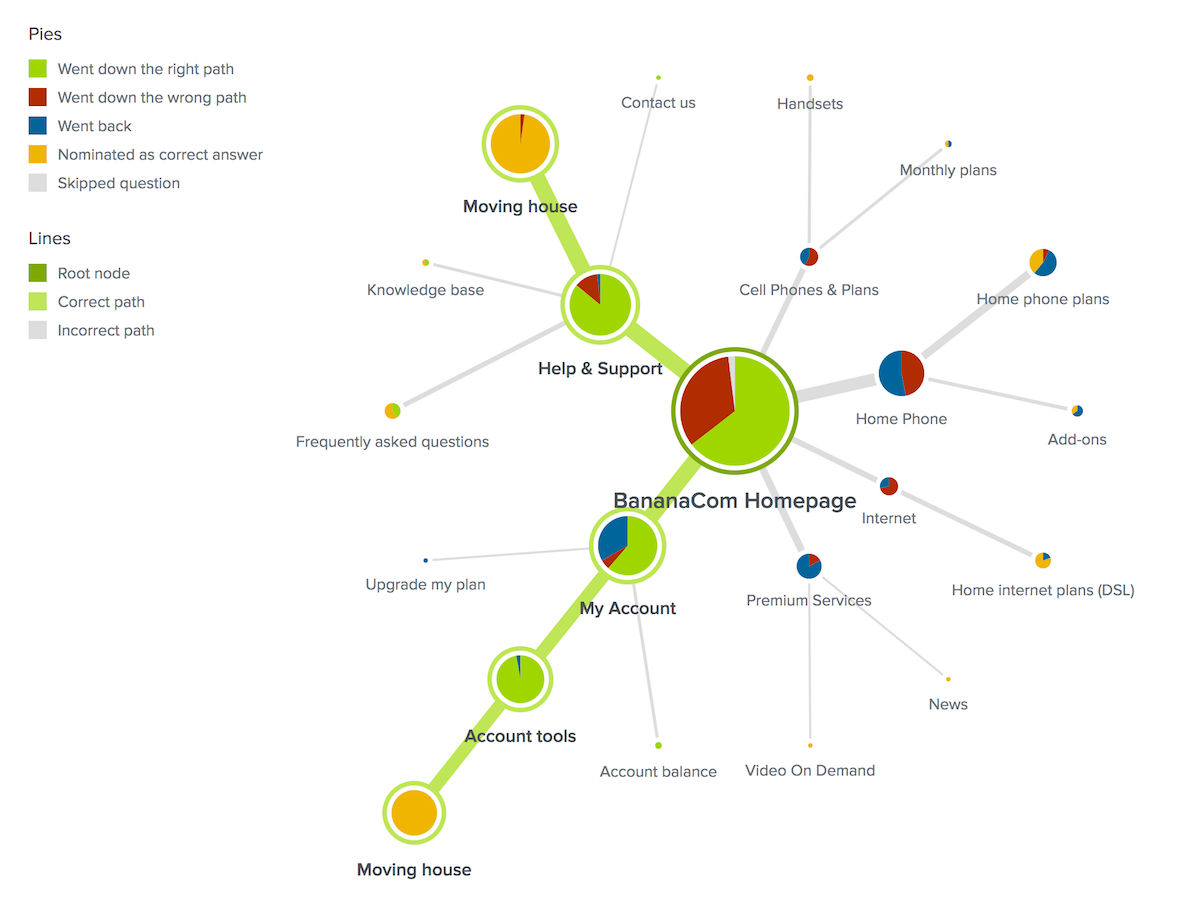
The output of tree testing will typically be percentages of success or failure. The researcher will tally the performance of each participant into four categories:
Direct success is when a participant navigates directly to the correct page with no issues.
Indirect success is when a participant navigates to the correct page after backtracking or taking detours.
Indirect failure is when a participant navigates to the wrong page after backtracking or taking detours.
Direct failure is when a participant navigates directly to the wrong page.
It's important to note that in the real world, what might be an indirect success could result in a user giving up. A large percentage of indirect successes should still be cause for concern.
Why? Because design skills make you valuable. In any job. Any industry.
In This Course, You'll
Get excited to build the authority and influence of a designer who backs qualitative user insights with hard, statistical evidence. A classic UX design study by Bailey and Wolfson found that users complete their task 87% of the time when their first click on a website leads down the right path, but just 46% of the time when it leads down the wrong one. A first-click test with dozens of users reveals where your navigation is leading them down the wrong path, so you can fix it before it translates to lost conversions. That's the power quantitative research gives you. You can surface and confirm user behavior at a scale your qualitative work cannot, tie your design decisions to business outcomes, and settle conflicting feedback or too many ideas.
Prove the return on investment (ROI) of your design decisions to stakeholders when you have more data and confidence than qualitative methods alone could ever give you. Whether you're switching into a design career or stepping into a senior role, this course takes you from the foundations through to running surveys, early-design tests, analytics, and A/B tests in real projects. You'll get a practical,formula-free grounding in statistics, significance, and sampling.
Make yourself invaluable when you can choose the best quantitative method for the situation, apply it effectively, analyze the results, and turn the numbers into confident decisions. You'll build versatility as you master surveys, tree testing, first-click testing, web and app analytics, and A/B and multivariate testing. Finally, you'll use triangulation to validate your qualitative insights before you commit organizational resources. As AI becomes standard for processing data, your ability to frame the right problems, interpret results through a human lens, and translate insights into action is the human-centered skillset hiring managers want to see.
Gain confidence and credibility as you strengthen your research toolkit and can make the case for using it. You'll learn to screen participants, spot disengaged ones, and write survey questions that minimize bias. You'll use standardized usability questionnaires like SUS and WAMMI to benchmark your product against industry data. For analytics, you'll work through Jansen's four-step process in Google Analytics: identify the stakeholders whose cooperation you'll need, define primary goals and conversions, identify your most important visitors, and set KPIs that hold up over time. On the statistics side, you'll learn hypothesis testing and the null hypothesis: the logic behind every test you'll run. You'll also gain a clear decision process for choosing one based on your data type. Since most UX data is categorical (conversions, clicks, choices), you'll focus on Chi-Square and Fisher's exact, with the t-test and Mann-Whitney U for numerical cases like task times.
Craft your portfolio with an optional, multi-part project. You'll design and run a real survey, an early-design test, an analytics analysis, and an A/B test on a website or app of your choice. Throughout the course, you'll get downloadable resources, including a Likert Scale Spreadsheet, a Data Types and Statistical Tests Template, and a Survey Question Tips Template, so you can immediately apply what you learn.
Learn From Industry Leaders
Master complex skills with proven best practices and toolkits directly from industry leaders. Meet your expert for this course:
William Hudson: User Experience Strategist and Founder of Syntagm.
Earn Industry-Recognized Certificates
Industry giants trust our courses to train their teams, and prestigious universities integrate our content into their curricula. Add your certificates to your LinkedIn profile, résumé, and job applications.
Whenever you’re working in UX (User Experience) design, you have to understand user expectations if you’re going to be able to group information effectively. Card sorting is a handy and relatively simple way to engage participants so they categorize topics in a way they find logical. This approach h
Tree Testing reveals where users lose their way in your navigation. It’s a focused approach to evaluate a site's navigational structure. But it’s more useful in certain scenarios—so, you need to understand where you’ll benefit from tree testing the most. Learn about the pros and cons of testing tool
Tree Testing helps you to find where users get lost in your navigation.Tree testing provides goal-oriented verification of a navigation hierarchy. No other part of the solution is involved since users only interact with a simulation of the menus. In the video William Hudson talks about getting start
Early-Design Testing is a great way to minimize extra work later in the process.Let’s get started on this exciting topic! In the video, William Hudson introduces early-design testing generally and the two methods we’re going to cover in detail: tree testing and first-click testing:References & W
Example of a tree-testing “pietree” from Optimal WorkshopAs with most research tools, you need to decide what you’re trying to find out and who to conduct your research with. In this video, William Hudson talks about these important questions and the related issues of participant recruitment and scr
Social shares
443
Published
Read Article
Getting Started with Early-Design Tests
Example of a tree-testing “pietree” from Optimal Workshop
As with most research tools, you need to decide what you’re trying to find out and who to conduct your research with. In this video, William Hudson talks about these important questions and the related issues of participant recruitment and screening:








 Example of a tree-testing “pietree” from Optimal