Prototyping is an integral part of Design Thinking and User Experience design in general because it allows us to test our ideas quickly and improve on them in an equally timely fashion. The Institute of Design at Stanford (d.school) encourages a “bias towards action”, where building and testing is valued over thinking and meeting. However, why is prototyping so important in the design process? Moreover, how does it help you create human-centred design solutions? Before we start making prototypes to test our assumptions, let’s get a closer understanding behind the what, how and why of prototyping.
Imagine this situation: It’s an exciting new project, something your team had spent months brainstorming and planning, then building and crafting to perfection. You did all you could to ensure it was just right, with all the necessary features. You tried to ensure that you gave design more focus and that your message was crafted well. The website attracted attention and brought in many interested visitors looking for the products you'd collected on the site, but somehow the product and service providers just weren't interested in testing it out. They seemed comfortable just to keep doing business as usual, uninterested in the thousands of hits your website was getting from potential customers. It made no sense to you, but there you were months later, having sweated and spent valuable time, money, and resources and even attracting visitors, but no customers.
What went wrong?
It's a story repeated time and time again—ideas being executed by people with an obsession for making a dent in the market, making big changes in society or just completely re-inventing the wheel, only to realise right at the end of their journey that they've been wasting their time or focussing on the wrong thing.
This is where prototyping comes in by providing a set of tools and approaches for properly testing and exploring ideas before too many resources get used. Many of us may recall the art of prototyping from our early childhood where we created mock-ups of real-world objects with the simplest of materials such as paper, card, and modelling clay or just about anything else we could get our hands on. There is not much difference between these types of prototypes and the early rough prototypes we may develop at the earlier phases of testing out ideas.
“If a picture is worth a thousand words, then a prototype is worth a thousand meetings.”
– Saying at IDEO
What is a Prototype?
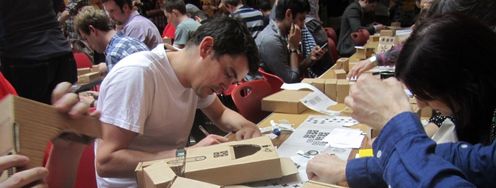
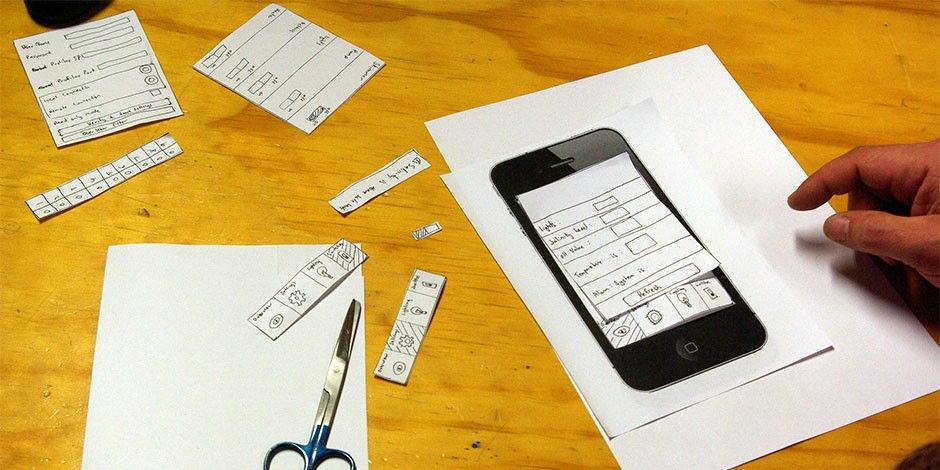 Author/Copyright holder: Samuel Mann. Copyright terms and licence: CC BY 2.0
Any finished product is just that—at the finishing line of a journey, a design journey involving a prototype or two (or more) with working titles such as ‘Mark I’, ‘Mark II’, ‘Mark III’, and so on.
A prototype is a simple experimental model of a proposed solution used to test or validate ideas, design assumptions and other aspects of its conceptualisation quickly and cheaply, so that the designer/s involved can make appropriate refinements or possible changes in direction.
Prototypes can take many forms, and just about the only thing in common the various forms have is that they are all tangible forms of your ideas. They don’t have to be primitive versions of an end product, either—far from it. Simple sketches or storyboards used to illustrate a proposed experiential solution, rough paper prototypes of digital interfaces, and even role-playing to act out a service offering an idea are examples of prototypes. In fact, prototypes do not need to be full products: you can prototype a part of a solution (like a proposed grip handle of a wheelchair) to test that specific part of your solution.
Prototypes can be quick and rough — useful for early-stage testing and learning — and can also be fully formed and detailed — usually for testing or pilot trials near the end of the project.
Prototyping is about bringing conceptual or theoretical ideas to life and exploring their real-world impact before finally executing them. All too often, design teams arrive at ideas without enough research or validation and expedite them to final execution before there is any certainty about their viability or possible effect on the target group.
Why We Need to Prototype
Early Research isn't Everything
Research conducted during the early stages of your Design Thinking project does not tell you everything you need to know in order to create the optimal solution. Regardless of whether you have researched thoroughly and gathered a large body of information, or whether your ideation sessions have resulted in what many perceive as a world-changing solution, testing is still crucial for success. Design teams can easily become fixated on the research artefacts they have gathered during the earlier phases of exploration, creating a bias towards their ideas. By prototyping and then testing those prototypes, you can reveal assumptions and biases you have towards your ideas, and uncover insights about your users that you can use to improve your solutions or create new ones.
You can use prototyping as a form of research even before other phases in Design Thinking, allowing you to explore problem areas in interfaces, products or services, and spot areas for improvement or innovation.
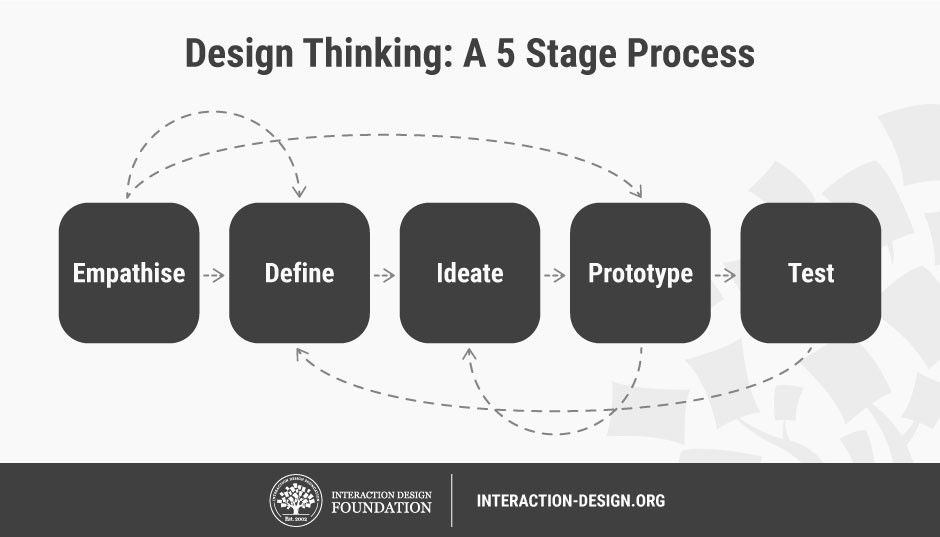 Author/Copyright holder: Teo Yu Siang and Interaction Design Foundation. Copyright terms and licence: CC BY-NC-SA 3.0
Design Thinking is a design methodology that provides a solution-based approach to solving problems. It’s extremely useful in tackling complex problems that are ill-defined or unknown, by understanding the human needs involved, by reframing the problem in human-centric ways, by creating many ideas in brainstorming sessions, and by adopting a hands-on approach in prototyping and testing. The five stages of Design Thinking are not sequential steps, but different “modes” you can put yourself in, to iterate on your problem statement, ideas, or prototype, or to learn more about your users at any point during the project.
Prototype to Empathise, Define, Ideate, and Test
We can — and should — use prototyping as part of various stages of Design Thinking. You can use prototyping as an ideation method, as it allows you, as well as users, to explore alternative solutions. This is possible because prototypes are physical representations of your solutions, and thus prototyping allows you to think by doing. Adopting a ‘thinking by doing’ mindset is extremely helpful in letting you derive more value from researching, defining, ideating, and testing.
Some of the purposes that prototypes fulfil are:
Exploring and Experimentation
You can use prototypes to explore problems, ideas, and opportunities within a specific area of focus and test out the impact of incremental or radical changes.
Learning and Understanding
Use prototypes in order to better understand the dynamics of a problem, product, or system by physically engaging with them and picking apart what makes them work or fail.
Engaging, Testing, and Experiencing
Use prototyping to engage with end users or stakeholders, in ways that reveal deeper insight and more valuable experiences, to inform design decisions going forward.
Inspiring and Motivating
Use prototypes to sell new ideas, motivate buy-in from internal or external stakeholders, or inspire markets toward radical new ways of thinking and doing.
How Prototyping Works
Bias Towards Action
One of the essential mindsets for Design Thinking listed in d.school’s Design Thinking Bootcamp Bootleg Toolkit is having a bias towards action:
“Design thinking is a misnomer; it is more about doing than thinking. Bias toward doing and making over-thinking and meeting.”
– d.school
This means that analysis paralysis is unable to take hold, because you will investigate each assumption through active testing, instead of theoretically thinking it through. By using controlled experiments, you can either prove or disprove your assumptions in their real context and thus further refine — or even abandon — your initial idea.
Learning by Doing
One of the most important aspects of Design Thinking is exploring unknown possibilities and uncovering unknown insights. This is the reason the discipline places emphasis on learning and on activities that increase the learning potential of the team. You can boost action-orientated learning by experimenting and exploring the proposed solutions in order to understand what problems may exist with the assumptions behind those solutions. As such, your team can iterate rapidly, modifying your test models and moving you closer and closer to the goal.
Creative Serendipity
Do breakthrough ideas really just come from nowhere?—A spark of genius in a rush of creativity? With the way breakthrough inventions, start-ups, and other revolutionary ideas are “sold” to inspire and encourage creativity, one would think that all we need is flipping a switch to a success mindset.
David and Tom Kelley, founders of international design firm IDEO, discuss in their book Creative Confidence the importance of cultivating creative serendipity. They encourage the adoption of approaches that lead to an epiphany-friendly environment within oneself. The idea is this: by deeply immersing yourself within your subject of interest, you can open up opportunities for happy accidents. What this means is that the vast majority of people who "stumble" across breakthroughs do so along their journey of engaging with the subject area.
The Kelleys cite various examples of people who made breakthroughs not by thinking through solutions but by trying things and figuring them out. One of the best ways to learn about the positive and negative dynamics of your solutions is to take physical action, by experimenting with and exploring potential solutions. When you prototype, you bring your ideas onto a tangible plane, which will enable you and your team to see and discuss the pros and cons, to learn from users’ feedback, and to create little opportunities for creative serendipity. So, stop thinking, and start doing now.
The Take Away
Many times, we tend to invest in exciting new ideas, brainstorming, and planning for their implementation — until we realize, after launching them, that our brilliant designs had no traction with our users. In other words, the assumptions we based our solutions on might have been wrong – and when they are wrong, they can lead to significant wastes of time and resources. Prototyping helps prevent this. Prototyping quickly, and frequently, is the best way to test your assumptions, learn about users, and improve on your ideas. Prototypes can be anything from sketches on a napkin to role-playing: just anything that lets you make your ideas tangible and testable. Prototyping helps create a bias towards action (i.e., make rather than think) and opportunities for creative serendipity — the innovative spark you need to create truly useful and revolutionary solutions.
References & Where to Learn More
d.school Bootcamp Bootleg, 2013.
Tom Kelley and Dave Kelley, Creative Confidence: Unleashing the Creative Potential Within Us All, 2013.
Hero Image: Author/Copyright holder: m0851. Copyright terms and licence: CC0