Creativity in UX/UI Design

Your constantly-updated definition of Creativity in UX/UI Design and collection of videos and articles.
Be a conversation starter: Share this page and inspire others!

839 Shares
Save

Get 1 Powerful Email Each Week

Join 315,237 subscribers.

What is Creativity in UX/UI Design?

Creativity is a process designers use to drive their abilities towards making artistic innovations (regarding aesthetics) and technical ones (about tackling design problems). Vital in ideation, creativity involves diversity and structure, splits into stages and types, is learnable and has a variety of methods to try.

See what creativity involves as a vital ingredient in design.  

Transcript
 

There’s More than Meets the Eye to Creativity

Generally, Creativity is often mislabeled as a phenomenon rather than a process, and classic misconceptions about it include:

  • Only imaginative individuals can produce good, unique and useful ideas.

  • The artistic, right-side brain governs creativity.

In user experience (UX) design, creativity is closely linked with innovation and—rather than be a natural-born talent—it involves a set of techniques and approaches anyone can learn. Because users’ problems are typically complex and intricately linked to the many contexts they find themselves in, the ideas designers strive for to solve these rarely “just happen”. Indeed, there’s a formula for creativity:

Creativity = Diversity + Structure

So, you can train your mind to be more creatively productive, leveraging techniques that expand in scale from simple methods up to the creativity-nurturing routine and environment you choose. Creative mindsets can seem anarchic and unruly, but there’s always a method to the madness involved somewhere (along with stages of creativity to grasp). Particularly, it’s important to learn how to tap into divergent thinking—to explore the horizon, including the wild, weird and downright wacky ideas—and then fine-tune your view of what might actually work using convergent thinkingOverall, creative ideas must be novel (i.e., involving a level of novelty that goes beyond anything you knew before making discoveries) and useful (i.e., truly practical for you to develop and ultimately beneficial to your users).
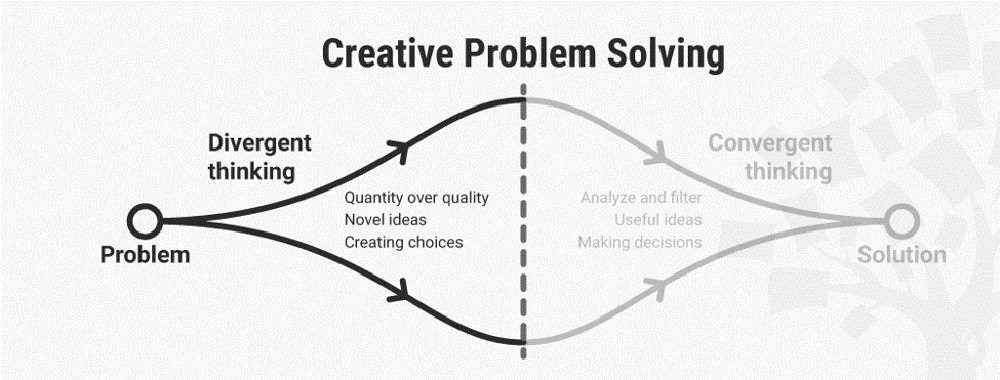
© Teo Yu Siang and Interaction Design Foundation, CC BY-NC-SA 3.0

Types of Creativity

Discover how various types of creativity apply to design.

Transcript
 

Creativity divides into two chief spheres that share certain areas:

Artistic creativity

Technical creativity

You would use this to (e.g.) design an attractive logo.

You would use this to (e.g.) solve a problem or put together a strategy as you explore (and push at the edges of) the design space.

Renowned cognitive scientist Margaret Boden has classified two additional types of creativity:  

H-creativity: historic creativity

P-creativity: personal creativity

New for humanity, such as first-in-the-world discoveries (e.g., the smartphone). 

Something that’s new for the person who makes the discovery. P-creativity is what you use when addressing a specific problem. Whether or not your idea becomes a “world first” is another matter, but H- and P-creativity do share common ground when designers make personal discoveries that later become historically important advances.

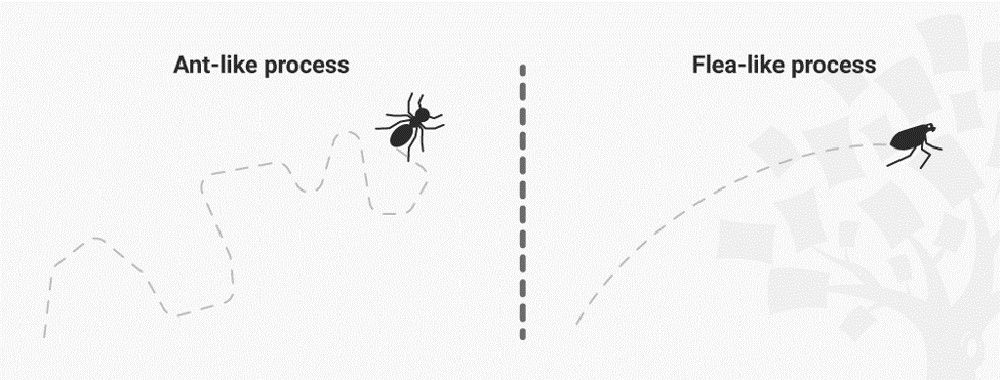
From a process aspect, we can add a further pair of types of creativity, as defined by Alan Dix:

Ant-like creativity

Flea-like creativity 

You take small and many iterative steps that collectively lead to a novel and useful design. Working carefully, you’ll typically have a solution in sight from early on and leverage convergent thinking to evolve your idea incrementally in a number of versions towards it.

You think wide and wild and jump at an idea that seems revolutionary. It’s the bold type of creativity—and hence often means you’ll go down the wrong avenues searching for optimal solutions—but risks can pay off and unlock doors to reveal radically brilliant insights and solutions.
© Teo Yu Siang and Interaction Design Foundation, CC BY-NC-SA 3.0

Tips for Getting Creative

To set out on a fresh pathway and journey towards truly unique and innovative ideas, you have a variety of options to explore (including learning how to overcome bias). It’s perfectly human to experience creative blocks, however, so here are some important things to consider:

  1. Quantity breeds quality – “More is more” in terms of idea generation. Brainstorming, for example, frees you to thoroughly investigate every possible dimension where a great solution might exist, no matter how silly things may first appear.

  2. Look within – Get in touch with your inner self by listing pain points, etc.; which pain points could you solve and how?

  3. Look without – Make detailed observations of what’s going on around you (e.g., your office) and describe or sketch others and what they’re doing.

  4. Break your habits/routine – Change something about your day-to-day life and examine any differences that arise from it. This can encourage the creative juices to flow.

  5. Stop thinking – Just shut off and see if a distraction (e.g., a long walk) breaks the block.

  6. Smother bad ideas – In the pursuit of sheer quantity over quality, sometimes you can bury yourself under an avalanche of thought relating to even just one bad idea. Try getting tough with it to see if it’s actually worth the effort. Maybe it is of questionable value. However, perhaps you can find good aspects or “secret staircases” within it that can take you up or down a level to reveal fresh insights.

Overall, allow yourself to fail – as creativity is an iterative (and enjoyably rewarding) learning process. Sooner or later, you’ll find yourself getting better at exploring your design space, finding intriguing hidden aspects of a problem, learning from mistakes along the way and, ultimately, tightening your grasp as you get a handle on what users really want from a product or service.

"Creativity is intelligence having fun."

— Albert Einstein

Questions About Creativity?
We've Got Answers!

What does creativity mean in UX design?

Creativity is an essential ingredient for design in general—in UX (user experience) design, it means solving problems in original and meaningful ways that improve how users interact with a product or service. Designers don’t just make things look nice—they think deeply about user needs and develop smart, often unexpected solutions that make digital experiences smoother and more enjoyable.

Creativity shows up in how designers simplify complex processes, use storytelling to guide users or blend visual and interactive elements in natural ways. It also plays a big role in adapting ideas from other fields, like psychology or architecture, to create designs that truly resonate with users.

For example, Airbnb’s designers reimagined how people book travel by focusing on trust and storytelling, not just transactions.

Watch as Author and Human-Computer Interaction Expert, Professor Alan Dix explains important points about creativity:

Transcript

Take our course Creativity: Methods to Design Better Products and Services.

What exercises boost creativity in UX?

Exercises that boost creativity in UX design challenge assumptions, spark new ideas, and stretch designers’ thinking. Many techniques help designers flex their creative “muscles”—like crazy 8s (sketching eight ideas in eight minutes), which pushes designers to think fast and freely and avoid overthinking. Brainwriting—a variant of brainstorming—lets team members jot down ideas quietly before sharing, which can lead to more diverse input than group brainstorming alone.

Other examples include bad ideas and worst possible idea—techniques that not only enable designers to explore fresh angles (i.e., what is bad about a potential solution or the worst possible way of handling a design problem) but are also great ice-breakers for team activities. Another strong tool is role-playing. When designers step into users’ shoes, they uncover insights they well might miss otherwise. SCAMPER (Substitute, Combine, Adapt, Modify, Put to another use, Eliminate, and Reverse) helps designers remix and reframe existing solutions creatively.

Overall, the exercises that help designers and design teams stretch to think outside the box and divergently—to get as many fresh ideas as possible and from many angles of a problem—are ones that can help power the way to solutions that are novel and innovative.

Watch as Professor Alan Dix explains some helpful methods for thinking divergently.

Transcript

Take our course Creativity: Methods to Design Better Products and Services.

Does collaboration improve creativity?

Yes, collaboration boosts creativity—especially in UX design. When designers work together, they blend different perspectives, backgrounds, and problem-solving styles. That mix can lead to richer ideas than any one person could generate alone.

When designers and teams brainstorm together, they bounce ideas off one another, which often sparks unexpected insights. Group creativity sessions with techniques like brainstorming—and variants such as brainwriting and brainwalking—create space for fast, focused teamwork and help teams generate more ideas, faster.

These activities encourage divergent thinking—where the team explores many possible solutions before narrowing down. Designers build on each other’s thoughts, challenge assumptions, and combine ideas in new ways. This collective momentum often leads to more innovative, user-focused outcomes than solo work alone.

Watch our video about brainstorming:

Transcript

Take our course Creativity: Methods to Design Better Products and Services.

Can structure limit creativity in UX?

Structure can limit creativity in UX—but only if it’s too rigid. Overly strict rules, fixed templates, or narrow design systems can box designers in and suppress fresh ideas. However, when used wisely, structure can guide creativity instead of blocking it.

The right constraints can be a big help to spark creativity. Clear goals, user needs, and even design systems give direction, not restrictions. When designers understand the boundaries, they stop guessing and start inventing within them.

Arbitrary constraints can push creativity forward. Asking a team to design a checkout flow using only two colors or with zero text forces them to think differently. These “creative limits” challenge assumptions and can lead to bold, unexpected solutions.

Psychologists call this “creative constraint,” when rules act as prompts rather than barriers. Having just enough structure can help find a spark that can ignite creativity fully and lead to innovative solutions.

Watch as Professor Alan Dix explains some helpful methods for thinking divergently, which include arbitrary constraints.

Transcript

Take our course Creativity: Methods to Design Better Products and Services.

What can I do to help myself be more creative?

To help fuel your creativity levels and get unstuck when ideas dry up, having the right habits, mindset, and environment is important. Start by building a daily rhythm that encourages creativity. Keep a sketchpad or swipe file handy. Jot down stray thoughts, doodle interfaces, or capture odd ideas. These tiny rituals can keep your creative muscles warm.

When you hit a creative impasse, don’t force it—shift gears instead. Go for a walk, talk through the problem with a colleague, or try lateral thinking exercises like changing the user’s context or adding absurd constraints. Often, the best ideas emerge when you stop chasing them head-on.

Design your space to support creative flow, too. Use natural light, surround yourself with inspiring visuals, or work in new locations. Even rearranging your desk can reset your perspective.

Watch as Author and Human-Computer Interaction Expert, Professor Alan Dix explains important points about habits that help with creativity:

Transcript

Take our course Creativity: Methods to Design Better Products and Services.

How do I brainstorm creative solutions in UX?

To brainstorm creative solutions in UX, start by welcoming every idea—even the “bad” ones—and brainstorm with a diverse group of team members. Sometimes, the worst ideas lead to the most original breakthroughs once you tweak or flip them. This removes pressure and keeps energy high.

Begin with a clear challenge and try variants like brainwriting—writing ideas silently and passing them around—or reverse brainstorming—thinking about how to make the problem worse. These methods can reveal important unexpected angles and reduce the fear of judgment. SCAMPER and “How Might We” questions help you stretch ideas by reimagining existing solutions, too.

Encourage quantity first—evaluate later. Use sticky notes or digital whiteboards to capture everything, then group ideas into themes. Look for patterns or mashups that combine different sparks into one strong concept.

Watch our video about brainstorming:

Transcript

Enjoy our Master Class Harness Your Creativity to Design Better Products with Alan Dix, Professor, Author, and Creativity Expert.

Should I always aim to be original in UX design?

You shouldn’t always aim for pure originality in UX design—what matters most is solving user problems in ways that feel both fresh and intuitive. Users rely on familiar patterns to navigate interfaces efficiently. Stray too far, and you risk confusion or frustration.

Instead of chasing uniqueness for its own sake, focus on meaningful innovation. Use creative techniques like SCAMPER, “How Might We” questions, or lateral thinking to explore bold ideas. After harvesting many divergent ideas, use convergent thinking to tighten the process and focus on what might solve the users’ problem. Then, once you and your design team have what you believe is the best solution, prototype and test it to ensure it aligns with user expectations. Prototype early, get feedback fast, and refine based on real use.

The goal is to trailblaze without disorienting your users with a design solution that is too exotic for them to understand, let alone use well. It’s better to introduce new concepts gradually, anchor them with recognizable cues, and make interactions feel natural. Creativity should enhance clarity, not obscure it.

Watch as Professor Alan Dix explains important points about convergent thinking:

Transcript

Take our course Creativity: Methods to Design Better Products and Services.

How do I show creativity in my UX portfolio?

To show creativity in your UX portfolio, highlight how you solved problems—not just what the final designs look like. Walk through your thought process, from user research to wild ideas to refined solutions. Show sketches, wireframes, and iterations to make your creative journey visible.

Don’t just say you brainstormed—show the messy notes, Post-its, or mind maps that led to breakthroughs. Use storytelling to explain how you reframed challenges, applied creative techniques, or turned constraints into advantages.

Case studies are vital opportunities to showcase your creativity, and you’ll want to tailor each case study to bring out the best in what you can offer. Add personality, custom visuals, or interactive elements that reflect your style. Make sure it’s still clear, structured, and easy to navigate—creativity and usability go hand in hand here, too.

Watch as Managing Director and Head of Design at Societe Generale Corporate & Investment Banking, Morgane Peng explains important points about UX portfolios:

Transcript

Take our course Build a Standout UX/UI Portfolio: Land Your Dream Job.

What are some recent scientific articles about creativity?

Shokrizadeh, A., Tadjuidje, B. B., Kumar, S., Kamble, S., & Cheng, J. (2025). Dancing with chains: Ideating under constraints with UIDEC in UI/UX design. arXiv preprint arXiv:2501.18748.

This study explores the impact of design constraints—such as brand identity, design norms, and industry guidelines—on the ideation processes of UI/UX designers. Through interviews, the authors identify three designer personas with varying perspectives on constraints, informing the development of UIDEC, a generative AI-powered tool. UIDEC allows designers to input project specifics and generates diverse design examples adhering to these constraints, minimizing the need for extensive prompting. User evaluations indicate that UIDEC aligns well with existing ideation workflows and is a valuable source of creative inspiration, particularly in initiating new projects. This work is significant for providing design implications for AI-powered tools that integrate constraints to support creativity in UI/UX design.

Khan, A., Shokrizadeh, A., & Cheng, J. (2025). Beyond automation: How UI/UX designers perceive AI as a creative partner in the divergent thinking stages. arXiv preprint arXiv:2501.18778.

This paper explores how professional UI/UX designers perceive and utilize AI during divergent thinking—the stage of idea generation and exploration essential for creativity. Based on interviews with 19 designers, the study identifies four main roles of AI: aiding research, kick-starting creativity, generating design alternatives, and enhancing prototype development. Unlike automation-focused studies, this work reveals a nuanced view of AI as a collaborative tool, rather than a creative replacement. Designers valued tools that preserved control, supported visual workflows, and encouraged exploration. This study is important because it fills a critical gap in understanding how AI supports innovation during the formative stages of design, offering concrete implications for future co-creative tools.

Kelley, T., & Kelley, D. (2013). Creative Confidence: Unleashing The Creative Potential Within Us All. Crown Business.

In Creative Confidence, Tom and David Kelley, founders of the renowned design firm IDEO, challenge the notion that creativity is reserved for a select few. They argue that everyone possesses innate creative potential and offer strategies to unlock it. Drawing from their extensive experience, the authors present principles and real-world examples to help individuals and organizations cultivate innovation. This book is significant as it democratizes creativity, emphasizing its role in problem-solving and personal growth, thereby inspiring readers to approach challenges with renewed confidence and ingenuity.

Saffer, D. (2009). Designing for Interaction: Creating Innovative Applications and Devices (2nd ed.). New Riders.

Dan Saffer’s Designing for Interaction offers a clear and structured guide to the practice of interaction design, an essential facet of UX. The book balances theory and practical application, introducing foundational methods such as research, ideation, prototyping, and usability testing. By demystifying how successful products are conceived and designed, Saffer provides essential insights for UX designers, developers, and product managers. Its accessibility and case-driven approach make it a staple in design curricula and professional reading lists. The book remains significant for its ability to translate creativity into user-focused digital solutions, fostering innovation in web, mobile, and device design.

Earn a Gift, Answer a Short Quiz!

1
2
3
4
1
2
3
4
Question 1
Question 2
Question 3
Get Your Gift

Question 1

What best describes creativity in design?

1 point towards your gift

  • A natural talent that only a few individuals possess.
  • A structured process that can be learned and applied.
  • An unstructured approach that relies on spontaneous ideas.

Question 2

What does P-creativity refer to in the design process?

1 point towards your gift

  • Creativity based on global historical innovations.
  • Creativity that primarily focuses on aesthetics.
  • Personal creativity that brings new ideas to the individual.

Question 3

Which type of thinking should designers apply to refine a broad range of ideas into workable solutions?

1 point towards your gift

  • Convergent thinking
  • Divergent thinking
  • Reflective thinking

Learn More About Creativity in UX/UI Design

Make learning as easy as watching Netflix: Learn more about Creativity by taking the online IxDF Course Creativity: Methods to Design Better Products and Services.

Why? Because design skills make you valuable. In any job. Any industry.

In This Course, You'll

  • Get excited to innovate and get creative, even when you feel blocked. Learn a repeatable creative approach that'll help you generate strong concepts on demand, break through when you're stuck, and turn your best ideas into solutions users love. In this course, design legend and author of the bestselling book "Human-Computer Interaction (HCI)," Professor Alan Dix, shows you why the best ideas come from a structured process and gives you the toolkit to do it yourself. The World Economic Forum ranks creative thinking among the top skills employers want in any profession, today and through 2030. Whether you're starting out, switching careers, or in a senior role and want a process you can rely on, you'll turn creativity from something that happens to you into something you can switch on. No creative background needed.

  • Make yourself invaluable by mastering a wide range of ideation methods so you never get stuck in one approach. To generate and explore new ideas, you'll apply Bad Ideas, Random Metaphors, and Arbitrary Constraints, and to refine and develop them, you'll apply Embrace Opposites, Multiple Classifications, and Teasing Apart, Piecing Together (TAPT). With Edward de Bono's Six Thinking Hats, you'll learn to guide a team to see a problem from every angle. You'll also learn to build an environment that nurtures creativity and to remove the hidden barriers that hold people back. You won't just have better ideas, you'll help everyone around you have them too. As AI churns out endless options, it's your timeless, human-centered design skills, like understanding people and what they actually need, that ensure your solutions are genuinely new and useful.

  • Gain confidence and credibility with a creative process that helps you be productive even under pressure. You'll learn to plan and time-manage your work so good ideas arrive when you need them, and apply proven strategies to beat procrastination, bias, and fixation. You'll keep momentum going with busywork, recognize when stepping back to let an idea incubate is the smartest move, and tackle big, messy "wicked problems" without stalling. When you hit a wall, you'll know whether to push through, switch to something else, or step away, instead of forcing it. And because your best ideas often arrive in the shower or on a walk, not at your desk, you'll learn simple ways to capture them before they slip away. The result is a process you can rely on, so you deliver strong work whether the spark comes on schedule or not.

  • Craft your personal portfolio with a piece that clearly captures your entire creative process. With optional, hands-on activities, you'll build a case study that shows how you ideate, from a ready-made persona and empathy map through to a fully developed concept. Downloadable templates let you apply your new skills immediately. You walk away able to show employers and clients what a polished mockup alone doesn't: how you actually approach and solve problems.

Learn From Industry Leaders

Master complex skills with proven best practices and toolkits directly from industry leaders. Meet your experts for this course:

  • Alan Dix: Author of the bestselling book "Human-Computer Interaction" and Director of the Computational Foundry at Swansea University.

  • Don Norman: Father of User Experience (UX) Design, author of the legendary book "The Design of Everyday Things," and co-founder of the Nielsen Norman Group.

Earn Industry-Recognized Certificates

Industry giants trust our courses to train their teams, and prestigious universities integrate our content into their curricula. Add your certificates to your LinkedIn profile, résumé, and job applications.

Our clients: IBM, Harvard University, University of Cambridge, NASA, Adobe, Stanford, Massachusetts Institute of Technology, LinkedIn
Course Certificate

All Free IxDF Articles on Creativity in UX/UI Design

Read full article
7 Tips to Improve Your UX Design Practice - Article hero image

7 Tips to Improve Your UX Design Practice

Hey! But my UX design practice is perfect! Thankfully, we don’t hear that very much but the truth is – the longer we’re in a job, the better we consider ourselves to be at that job. Sometimes, it’s worth remembering that even the best professionals still have learning to be done. It’s also worth rem

Social shares
971
Published
Read Article
Read full article
The Basic Principles of Effectuation – How to Use What You Already Have to Become More Innovative - Article hero image

The Basic Principles of Effectuation – How to Use What You Already Have to Become More Innovative

In your role as a designer, coming up with creative and innovative designs and ideas that should have a positive impact on both users and business is part of the job description, whether you are employed, a student or an entrepreneur. Sometimes, though, devising the next great idea can be a challeng

Social shares
928
Published
Read Article
Read full article
10 Simple Ideas to Get Your Creative Juices Flowing - Article hero image

10 Simple Ideas to Get Your Creative Juices Flowing

Writers deal with writer’s block and designer’s often find that they get stuck for ideas too. There’s no shame in it but learning to smash through the block is a necessary professional skill. Time waits for no-one and when there’s a deadline looming… you’ve got to pull something out of the bag. The

Social shares
878
Published
Read Article
Read full article
Ideation for Design  - Preparing for the Design Race - Article hero image

Ideation for Design - Preparing for the Design Race

Ideation is easy to define. It’s the process by which you generate, develop and then communicate new ideas. Ideas can take many forms such as verbal, visual, concrete or abstract. The principle is simple to create a process by which you can innovate, develop and actualize new products. Ideation is c

Social shares
875
Published
Read Article
Read full article
15 Inspiring UX Quotes for Innovation and Design - Article hero image

15 Inspiring UX Quotes for Innovation and Design

In design—and anywhere else that innovation is involved—words can often paint a picture far more vividly than strokes on a canvas ever could, and that’s true in UX design (user experience design), where inspiration often comes from straightforward phrases. These brief quotes are way more than just w

Social shares
822
Published
Read Article
Read full article
What Does a Creative Designer Do? - Article hero image

What Does a Creative Designer Do?

Creativity is a massive appeal factor for designers (and those who enjoy what we do!) as they bring to bear their creative talents and skill sets on projects and dazzle users, customers, and the brand themselves who launch their design solutions. With that said, though—and for all the digital produc

Social shares
764
Published
Read Article

Understand the Various Types of Creativity

Understand the Various Types of Creativity

When you want to be more creative, you’ll want to learn the techniques for creative thinking and understand the various forms of creativity and creative processes. This video will give you an overview of some of the different forms of creativity. For example, you’ll learn that there are two types of creative processes: the ant and the flea process. The ant process is slow and evolutionary, while the flea process takes giant revolutionary leaps. Crucially, you’ll learn about the golden formula for creativity : truly creative solutions to problems need a combination of the ant and the flea useful, structured insight as well as novel ideas.

Copyright
Transcript


39% of Today's Skills Will Change by 2030

The World Economic Forum expects 39% of today's skills to be transformed or become outdated by 2030.

The good news is that jobs in UX / UI design and AI are among the fastest-growing professions globally.

Build Skills That Keep You Relevant

Privacy Settings

By using this site, you accept our Cookie Policy and Terms of Use.
Customize
Accept all

Be the One Who Inspires

People remember who shares great ideas.

Share on:

Academic Credibility — On Autopilot

Don't waste time googling citation formats. Just copy, paste and look legit in seconds.