Illustration of a hook with the text "short" and "60 words".

Grab Hiring Managers’ Attention with Your Design Portfolio Right From the Start

by Laia Tremosa • 14 min read

582 Shares

How do you ensure your design portfolio grabs the attention of potential employers from the get-go? Your hook holds the answer—the gateway to make a memorable impression. Let's discover how to craft a hook that captivates and sets you apart.

In this video, Morgane Peng, Design Director at Societe Generale CIB, shows you how to create engaging hooks and headlines for your portfolio.

Transcript

What Are Hooks and Why Are They Important?

Hooks are the attention-grabbing elements of any content, usually found at the beginning. Their purpose is to pique the audience's interest and compel them to continue reading or engage further. In essence, hooks serve as the initial "grabber" that draws readers in and makes them want to know more.

Hooks are essential because they are the first impression a reader or viewer receives, and as the saying goes, "first impressions are lasting impressions." A strong hook can make the difference between someone continuing to read, watch or listen to your content or moving on to something else. In a world where attention spans grow increasingly shorter and competition for engagement is fierce, a compelling hook is essential to capture and retain audience attention.

In terms of a design portfolio, a hook refers to a compelling element or a combination of elements and aspects that immediately captures the viewer's attention and sparks interest to explore more of the portfolio. The hook can be a striking unique personal statement, an intriguing project thumbnail or a distinctive visual theme or design. Its purpose is to differentiate the portfolio from others and entice potential employers, clients or collaborators to go deeper into the designer’s work. Essentially, the hook is a standout feature that represents the designer's skills, creativity and unique approach—it makes the portfolio memorable and engaging right from the start.

What Are Headlines and Why Are They Important?

Headlines serve as concise summaries that introduce the content's main topic and are a key element in a good hook. Positioned at the top, a headline is a vital element that captures attention, generates interest and sets clear expectations for the reader. Well-crafted headlines also enhance content readability and shareability.

In a design portfolio, headlines act as part of the initial hook that captures and retains viewer attention. They serve as concise, compelling titles, statements or captions that introduce you and your portfolio. Effective headlines help organize the portfolio—they highlight the designer’s skills succinctly and differentiate them from others. Additionally, well-crafted headlines can enhance the portfolio's overall appeal and professionalism, which sets the tone and context for what the viewer can expect.

How to Craft a Good Headline
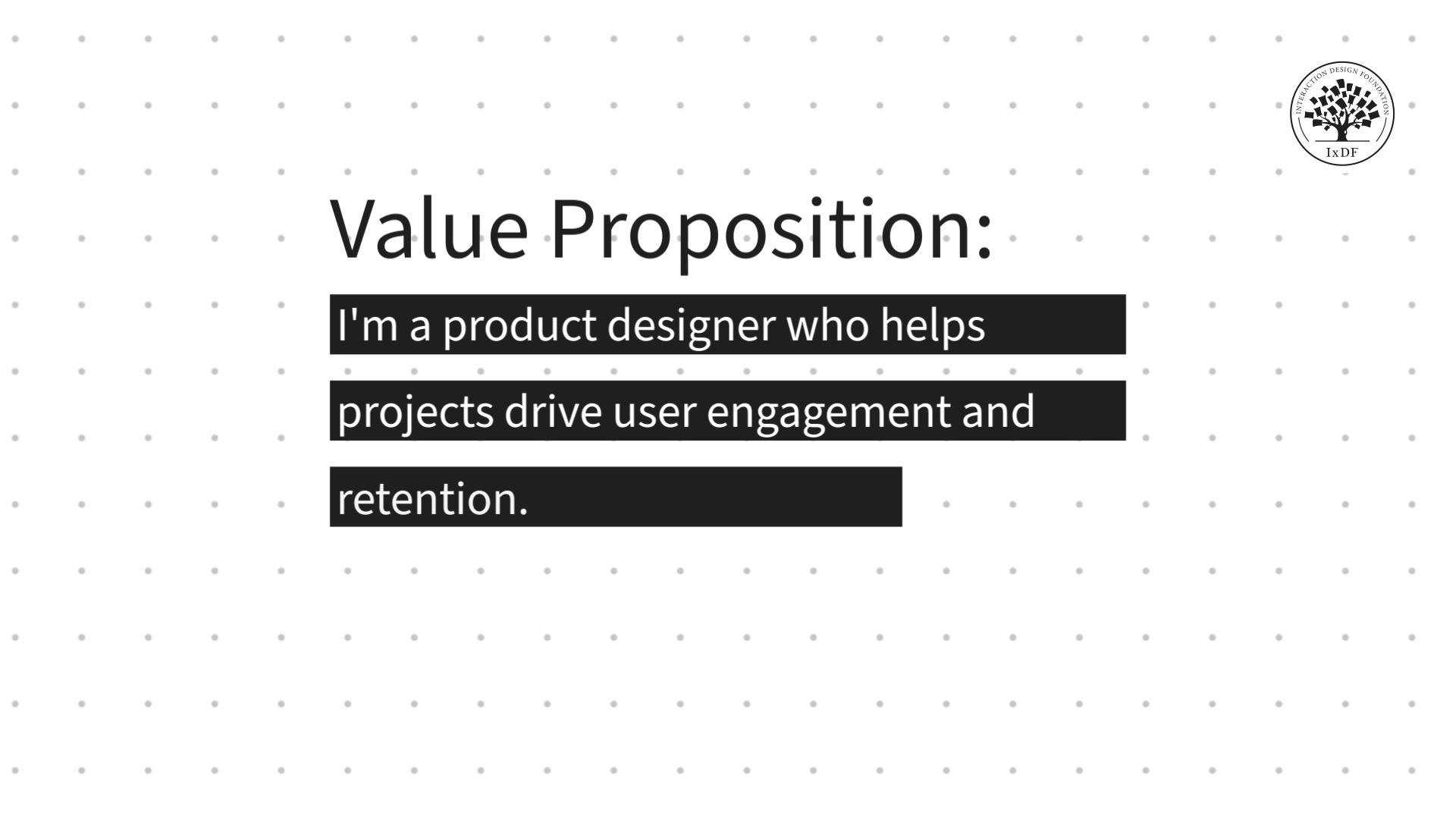
Text: Value proposition: I'm a product designer who helps projects drive user engagement and retention.

© Interaction Design Foundation, CC BY-SA 4.0

Your headlines should not only grab attention, but also help hiring managers scan the content of your design portfolio.

Here's a step-by-step guide to help you create an effective headline:

  1. Include key skills or specializations: Incorporate essential skills or specializations directly into your headline to quickly convey what sets you apart as a designer. This allows hiring managers to immediately identify whether your expertise aligns with their needs.

"Expert Web Designer Specializing in E-commerce Solutions"

  1. Highlight achievements or awards: If you have received notable achievements or awards in your design career, showcase them in your headline to provide instant credibility and make your portfolio stand out.

“D&AD-Award-Winning Graphic Designer with a Passion for Branding"

  1. Specify industry experience: If you have extensive experience working within specific industries, mention them in your headline to signal to hiring managers that you have relevant expertise in their field.

“Specialist UX/UI Designer in the Tech and SaaS Industries"

  1. Quantify results or impact: If possible, quantify the results or impact of your design work in your headline to demonstrate your effectiveness as a designer. This helps hiring managers quickly understand the value you can bring to their team.

"Increased Conversion Rates by 30% Through Strategic Design Solutions"

  1. Use keywords relevant to the job: Tailor your headline to include keywords relevant to the job description or the specific role you're applying for. This can help your portfolio to appear more prominently in search results and catch the eye of hiring managers.

"Versatile Designer Skilled in Responsive Web Design and SEO Optimization"

  1. Keep it brief and scannable: While it's important to include relevant information in your headline, keep it brief and scannable so hiring managers can quickly grasp the essence of your portfolio. Avoid long sentences or unnecessary details.

"Creative Designer | UX Expert | Branding Enthusiast"

  1. Be authentic: Let your personality shine through in your hook to establish a genuine connection with your audience.

"Passionate about designs that not only look good but also make a meaningful impact on users' lives."

Use this template to craft your impactful, attention-grabbing headline.
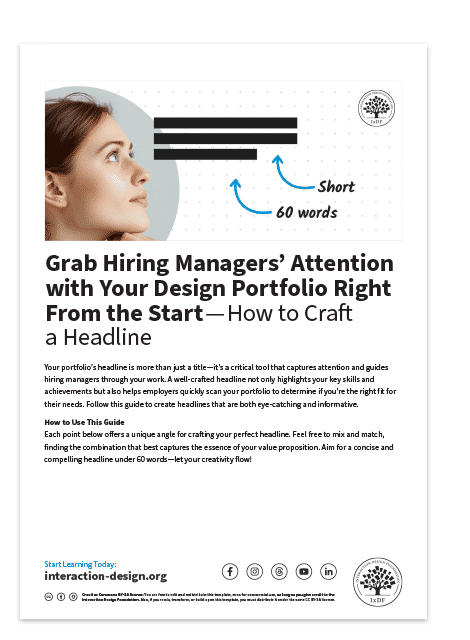
Advance Your Career With This Free Template for “Grab Hiring Managers Attention With Your Design Portfolio Right From the Start How To Craft a Headline”
Grab Hiring Managers Attention With Your Design Portfolio Right From the Start How To Craft a Headline
We respect your privacy
Get 1 powerful email each week: Design a life you love!

The Take Away

The primary purpose of your portfolio's landing page is to engage visitors, especially potential employers, and convince them that they've found the right candidate. To achieve this, your hook and introduction need to be spot on.

A good hook should be visually appealing and straightforward, as our initial impressions heavily rely on visuals. Once visitors start reading your landing page, they should find your content valuable, primarily focused on you and your work. Therefore, a well-written headline is essential to introduce yourself effectively. Your headline should be concise (around 60 words maximum) and provide a snapshot of who you are and what you do. Experiment with different angles, such as your role, industry, value proposition or processes, to distinguish yourself from other candidates.

Test your headline to ensure readability and clarity, and seek feedback from mentors or peers for validation. Additionally, consider whether to include a photo next to your headline, as portfolios are more personal and allow for such visual elements to enhance the personal touch of your landing page.

References and Where to Learn More

Spark your creativity with The 10 Most Inspirational UX Design Portfolio Examples in 2024.

Check out Journey’s piece, How to Create an Effective Design Portfolio Copy.

Build a network that supports your career growth—join an IxDF Local Group.

Hero image: © Interaction Design Foundation, CC BY-SA 4.0

Topics in This Article

Learn More in This Course:

Build a Standout UX/UI Portfolio: Land Your Dream Job

15 days
13 % booked
View Course

What You Should Read Next

  • Read full article
    UX Roles: The Ultimate Guide – Who Does What and Which One You Should Go For? - Article hero image
    Interaction Design Foundation logo

    UX Roles: The Ultimate Guide – Who Does What and Which One You Should Go For?

    Do you have the ambition and enthusiasm for a career in UX design but don’t know where to start? You’ll be pleased to know there are many paths you can take. Even as a relatively new field, user experience (UX) design has both general and specialist job roles. This variety means there is a role wait

    Social shares
    1.2k
    Published
    Read Article
  • Read full article
    How to Write the Conclusion of Your Case Study - Article hero image
    Interaction Design Foundation logo

    How to Write the Conclusion of Your Case Study

    You worked on an amazing UX project. You documented every detail and deliverable and when the time came, you began to write a UX case study about it. In the case study, you highlighted how you worked through a Design Thinking process to get to the end result; so, can you stop there and now move on t

    Social shares
    1k
    Published
    Read Article
  • Read full article
    How to create the perfect structure for a UX case study - Article hero image
    Interaction Design Foundation logo

    How to create the perfect structure for a UX case study

    UX case studies form the core content of a UX professional’s portfolio. They are essential to getting you hired, because case studies are a window to your professional practice, by showing how you think, adapt, cooperate and ultimately solve challenges. A UX case study has to tell a story about you.

    Social shares
    975
    Published
    Read Article
  • Read full article
    How to Build a UX/UI Design PDF Portfolio That Hiring Managers Will Love (Includes Examples) - Article hero image
    Interaction Design Foundation logo

    How to Build a UX/UI Design PDF Portfolio That Hiring Managers Will Love (Includes Examples)

    If you already have an online UX/UI design portfolio, do you need a PDF version? The answer is – yes; it is better to be safe than sorry! Some hiring managers like to see a more detailed PDF portfolio after reviewing your online portfolio, while some job applications may request an upload instead of

    Social shares
    943
    Published
    Read Article
  • Read full article
    How to Write UX/UI Design Case Studies That Boost Your Portfolio and Get You Hired - Article hero image
    Interaction Design Foundation logo

    How to Write UX/UI Design Case Studies That Boost Your Portfolio and Get You Hired

    The term “case study” sounds a little boring, doesn’t it? What if, instead, it were called a “design story”? Well, that’s exactly how you should think of it! Approach your UX/UI design case studies like stories, not just a list of tasks you completed. You will not only make your portfolio easier and

    Social shares
    941
    Published
    Read Article
  • Read full article
    The 10 Most Inspirational UX Design Portfolio Examples in 2026 - Article hero image
    Interaction Design Foundation logo

    The 10 Most Inspirational UX Design Portfolio Examples in 2026

    UX (user experience) design is an exciting (and highly competitive) field, and it calls for a superb portfolio to get into it, a portfolio that will be your passport to success. It’s your chance to unveil your expertise, innovation, and problem-solving prowess. And regardless of what your expertise

    Social shares
    910
    Published
    Read Article
  • Read full article
    What Should a UX Design Portfolio Contain? - Article hero image
    Interaction Design Foundation logo

    What Should a UX Design Portfolio Contain?

    Your UX design portfolio is the key that gets you a job interview, and it is therefore vital that you include everything necessary in it. After all, a recruiter spends only a few minutes to form an opinion of you through your portfolio. If you’re new to UX, however, you might not know what exactly n

    Social shares
    825
    Published
    Read Article
  • Read full article
    What Tech Job is Right for Me? A Comprehensive Guide to Navigating Your Career Path - Article hero image
    Interaction Design Foundation logo

    What Tech Job is Right for Me? A Comprehensive Guide to Navigating Your Career Path

    Think about which tech career is right for you and you may well find that choosing a career is about getting work that offers fulfilling employment, personal growth opportunities, and—of course—good remuneration. If you’re finding yourself contemplating a change or exploring alternative paths on you

    Social shares
    817
    Published
    Read Article
  • Read full article
    8 Essential Writing Tips for a Clear and Confident UX/UI Design Portfolio - Article hero image
    Interaction Design Foundation logo

    8 Essential Writing Tips for a Clear and Confident UX/UI Design Portfolio

    Have you ever read and re-read something over and over and still didn’t understand it? Unless it was a book on advanced nanoengineering, it probably wasn’t your fault. Much of the writing you will read in your life will be unnecessarily complex or vague. Surprisingly, however, it’s easy to write eff

    Social shares
    786
    Published
    Read Article
  • Read full article
    How to Handle Non-Disclosure Agreements (NDAs) When You Write Your UX Case Study - Article hero image
    Interaction Design Foundation logo

    How to Handle Non-Disclosure Agreements (NDAs) When You Write Your UX Case Study

    Most designers are familiar with non-disclosure agreements. Usually, your employer asks you to sign such an agreement to prevent you from revealing confidential information. But when you write your UX case studies, your NDAs suddenly seem like an obstacle. How should you write about your design proj

    Social shares
    786
    Published
    Read Article

Top Articles

Top Topic Definitions

Feel Stuck?
Want Better Job Options?

AI is replacing jobs everywhere, yet design jobs are booming with a projected 45% job growth. With design skills, you can create products and services people love. More love means more impact and greater salary potential.

At IxDF, we help you from your first course to your next job, all in one place.

See How Design Skills Turn Into Job Options
Privacy Settings
By using this site, you accept our Cookie Policy and Terms of Use.
Customize
Accept all

Be the One Who Inspires

People remember who shares great ideas.

Share on:

Academic Credibility — On Autopilot

Don't waste time googling citation formats. Just copy, paste and look legit in seconds.

Feel Stuck? Want Freedom?

Join 326,033+ designers who get one powerful email each week. Learn to design a life you love.

Next email in
1
day
10
hrs
36
mins
23
secs

Free forever. No spam. Unsubscribe anytime.