Multi-store memory model showing environment input flowing through sensory and short-term memory to long-term memory, with rehearsal, retrieval, and recall

How We Use Long-Term Memory and How it Informs Us Who We Are

by William Hudson • • 28 min read

505 Shares
Save

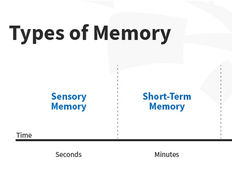
The sensory, short-term, and long-term components of memory come from the well-established multi-store model of memory, first proposed by Atkinson and Shiffrin in the late 1960s (see below for the original paper). While not without its detractors, it is still the most commonly accepted description of how our memories work.

The diagram shows the relationships between the three stores and the activities or events that “progress” memories from shorter-term stores, eventually to long-term memory, while considering factors such as color blindness to ensure accessibility in visual representations.

In this clip Professor of HCI, Alan Dix discusses long-term memory and some of the transitions between memory stores.

Transcript

References and Where to Learn More

Learn More in This Course:

Learn Design and AI From the Best

Get one powerful email each week, like 313,901 others.

Next email in:

What You Should Read Next

  • Read full article
    Recalling Color Theory Keywords: a way to refresh your memories! - Article hero image

    Recalling Color Theory Keywords: a way to refresh your memories!

    Choosing the best combination of colors for an interactive design layout is not, as it may appear, a guessing game. Knowing which ones to use will save you time (and headaches). Getting it right will also keep your users connected.Since the early days of art and design, the use of color has followed

    Social shares
    1.1k
    Published
    Read Article
  • Read full article
    Preattentive Visual Properties and How to Use Them in Information Visualization - Article hero image

    Preattentive Visual Properties and How to Use Them in Information Visualization

    A preattentive visual property is one which is processed in spatial memory without our conscious action. In essence it takes less than 500 milliseconds for the eye and the brain to process a preattentive property of any image. This is good news for information visualization designers and graphic des

    Social shares
    993
    Published
    Read Article
  • Read full article
    The Properties of Human Memory and Their Importance for Information Visualization - Article hero image

    The Properties of Human Memory and Their Importance for Information Visualization

    It is important to know that while neuroscience has progressed dramatically over the last decades; there is no complete understanding of how human memory works. We know, for example, that data in the brain is stored in clusters of neurons but we don’t know how, precisely, it is stored or even how it

    Social shares
    911
    Published
    Read Article
  • Read full article
    Learn the Role of Perception and Memory in HCI and UX - Article hero image

    Learn the Role of Perception and Memory in HCI and UX

    Have you ever wondered how your brain makes sense of the world? It's a fascinating process! If you want to design helpful products and services that people love, you must first understand how they think. A large part of human interaction relies on perception, our ability to see, hear and feel our su

    Social shares
    675
    Published
    Read Article
  • Read full article
    The Self-Generation Effect: How to Create More Memorable User Interfaces - Article hero image

    The Self-Generation Effect: How to Create More Memorable User Interfaces

    Learn how to improve user experience by incorporating the self-generation effect in your user interface design. The self-generation effect is prompted in many of the customization tools built into some of the most widely-used products out there. This phenomenon provides users with a sense of control

    Social shares
    674
    Published
    Read Article
  • Read full article
    What Types of Memory do we Have? - Article hero image

    What Types of Memory do we Have?

    Our focus here will be on how human memory is organized, along with a brief look at how it works. Our main goal is that you come away with a better understanding of how memory functions and some of its limitations so that we can be more effective as designers.The main topics are:Sensory memoryPercep

    Social shares
    526
    Published
    Read Article

Top Articles

Top Topic Definitions

39% of Today's Skills Will Change by 2030

The World Economic Forum expects 39% of today's skills to be transformed or become outdated by 2030.

The good news is that jobs in UX / UI design and AI are among the fastest-growing professions globally.

Build Skills That Keep You Relevant

Privacy Settings

By using this site, you accept our Cookie Policy and Terms of Use.
Customize
Accept all

Be the One Who Inspires

People remember who shares great ideas.

Share on:

Academic Credibility — On Autopilot

Don't waste time googling citation formats. Just copy, paste and look legit in seconds.

Learn Design and AI From the Best

Get one powerful email each week, like 313,901 others.

Next email in: