Abraham Maslow has provided one of the most prominent accounts of human motivation with the 'Hierarchy of Needs', representing his most well-known contribution to psychology. Maslow researched both 'exemplary people' from the past, such as Albert Einstein and Eleanor Roosevelt, and elite college students. Following these studies, Maslow produced the hierarchy of needs, which consists of five distinct groups of needs: physiological, safety, love/belonging, esteem, or self-actualization. To achieve happiness, we must first satisfy our physiological needs; an inability to do so prevents us from dedicating the time and energy required to satisfy our more complex needs. Designers must consider the types of needs they are targeting with their products so as to grab the customer's/user's attention and accentuate the positive aspects of both owning and using them.
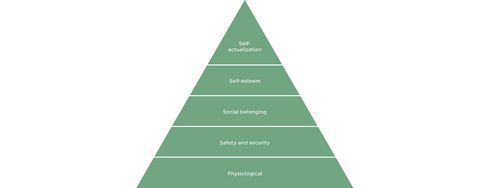
An understanding of how users think and how they behave in response to sensory information is essential to design, but at the heart of human actions is the desire to satisfy certain needs. Abraham Maslow, an American psychologist (1908–1970) and prominent advocate of viewing people in terms of their drives as opposed to a "bag of symptoms", provided one of the most well-known accounts of human needs in what we now call 'Maslow's Hierarchy of Needs'. As you can see from the graphic above, Maslow's hierarchy has since been demonstrated in the form of a pyramid to emphasize the increasing complexity of human needs.
Background
Maslow's hierarchy of needs is based on his research of 'exemplary people' (prominent figures throughout the ages who have had a significant impact on our understanding of the world), such as Albert Einstein, Jane Addams, Eleanor Roosevelt, and Frederick Douglas. Maslow took this approach, as opposed to the somewhat traditional approach of observing, testing, and researching the mentally ill or neurotic, in an attempt to develop an account of human motivation based on the positive aspects of human psychology. In Motivation and personality (1954) Maslow stated, "...the study of crippled, stunted, immature, and unhealthy specimens can yield only a cripple psychology and a cripple philosophy". In addition to researching the so-called exemplary people, Maslow studied college students who were the healthiest 1% for their particular group. By concentrating on 'healthy' individuals, Maslow intended to provide a more representative account of motivation that would be applicable to the general population, free from the potential biasing effect of using those with some established psychological health problem.
The Levels of Maslow's Hierarchy of Needs
The most basic human needs are shown at the bottom of the hierarchy, and these are the physiological drives that ensure survival, including the need for air, food, water, and sleep. Our physiological needs are then followed by our safety needs, which include protection, security, law, stability, and safety for our loved ones. Assuming the central layer of the hierarchy are our relationship needs or the desire for love and belonging; this level includes the need for family, affection, friendships, and sexual intimacy. Now we have the esteem needs, which include self-esteem, confidence, reputation, and respect for oneself and from others. At the top of the hierarchy or pyramid are the needs connected to self-actualization, which refers to "the curative force in psychotherapy - man's tendency to actualise himself to become his potentialities...to express and activate all the capacities of the organism" (Carl Rogers, psychologist, 1902–1987). Examples of self-actualization include expressing one's individuality, creativity, the quest for spiritual enlightenment, the pursuit of knowledge, and the desire to be a part of society and/or a community.
In order to progress through the levels of needs, we must satisfy the basic physiological needs. This is somewhat obvious, but unless we have food, sleep, shelter, etc., we do not have the energy or time to fulfill our more complex, yet secondary needs. When we are incapable of finding the time and/or energy for these further needs, due to an inability to effectively and efficiently satisfy our physiological needs, we are more likely to experience some negative emotion.
Further work by Maslow brought about a few more levels to the pyramid, resulting in an 8-level need structure as follows; however, for this course, we will focus on the original five levels.
- Biological and Physiological
- Safety
- Love and belongingness
- Esteem
- Cognitive: knowledge and understanding, curiosity, exploration, need for meaning and predictability
- Aesthetic: appreciation and search for beauty, balance, form, etc.
- Self-Actualization
- Transcendence: helping others to achieve self-actualization
Research
Daniel Schacter and his colleague professors of Psychology at Harvard (2011) state that when we are unable to realize our potential, due to these difficulties, or we live a life at odds with our capabilities, we are less likely to be happy than people who achieve a balance between their goals and the lives they achieve. For example, if we show some innate sporting ability, but we are unable to achieve our basic needs, this potential will go unrealized, as we have insufficient physical and mental resources available to us. Henry Gleitman, and his colleague professors of Psychology at Pennsylvania, Stanford and Reed College (2011), stated self-actualization is "...the full realisation of one's potential, and of one's ‘true self’ ". Therefore, according to Maslow's theory of human motivation, contentedness, or true happiness as a human being (over other animals), is achieved when we are able to realize our true potential, but this is only possible when we have successfully tended to our basic, physiological needs.
Maslow's Hierarchy of Needs and Design
User needs are no different from our general needs. For each of the levels of Maslow's hierarchy, we can recognize these needs in the drives displayed by users. Advertising represents one of the clearest examples of Maslow's hierarchy of needs influencing design. It would be quicker to name products that are not advertised using models (male and/or female) to tap into the physiological need for the sex. Such is the power of harnessing the drive presented by human need, even where there is no genuine link between a product and one of the basic physiological needs, that it does not stop advertisers from playing (or should that be preying?) on one or more of them so as to grab our attention and get us to part with our money. Take Richard Branson's failed attempt to get a piece of the soft drink market, with Virgin Cola, which had a bottle design apparently modelled on Pamela Anderson's figure.
Human needs should also be considered when you are trying to highlight the positive aspects of your products. For example, if you are selling drinks, images and text which draw attention to or accentuate the thirst-quenching nature of the product can improve its appeal. Likewise, a package holiday deal can seem a lot more attractive if you show people enjoying a meal and a few drinks (i.e. two physiological needs). Regardless of the product you are working on, it will be for some human need, whether it is to satisfy a physiological, safety, love/belonging, esteem, or a self-actualization need; if there is no need, then you should probably look at starting another project.
The Take Away
Abraham Maslow has provided one of the most prominent accounts of human motivation with the 'Hierarchy of Needs', representing his most well-known contribution to psychology. Maslow researched both 'exemplary people' from the past, such as Albert Einstein and Eleanor Roosevelt, and elite college students. Following these studies, Maslow produced the hierarchy of needs, which consists of five distinct groups of needs: physiological, safety, love/belonging, esteem, or self-actualization. To achieve happiness, we must first satisfy our physiological needs; an inability to do so prevents us from dedicating the time and energy required to satisfy our more complex needs. As designers, we must consider the types of needs we are targeting with our products so as to grab the customer's/user's attention and accentuate the positive aspects of both owning and using them.
References & Where to Learn More
Hero Image: Copyright: the Author, Copyright license and terms: Public Domain
Schacter, D. L., Gilbert, D. T., & Wegner, D. M. (2011). “Human needs and self-actualization”. Psychology, 486-487, Worth, New York.
Gleitman, H., Fridlund, A., & Reisberg, D. (2011). Psychology (8th edn). New York: WW Norton & Company
Maslow, A. H. (1954). Motivation and personality. New York: Harper and Row.