A variety of electric plugs using different standards.

Get to Grips with Constraints

by William Hudson • • 10 min read

477 Shares
Save

Got constraints? Perfect. That’s where great design begins. Just as electrical standards define how a toaster safely works without shaping what it does, your software also lives within boundaries that quietly guide its behavior. Functional requirements describe what your system does: the stories of use, the features your users see. However, non-functional requirements define how it must work: securely, accessibly, and efficiently. When you treat these constraints as design allies rather than obstacles, you make smarter choices, avoid costly rework, and build products that feel solid, consistent, and ready for anything.

In this video, William Hudson, User Experience Strategist and Founder of Syntagm Ltd, explains how constraints, or non-functional requirements, define essential qualities such as accessibility, security, and device support that guide your product’s design.

Transcript

What are Constraints?

Constraints, also known as non-functional requirements, are the conditions or limits that shape how you can design or build your solution. They don’t define what a system does, but rather how it must work, such as performance targets, legal requirements, supported devices, or accessibility standards. In short, constraints set the boundaries within which design and development must operate.

As the diagram below shows, non-functional requirements are split into two kinds of constraints.
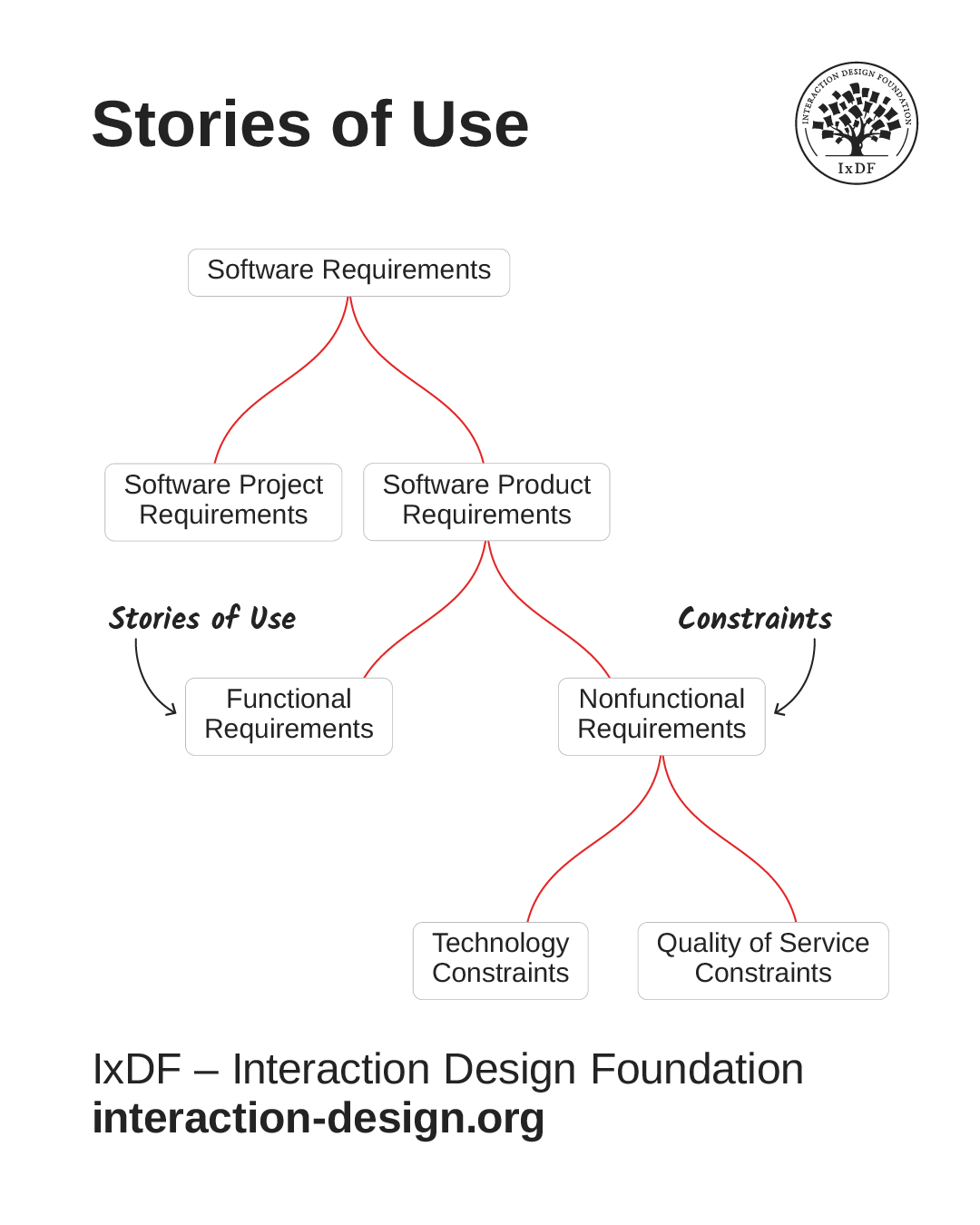
Categories of software requirements showing functional requirements associated with stories of use and nonfunctional requirements as constraints.

Stories of use, such as user stories and use cases, mostly come from functional requirements. However, non-functional requirements are still essential to good UI design. Many of the design decisions you make will be based on constraints, and they will help you avoid rework, feature bloat, and unexpected limitations during handoff.

© Adapted from the Software Engineering Book of Knowledge V4 by Interaction Design Foundation, Fair use

Technology Constraints

Technology constraints have little or no impact on a solution's functionality from a user’s perspective. They're choices about what programming language will be used, what platforms will be supported and other implementation details.

However, some technology constraints are directly relevant to UI design. For example, the decision to support mobile devices will significantly influence how you approach a solution's visual and interface design.

Quality of Service Constraints

Quality of service constraints cover a broad collection of characteristics. Here's a common categorization:

  • Performance

  • Scalability

  • Portability

  • Compatibility

  • Reliability

  • Availability

  • Maintainability

  • Security

  • Localization

  • Usability

Some of these can affect your stories of use directly. For example:

  • Security requirements may mean that your users need to log in each time they access a solution or that they must establish two-factor authentication. An example story of use for this constraint would be, "Rachel chooses her desired form of two-factor authentication."

  • Localization requirements may mean you need to create stories around users choosing the language of interaction.

Notice that the final entry in the list is usability! Since constraints must be measurable, it isn't enough to say that “the solution should be usable.” Instead, you would see a requirement like this: "90% of users must be able to complete key tasks in 60 seconds or less.”

Finally, accessibility isn't explicitly mentioned, but it typically falls under the category of usability. An example requirement would be: “Solution must comply with WAI WCAG 2.x at Level AA.”

Functional vs Non-Functional Requirements: What's the Difference?

An easy way to see the difference between functional and non-functional requirements is with an example, a little simpler than an interactive software solution: a pop-up toaster.

The number of slots in a given model is a functional requirement as it directly affects the stories of use we write about it. For example, "Javier makes toast for his whole family." How the slots are configured is also a functional requirement since that can make it possible for two people to use the toaster simultaneously.

On the other hand, the kind of electrical system a toaster is compatible with is a non-functional requirement. A toaster is either made to work in the USA or the UK, or it isn’t. Because the plugs and voltages differ, a toaster made for one country won’t work in the other. Travel adapters don’t help because the voltages are quite different, and the amount of power required is substantial.
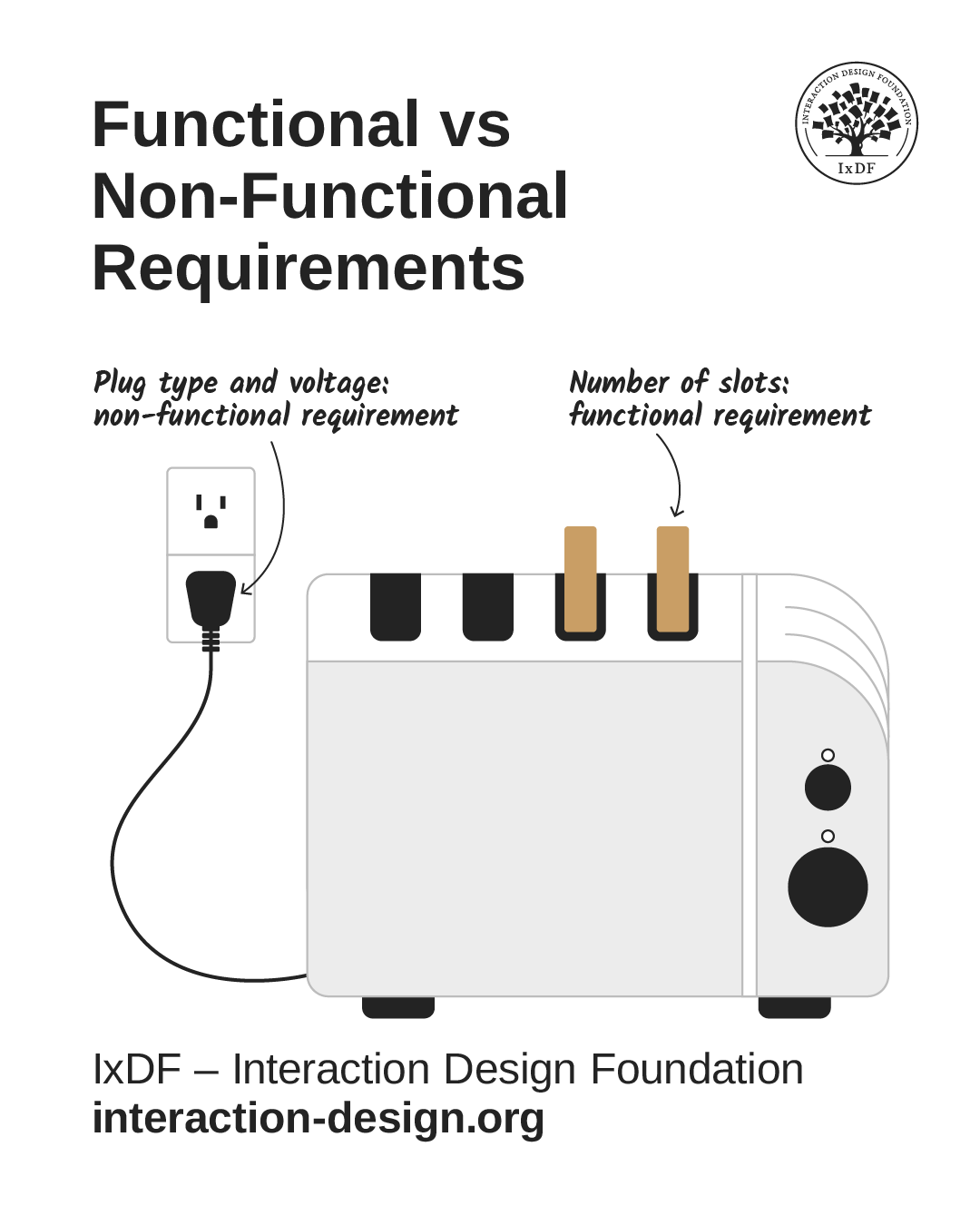
Illustration of a 4-slice toaster with a US-type electrical plug.

Just like software solutions, appliances of any type have many functional and non-functional requirements (constraints).

© Interaction Design Foundation, CC BY-SA 4.0

Many non-functional requirements affect only how a solution is implemented, which has little or no impact on how it works. For example, a social networking solution with end-to-end encryption will have little or no impact on functionality. It’s invisible to users.

The Take Away

Constraints, also known as non-functional requirements, define the essential qualities your solution must meet. They’re grouped into technology constraints and quality-of-service characteristics, such as security, localization, and usability. These aren’t just technical details; they directly shape how your product looks, feels, and performs for users.

When you understand and design with constraints in mind, you prevent surprises later, such as last-minute rework or usability gaps, and ensure your solution works smoothly in the real world. Some constraints may even reveal new or adjusted functional requirements, helping you create designs that aren't only functional but genuinely reliable and user-centered.

When you master this balance between what your system does and how it must work, you can turn limitations into direction and design decisions into lasting value for your users.

Hero image: © Interaction Design Foundation, CC BY-SA 4.0

Learn More in This Course:

Learn Design and AI From the Best

Get one powerful email each week, like 308,941 others.

Next email in:

What You Should Read Next

  • Read full article
    What Does a User Interface (UI) Designer Do? - Article hero image

    What Does a User Interface (UI) Designer Do?

    What’s in every memorable digital experience is a seamlessly navigable website or an app that feels like second nature—and what lies behind those are user interface (UI) designers; they’re the ones who shape the aesthetics and functionality of any digital interface. But what does a user interface de

    Social shares
    614
    Published
    Read Article
  • Read full article
    Should You Choose between Responsive and Adaptive Design? - Article hero image

    Should You Choose between Responsive and Adaptive Design?

    Designers can choose between adaptive and responsive design to bridge the gap between devices and changing user contexts. Here you’ll learn the merits of each approach, so you’re in a great position to select an approach for your project.  What Are the Main Differences Between Responsive a

    Social shares
    565
    Published
    Read Article
  • Read full article
    System Usability Scale for Data-Driven UX - Article hero image

    System Usability Scale for Data-Driven UX

    Ever wondered how the top designers, researchers, and product developers manage to create products that are user-friendly, efficient, and enjoyable—consistently? One of the key things there is what’s called the System Usability Scale (SUS), a vital tool and questionnaire-based method that profession

    Social shares
    967
    Published
    Read Article
  • Read full article
    Don Norman’s Top Tips from the Design for the 21st Century Course - Article hero image

    Don Norman’s Top Tips from the Design for the 21st Century Course

    The design field is evolving. It’s been proven that aside from driving business success and delivering beautiful and successful products, design can be pivotal to solving complex human issues. For instance, GE Healthcare used Design Thinking to improve the MR scanner experience for children—which is

    Social shares
    592
    Published
    Read Article
  • Read full article
    Sustainability Is Not Enough - Article hero image

    Sustainability Is Not Enough

    Sustainable design. Sustainable fashion. Sustainable living. We often hear these terms in marketing campaigns and popular media. But what does sustainability mean and why does pioneer of User Experience Design Don Norman think that sustainability shouldn’t be our goal when we design?In this video, D

    Social shares
    485
    Published
    Read Article
  • Read full article
    Black Friday 2024: Invest in UX Design Education - Article hero image

    Black Friday 2024: Invest in UX Design Education

    “The best investment you can make, is an investment in yourself... The more you learn, the more you'll earn.”—Warren Buffett, Chairman and CEO of Berkshire HathawayHow many items have you added to your Black Friday shopping wishlist? This year, instead of short-term deals on products, why not take a

    Social shares
    564
    Published
    Read Article
  • Read full article
    Why Is AI so Important and How Is It Changing the World? - Article hero image

    Why Is AI so Important and How Is It Changing the World?

    You've heard about AI and all the wonderful (and sometimes scary) possibilities. But unlike sci-fi apocalyptic movies, AI isn't out to destroy humanity. Let's take a look at the challenges and opportunities we face as AI meets design.In this video, Ioana Teleanu, Founder of UX Goodies and former Lea

    Social shares
    487
    Published
    Read Article
  • Read full article
    Who, What, and How: Design Maps Show You the Way for Implementation - Article hero image

    Who, What, and How: Design Maps Show You the Way for Implementation

    For something called a “team project,” it’s amazing how often everyone’s on a different page. Design maps connect the dots. They organize your research, stories of use, and design artifacts into clear, user-centered interfaces that your team can actually build fast. No more “Wait, what did you mean

    Social shares
    403
    Published
    Read Article
  • Read full article
    How Can Designers Adapt to New Technologies? The Future of Technology in Design - Article hero image

    How Can Designers Adapt to New Technologies? The Future of Technology in Design

    The design industry is rapidly evolving with the integration of technologies such as artificial intelligence (AI) and 3D printing. While there may be concerns about job displacement, history has demonstrated that new technologies typically create more job opportunities. Don Norman, author of The Des

    Social shares
    691
    Published
    Read Article
  • Read full article
    Conceptual Models: The Hidden Structure Behind Your Next Great Interface - Article hero image

    Conceptual Models: The Hidden Structure Behind Your Next Great Interface

    Ever wondered why some interfaces feel effortless: like they already know what you’re trying to do, while others leave you guessing? The difference often lies in how well a product’s design matches the way users think. When your interface reflects their mental model, every action feels intuitive, an

    Social shares
    480
    Published
    Read Article

Top Articles

Top Topic Definitions

39% of Today's Skills Will Change by 2030

The World Economic Forum expects 39% of today's skills to be transformed or become outdated by 2030.

The good news is that jobs in UX / UI design and AI are among the fastest-growing professions globally.

Build Skills That Keep You Relevant

Privacy Settings

By using this site, you accept our Cookie Policy and Terms of Use.
Customize
Accept all

Be the One Who Inspires

People remember who shares great ideas.

Share on:

Academic Credibility — On Autopilot

Don't waste time googling citation formats. Just copy, paste and look legit in seconds.

Learn Design and AI From the Best

Get one powerful email each week, like 308,941 others.

Next email in: