Let’s examine a model that finds out how users feel about products (including our designs) and services. Every business uses some method to prioritize product and service features based on user research. As designers, we can count on the simple yet powerful categories defined by the Kano model. When we know what users expect and what literally delights them, we can plan our designs that much better.
Companies that produce and sell goods share one central goal: that their customers will buy, and preferably keep coming back to buy more. The same principle holds true for service providers. Businesses are constantly innovating to keep up with the changing demands of users. The reason for these changing demands is simple — what used to be cool becomes passé in no time, especially in the digital economy. What once was “the next best thing since sliced bread” becomes ordinary, and what used to delight customers becomes basic, expected and needed. Technological advancements seem to have a shorter shelf life now. Herbert Simon, a Nobel Prize economist, wrote: “A wealth of information creates a poverty of attention.” A shorter average attention span means that the “coolest item” changes more often, as if it were a song on the charts. Companies need to watch these trends closely when developing future products and services.
Today, there’s a lot of buzz around “delighting” customers to win their loyalty. That’s easier said than done. Delighting customers is one among many factors that a company needs to consider when designing products and services. How do we identify the factor/s that should take priority over others at a given moment? How do we designers go about delighting our users?
The Power of Purpose and Audience, and how the Kano Model works
As subjective a term as “delight” may sound, it’s a measurable quantity. Professor Noriaki Kano and his colleagues developed the Kano Model in 1984. The model is highly relevant to companies trying to gain a competitive edge in the digital economy. It is a reliable framework to help us work out the features of a product or service that satisfy users at different levels. Professor Kano’s team noted that:
The level of functionality of product features determines the levels of user satisfaction.
Feedback (i.e., questionnaires, surveys) shows the company these levels of satisfaction.
The company can classify any such features into four categories.
Anyone working in proposing, designing and developing large projects that span multiple releases can benefit from this framework. The Kano Model can help everyone, including sales teams, in getting a competitive edge. It’s all about listening to our users and reacting accordingly.
Author/Copyright holder: Management Mania. Copyright terms and licence: All rights reserved Img source
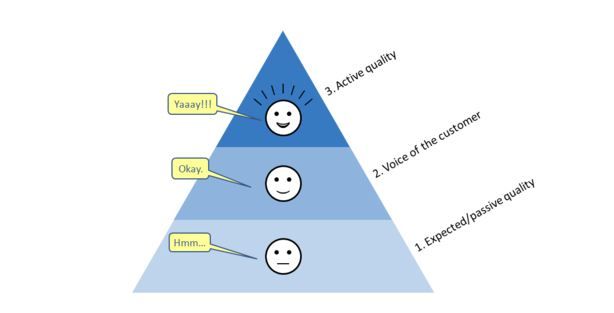
The Kano Model gives us a clear window to seeing users’ expectations. It assumes that user satisfaction at both functional and emotional levels varies over product features. Thus, people react to many aspects of a single product or service, experiencing delight, satisfaction, or frustration. The model breaks these reactions down into distinct categories:
Delighters
Satisfiers
Indifferent
We will plan and design features for a product to make it competitive. However, often the business can’t implement all the features at once due to budget and timeframe restrictions. Here, the company will need to find out which features are best to consider including. It needs criteria to decide which features are likely to have more than a proportional influence on satisfaction, and which ones are must-haves. From what it discovers, it can focus on which features are worth going for in a project, and which are better left out.
Let’s take an example. An airline company has plans for a revolutionary design. Designers have worked all sorts of cool features into it:
Fully reclining seat with moving walls to seal off compartment.
Video conferencing capabilities via large touchscreens in compartment.
Anti-turbulence seat suspension.
Super high-speed WiFi with no deadzones.
These features sound ideal, especially for business travelers, who could work, relax and rest well on long-haul flights. However, the company has four features to implement here. Some will be costly, and they might not be able to implement one due to government regulations (making full-privacy compartments around seats on an aircraft). Therefore, they’ll have to work out which features appeal most to users.
We have a product in the design phase — a business-class mini-cabin — with four proposed features. You as a designer should target the proper combination of features to obtain a high level of user satisfaction. We can use the Kano Model to find out how customers — users — feel about the presence and absence of those features.
A Kano analysis classifies them into Kano categories such as basic needs, delighters, and good to haves. It helps you, as a designer, to identify which features are essential, offer value for money, and delight customers. It also reveals which features aren’t worth taking into account.
The Three Kano Categories We Need To Design With
Basic Needs
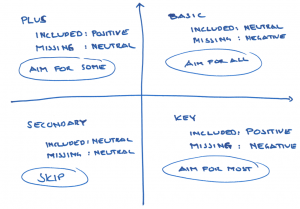
These are features that users expect to see and experience. Their presence does not increase satisfaction, but if they weren’t there, we’d soon hear about it in feedback! For instance, if Tom were going from the city where he worked to his parents’ home town, then his basic expectation would be to arrive there by a certain time. He knows how long it takes, and it’s a typical evening — no bad weather or problems with the trains or track. On arriving, his level of satisfaction would not increase significantly, because he would have had a normal journey. However, if the basic features are not there in a product or service, then customers will feel dissatisfied. If Tom’s train journey were delayed by several hours, he would become dissatisfied with the train service. Negative impacts like this can happen in any product or service. With viewable feedback more visible than ever, users can make judgments quickly. If a product or service doesn’t meet those all-important basic needs, users won’t make the purchase. On the chart below, we find Basic Needs in the lower quadrants.
Satisfiers (More is better)
These are features that users want as opposed to expect. Their presence will satisfy users, preventing them from feeling dissatisfied. The satisfaction is proportionally linked to level of fulfillment. Customers are happier when they get more. For example, the higher the car mileage or broadband speed, the more satisfied they’ll be.
Satisfiers are wonderfully straightforward looking. We see them represented in the straight blue arrow on our chart below. They portray a nice, direct relationship between the functionality of a product and the satisfaction our users will feel. On Tom’s next train journey, he might note these as satisfiers:
Nice clean, quiet compartment.
No other stops made (no other passengers got off on the way) = faster journey.
Although he finds these aspects pleasing, Tom accepts them as possibilities, and he’s had such a satisfying journey before — a couple of weeks earlier.
Delighters
Users don’t expect features that delight them. Consequently, if these features are not there, customers will not be dissatisfied. However, if they are present, they can easily have the biggest influence on the customers’ level of satisfaction. For instance, when Apple launched the iPhone, the touchscreen was unexpected and a delight to use. On Tom’s train ride, a delighter could be the point that, as the train is virtually empty, the driver announces that everyone may use the first-class compartments. Tom certainly wasn’t expecting that!
Shift from delight to expectation
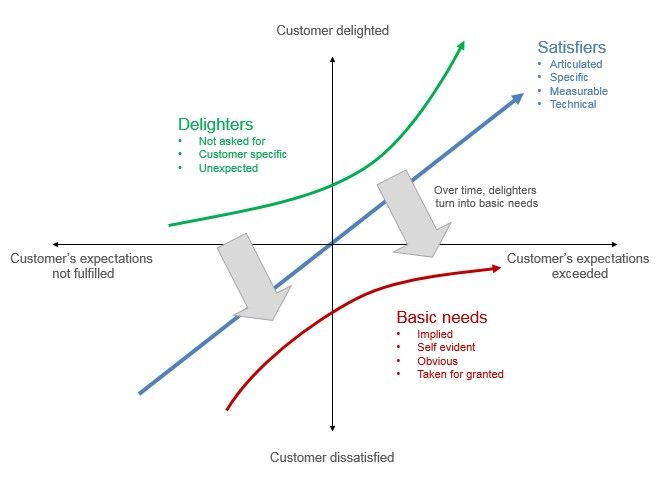
Kano predicted that users’ perceptions of satisfaction with a feature will shift from delight to expectation over time. This is either because they have got used to it or because competitors have started to include it in their offerings. In the case of the touchscreen, for instance, the newness that came with the iPhone is no longer a novelty; the touchscreen has become the norm. It’s no big deal anymore, but taking it away would be a big deal!
Figure 1: Kano’s customer satisfaction model
Kano Analysis
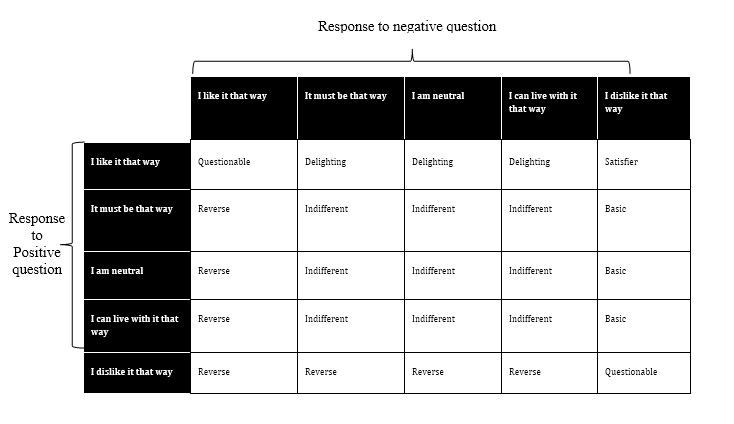
The simplest method of doing a Kano Analysis is to ask customers two simple questions for each attribute:
Rate your satisfaction if the product has this attribute? (Positive Question)
Rate your satisfaction if the product did not have this attribute? (Negative Question)
For each of these questions, the customer can have five different responses; these responses help in getting a sense of expectation about the attribute. Responses to both the answers are then combined in an evaluation table. Here’s an example from research done by Erin MacDonald, Martin Backsell, Richard Gonzalez, and Panos Papalambros in 2006.
Positive Question:
If the toothbrush’s bristles can vibrate at a variety of speeds, how would you feel?
I like it that way.
It must be that way.
I am neutral.
I can live with it that way.
I dislike it that way.
Negative Question:
If the toothbrush’s bristles always vibrate at the same speed, how would you feel?
(same responses)
Kano classification table for positive and negative questions
How the Kano Model pinpoints new opportunities
Let’s illustrate how the Kano Model can help a business. Tri-Me, Inc. (a fictitious company) is a popular supermarket chain, famous for building long-term loyalty with customers. People prefer to buy from Tri-Me, Inc. (online and in-store) because Tri-Me is a cut above the competition.
The “secret sauce”in Tri-Me’s success is knowing the pulse of its customers through user research techniques. Tri-Me regularly invites them to give feedback through online surveys to find out which are the most attractive features of their products and services. Their analytics team have just analyzed the latest results using the Kano principles. Then they collated these and identified 30 features they needed to implement to strengthen customer loyalty and attract new customers.
The project managers and business account teams faced a dilemma. They knew they couldn’t implement all 30 features. That would be too expensive and take too long. They were looking for answers to questions like:
How should we prioritize these features?
Which set of features is a shortlist of the best features?
Which features would go above being satisfiers?
Which ones are must-haves?
Which of the delighter features border on becoming satisfiers or even basic needs?
Using the Kano Model to classify features into Kano categories, the analytics team began by interpreting user response—their feelings about the presence and/or absence of different product and service features. The Kano Model helped them identify and categorize which features are essential, value for money, delightful, and irrelevant. The analysts soon discovered the following additional features in each category:
Two in the delighter category: Same-day free home delivery and the addition of an organic fresh vegetable section.
Two in the basic needs category: Resolution of complaints within 24 hours and opening hours from 8:00 AM to 9:00 PM seven days a week.
One in the satisfier category: Staff assistance to elderly and handicapped customers.
Tri-Me used the Kano Model to get an honest response from customers to help identify key product and service features. They found new pockets of opportunities and introduced targeted offerings and services to customers they understood better. The company was able to improve customer service where it mattered the most. Thus, it could stay ahead of its competitors.
To return to our aircraft design, the company would need to find out from users — business-class passengers — which features would be delightful. Having a private mini-cabin in which to enjoy restful sleep might blow many of them away. However, this might impact that all-important basic needs category. What if the mini-cabin is too confined and claustrophobic?
The bed-seat with turbulence-resistant suspension (shock absorbers) and faster, reliable internet speed will be great satisfiers. The ability to have live, big-screen video conferencing in the mini-cabin could also be a satisfier. However, this would depend on the surveys. Would closer, potentially more constant contact between airline users and their companies/clients be beneficial? The data will tell.
The Take Away
Every business uses some method to prioritize product and service features based on its own research. But the old methodologies and frameworks may not be enough anymore. In the digital economy, customer preferences are changing so rapidly that businesses need a more robust yet flexible methodology. The one built into the Kano Model to examine the features of products and services on an ongoing basis is crucial for knowing which features still delight customers and which ones border on becoming satisfiers or even basics.
The easy-to-use, powerful Kano Model categorizes these. It enables company executives to prioritize requirements that help to make a product or service stand out and delight users in the marketplace. Every part of a business inhabits a world of specific budgets and timelines. The principles of the Kano Model are timeless. Businesses must keep up with users on the go and understand their changing moods, interests, likes, dislikes—all in real time.
Used effectively, the Kano Model helps businesses make strategic investment decisions based on the invaluable insights they gain about user behavior. That gives them a competitive edge in the market. We designers need to keep our fingers on the same pulse. Goalposts are moving all the time. Fashion is fickle, as are our users. They can’t help becoming delighted or disappointed at how we’re designing for them. It’s vital to bring the Kano Model to bear on the situation and stay one step ahead.
Where to Learn More
Original reference of the model: Kano, Noriaki; NobuhikuSeraku, Fumio Takahashi, Shinichi Tsuji (April 1984).“Attractive quality and must-be quality,” Journal of the Japanese Society for Quality Control (in Japanese) 14 (2): 39–48. ISSN 0386-8230. For a translation, see Jan Moorman, "Leveraging the Kano Model for Optimal Results," Article No. 882 October 9, 2012, accessed April 20, 2015.
Zacarias, D. (2015). “The Complete Guide to the Kano Model – Prioritizing Customer Satisfaction and Delight”. Folding Burritos.
Geldman, A. (2014). “What Delights Your Customers? Use the Kano Model to Find Out”. Web Retailer.
Mind Tools Editorial Team (2015). “Kano Model Analysis – Delivering Products that Delight”. Mind Tools.
Hero Image: Author/Copyright holder: Crisp's Blog. Copyright terms and licence: All rights reserved. Img