Eight-week website project timeline maps designer and client milestones from initial meeting through research, design, development, testing, and launch

What is Information Architecture?

• 4 min read

742 Shares
Save

This week, we’re going to take a step back and define some of the terminology that relates to User Experience design and its related fields. Each day we’ll look at one term and what it means and then at the end of the series – we’ll tie in how it all relates to User Experience design.

What is Information Architecture?

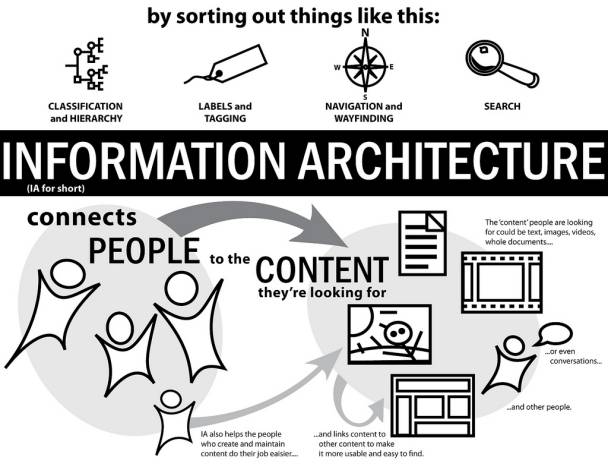
When it comes to the User Experience it’s not the technical infrastructure of information that we’re interested in nor are we interested in how the systems that we use to hold the data store that data; what we are interested in is how that data is presented to the user.

That means at the “big picture” view we’re concerned with how applications and websites display and organize data to our users. So we define what data will be held on any given page and then we determine how each page relates to other pages. One of the easiest ways to begin this process is to define a site map; this allows us to group pages together and helps determine the best structure to present them in.


Author/Copyright holder: Murray Thompson. Copyright terms and licence: All rights reserved Img source


Information architecture brings several challenges to the user experience designer and one of the biggest is how to bring together like terms so that they are sensibly classified. This is also known as “defining taxonomies” which sounds rather more complicated, doesn’t it? These taxonomies help us develop menus and other navigational structures to deliver a better user experience.

To get these taxonomies right; it’s a good idea to get involved in user research. This might be a structured interview to try and clarify how a user might approach a given data set. Or if the data sets are already defined and we want to test how logical they feel for the user – we might use card sorting techniques to see if the users group data in the same way that we did.


Author/Copyright holder: Conversion Rate Experts. Copyright terms and licence: All rights reserved Img source


Then there’s the tricky problem of incorporating pre-existing taxonomies. Big retailers, for example, will generally already have these defined for other systems and won’t be too happy if we mess about with them without some sort of overarching reason to do so. This can mean a careful examination of the existing taxonomy to ensure that menus, boxes, links, etc. can fully represent each taxonomy clearly without squashing data or omitting it entirely.

The best information architects will likely come from a background where they already have some experience in manipulating data. Librarians are a good example of this and so are DBAs (Data Base Administrators). The advantages of using a DBA include the ability to match your technical/system limitations to the user’s needs and achieve a “best fit” between the two to for an improved user experience when the perfect experience isn’t quite feasible.

Header Image: Author/Copyright holder: Unknown. Copyright terms and licence: Unknown. Img

Learn More in This Course:

Learn Design and AI From the Best

Get one powerful email each week, like 313,901 others.

Next email in:

What You Should Read Next

  • Read full article
    Don Norman: How You Can Rapidly Move Up by Thinking in Systems (Not Features) - Article hero image

    Don Norman: How You Can Rapidly Move Up by Thinking in Systems (Not Features)

    How can you move up in a company? Learn the fundamentals of business such as statistics, finance, accounting, marketing, supply chain and administration. How do you do that? One way to do this is to get a Master of Business Administration (MBA) degree. But Don says you can also learn them without go

    Social shares
    611
    Published
    Read Article
  • Read full article
    How to Find Your Voice: Speak with Confidence and Clarity - Article hero image

    How to Find Your Voice: Speak with Confidence and Clarity

    You’ve heard it before “It’s not what you said—it’s how you said it.” Your voice can change how people feel—even if your message doesn’t. If you vary your tone and pacing, you can make your ideas sound more trustworthy, exciting, or urgent. Harness this neuroscience-backed communication power and yo

    Social shares
    451
    Published
    Read Article
  • Read full article
    Avoid Death by PowerPoint: Structure Your Slides for Maximum Impact - Article hero image

    Avoid Death by PowerPoint: Structure Your Slides for Maximum Impact

    Your message is ready, your delivery honed. Now, how do you put that brilliance on slides? Discover how to structure your slide deck strategically so that it supports your message, whether you present live or share it for independent review.Whether you're pitching to stakeholders, leading a team mee

    Social shares
    424
    Published
    Read Article
  • Read full article
    Use Feedback as Your Superpower: Learn, Improve, Shine - Article hero image

    Use Feedback as Your Superpower: Learn, Improve, Shine

    Feedback: the word alone can inspire apprehension. Yet, it’s the lifeblood of great design. Whether it’s subtle critique or blunt rejection, how you respond to feedback matters more than you think. You can defend your design—or you can use that moment to learn, improve, and show you're the kind of p

    Social shares
    340
    Published
    Read Article
  • Read full article
    Overcome the Self-Doubt That Stops You from Being an Excellent Presenter - Article hero image

    Overcome the Self-Doubt That Stops You from Being an Excellent Presenter

    Do you doubt your ability to speak up, thinking you’re not the public speaking type? Many people do. But the truth is, most beliefs about presentation skills are simply wrong. Let’s break down these myths and boost your confidence—you’ve got far more potential than you think.In the next video, Morga

    Social shares
    314
    Published
    Read Article
  • Read full article
    Present Like a Pro: Become a Designer Who Leads - Article hero image

    Present Like a Pro: Become a Designer Who Leads

    Your ideas are only as powerful as your ability to communicate them. You can design the perfect solution ... but if nobody understands it, cares about it, or champions it? It goes nowhere. If you can master presentation skills, you’ll open new doors in your design career, access new opportunities, a

    Social shares
    321
    Published
    Read Article
  • Read full article
    Presentation Pitfalls and How You Avoid Them - Article hero image

    Presentation Pitfalls and How You Avoid Them

    You’ve worked hard on your ideas—don’t let simple messaging missteps keep them from landing. Make your brilliant ideas shine in every presentation by deftly sidestepping common messaging missteps, and give your hard work the influence it deserves every time.Morgane Peng, Head of Product Design & AI

    Social shares
    330
    Published
    Read Article
  • Read full article
    How to Change Your Career from Software Development to UX Design - Article hero image

    How to Change Your Career from Software Development to UX Design

    Most people believe that an aesthetic sense or a formal education in visual design is necessary to become a user experience (UX) designer. This perception unfortunately becomes an obstacle for software developers who want to switch their career to UX design.If you’re a software developer who wants t

    Social shares
    727
    Published
    Read Article
  • Read full article
    Design League Savings, AI Tutor, and Pricing Updates - Article hero image

    Design League Savings, AI Tutor, and Pricing Updates

    Rikke and I started IxDF in 2002 with nothing. We lived in a bamboo hut in Thailand with no investors, no safety net, and no plan B. We had a conviction that world-class design education should not be a privilege reserved for people who could afford a $15,000 degree.That conviction has never changed

    Social shares
    169
    Published
    Read Article
  • Read full article
    If You Don’t Fail, You’re Not Trying Hard Enough - Article hero image

    If You Don’t Fail, You’re Not Trying Hard Enough

    In some cultures, people never recover from failure, and Don Norman says this is wrong. In other cultures, failure is seen as a way to learn. David Kelley, the founder of design firm IDEO, once said, “Fail faster, succeed sooner.” Don says this is good, but encourages us to take it one step further,

    Social shares
    606
    Published
    Read Article

Top Articles

Top Topic Definitions

39% of Today's Skills Will Change by 2030

The World Economic Forum expects 39% of today's skills to be transformed or become outdated by 2030.

The good news is that jobs in UX / UI design and AI are among the fastest-growing professions globally.

Build Skills That Keep You Relevant

Privacy Settings

By using this site, you accept our Cookie Policy and Terms of Use.
Customize
Accept all

Be the One Who Inspires

People remember who shares great ideas.

Share on:

Academic Credibility — On Autopilot

Don't waste time googling citation formats. Just copy, paste and look legit in seconds.

Learn Design and AI From the Best

Get one powerful email each week, like 313,901 others.

Next email in: