The self-generation effect describes how information is better remembered when it is self-generated as opposed to passively consuming or interacting it. Successful companies such as Microsoft and Electronic Arts design customization tools that are built into many of the great products we use today. These tools reflect the importance of utilizing the phenomenon of the self-generation effect. When you incorporate this phenomenon into your designs, you will be able to create more memorable user interfaces.
Self-Generation Effect
Your constantly-updated definition of Self-Generation Effect and collection of videos and articles.
Be a conversation starter: Share this page and inspire others!
Get 1 Powerful Email Each Week
Join 313,908 subscribers.
What is Self-Generation Effect?
Learn More About Self-Generation Effect
Make learning as easy as watching Netflix: Learn more about Self-Generation Effect by taking the online IxDF Course User Experience: The Beginner's Guide.
Why? Because design skills make you valuable. In any job. Any industry.
Earn Industry-Recognized Certificates
Industry giants trust our courses to train their teams, and prestigious universities integrate our content into their curricula. Add your certificates to your LinkedIn profile, résumé, and job applications.




All Free IxDF Articles on Self-Generation Effect

The Self-Generation Effect: How to Create More Memorable User Interfaces
Learn how to improve user experience by incorporating the self-generation effect in your user interface design. The self-generation effect is prompted in many of the customization tools built into some of the most widely-used products out there. This phenomenon provides users with a sense of control
- Social shares
- 674
- Published
Read Article
The Self-Generation Effect: How to Create More Memorable User Interfaces
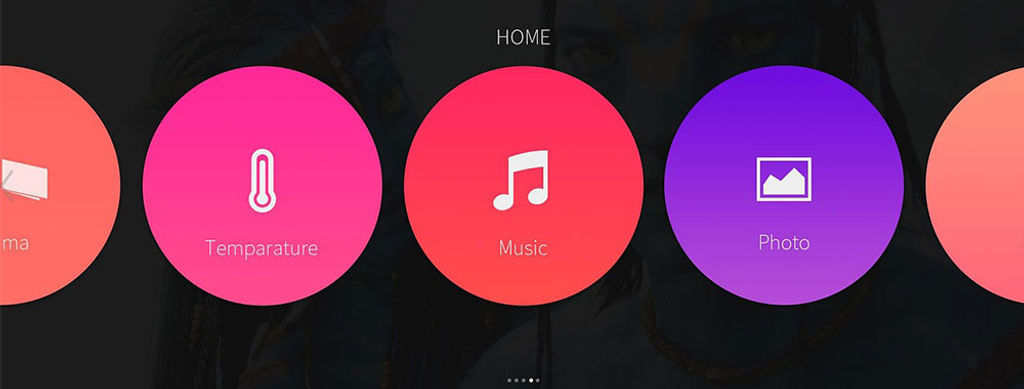
Learn how to improve user experience by incorporating the self-generation effect in your user interface design. The self-generation effect is prompted in many of the customization tools built into some of the most widely-used products out there. This phenomenon provides users with a sense of control as they customize their own tools and functionalities. Adobe Photoshop, Microsoft Word, EA Sports game controller settings, and Logitech MX Series mice are just a hand-full of the many popular products that have the self-generation effect reflected in their designs. This article will teach you how the self-generation effect applies to user interface design and give you ideas on how to incorporate it into your own designs by reviewing examples from both software/web and physical products.
The Self-Generation Effect
The self-generation effect describes how information is better remembered when it is self-generated as opposed to passively consuming or interacting with it. It is a robust phenomenon, studied by various cognitive science researchers including Norman Slamecka and Peter Graf (1978), that is observed across a variety of recall exercises involving verbal information, pictures, as well as arithmetic problems.
One theory for the self-generation effect is the lexical activation hypothesis, explored by cognitive scientists John Gardiner and James Hampton (1985). It explains that more semantic memory involvement is required in the process of generating information than the simple act of reading. Gardiner and Hampton proposed the lexical activation hypothesis based on three experiment results that support their theory. One experiment tested participants on a homogeneous set of letter bigrams, a sequence of two adjacent elements from a string of letters. The result was that recall performance was considerably worse when learning meaningless bigrams than when learning meaningful well-known abbreviations. The second experiment tested participants on both unitized and nonunitized numbers (e.g., 25 vs. 2, 5). The result showed the self-generation effect appears for the recall of unitized but not for the nonunitized numbers. In a third experiment examined by Gardiner and Hampton, participants were tested on both familiar and unfamiliar word pairs forming compound nouns, nouns made up of two or more words. They found that the self-generation effect occurs only when meaningful, familiar words pairs (e.g., cheesecake) were presented to participants but not for meaningless, unfamiliar words pairs (e.g., cheese ketchup).
Based on the lexical activation hypothesis, it seems as though we need to encourage the act of self-generating information in order to increase the sense of meaning it has as opposed to letting our users passively consume information. If you want your users to have better recall every time they log in to your app, or have a better experience every time they play the game you designed, then you may want to encourage them to set up (or self-generate) components of the product on their own. Because as far back as the 19th century, people have known that:
“If you want a thing done well, do it yourself.” – Napoleon Bonaparte
There are also many arguments against the self-generation effect, as various experiment results have tried to explain away the phenomenon by stating that when a participant is imagining the content when reading, they recall things (to retrieve from memory) just as well as when they are asked to self-generate. There have also been studies where the advantages of the self-generation effect are eliminated when participants are given instructions on how to process the information when reading, leaving the recall result just as effective as self-generation.
Nonetheless, it is important to understand how to incorporate self-generation into your user interface designs in order to improve user experience, as reflected in a variety of successful products designed by some very successful companies.
4 Examples of how the Self-Generation Effect Should Influence User Experience Design
We already know that, through our experiences in school, “testing yourself” by generating quiz questions or creating flash-cards is a great way for us to remember everything from historical dates to biological terminology. But what does it look like in user interface and product design?
1. Customizable Workspaces in Adobe Photoshop
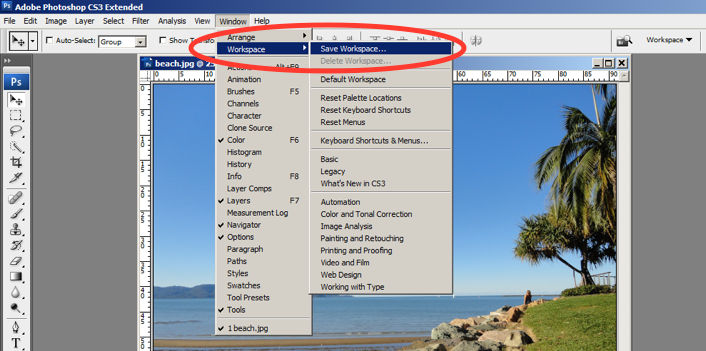
Adobe Photoshop created by Adobe Systems Incorporated, the large North American computer software company, is a great example of how making use of the self-generation effect in user interface design can result in widely popular and successful products. One of the many reasons for frequent users to love Photoshop is for its flexibility and efficiency created through self-generated workspaces. Users are able to utilize its flexibility by organizing and adding to their workspace, as well as making things more efficient by saving it for future use. That way, users are better able to remember where their tools are located, which serves to be a better user experience due to having less memory and cognitive friction involved for the end-user each time they open the application.
Author/Copyright holder: Adobe Systems Incorporated. Copyright terms and licence: Fair Use.
Photoshop allows for self-generation through giving users the ability to create and save their preferred workspace-setup.
2. Customizable Toolbar in Microsoft Word
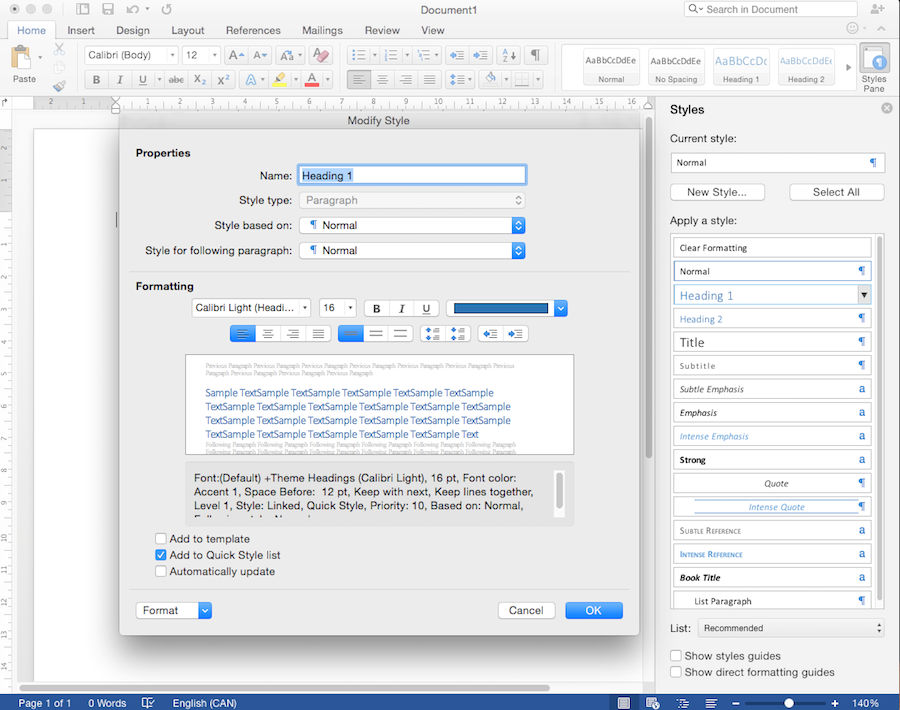
Microsoft Word created by Microsoft Corporation, one of the most successful technology companies in the world, is another great example of how empowering your users to customize their toolset can lead to a product that still remains one of the most commonly used word processor software in the market, decades after it was first released. In Microsoft Word, users are able to create, modify, and save various text formats and styles so that they can configure the appearance of their writing however they choose.
 Author/Copyright holder: Microsoft Corporation. Copyright terms and licence: Fair Use.
Microsoft Word gives users the ability to create, modify and save different word formats and styles. This reflects an understanding of the self-generation effect on the part of the designer.
3. Customizable Console-Controls in FIFA
Software and web application customization isn’t the only user interface examples that showcase how incorporating the self-generation effect can improve user experience. The positive effects of customization and self-generation can be seen in a variety of physical products as well. The controller used for the video game, FIFA created by one of the most widely known game publishers in the world, Electronic Arts, Inc., is a great example of how users can feel even more excited and immersed in the game when you incorporate self-generation.
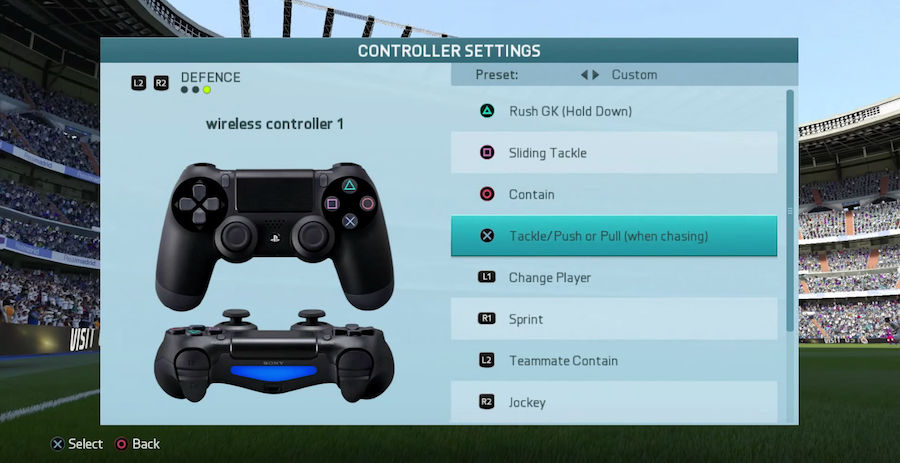 Author/Copyright holder: Electronic Arts, Inc. Copyright terms and licence: CC BY-NC-SA 2.0
FIFA gives users more control over how they play the game by allowing them to customize the buttons and settings of their game controller.
4. Customizable Buttons in Logitech MX Master Wireless Mouse
The Logitech MX Master Wireless Mouse by Logitech International S.A. is another great example of how a physical product can be designed to allow for user customization in order to bring about the self-generation effect and provide a greater user experience for the consumer.
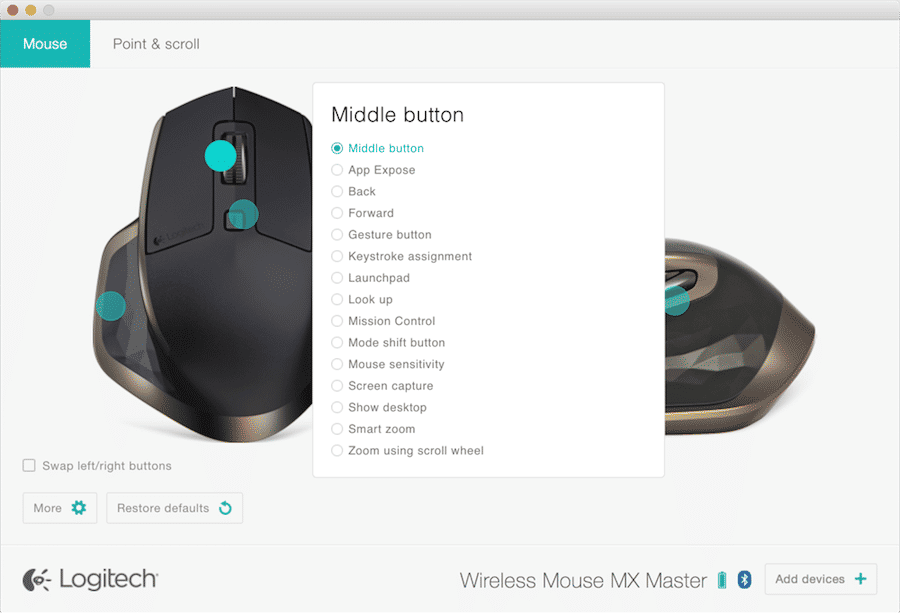 Author/Copyright holder: Logitech International S.A. Copyright terms and licence: Fair Use.
Logitech MX Master Wireless Mouse makes their user’s life easier by providing more control over how they want to customize their mouse, generating their own functionalities, in order to experience greater productivity and efficiency when using their product.
The Take Away
Leveraging your understanding of human cognition and understanding how to ease the memory and learning process for your users can help you improve on your user experience designs. Enabling customization in your product interface, especially when it contains many possible functions or commands, can really benefit your users as the tools and functionalities can evolve in line with their increased proficiency over time. Always remember to keep in mind the difficulties that exist in human learning and think about how you can make things easier by hand-holding your users through the learning process as well as providing flexibility in any user interface you design.
References & Where to Learn More
To find more information, dig into ‘The Generation Effect: Delineation of a Phenomenon’ by Slamecka and Graf (1978).
‘Semantic Memory and the Generation Effect: Some Tests of the Lexical Activation Hypothesis’ by Gardiner and Hampton (1985).
Hero Image: Author/Copyright holder: bh_style. Wikimedia. Copyright terms and license: Public Domain