In the Ideation stage, design thinkers spark off ideas — in the form of questions and solutions — through creative and curious activities such as Brainstorms and Worst Possible Idea. In this article, we’ll introduce you to some of the best Ideation methods and guidelines that help facilitate successful Ideation sessions and encourage active participation from members.
When facilitated in a successful way, Ideation is an exciting process. The goal is to generate a large number of ideas — ideas that potentially inspire newer, better ideas — that the team can then cut down into the best, most practical and innovative ones.
“Ideation is the mode of the design process in which you concentrate on idea generation. Mentally it represents a process of “going wide” in terms of concepts and outcomes. Ideation provides both the fuel and also the source material for building prototypes and getting innovative solutions into the hands of your users.”
– d.school, An Introduction to Design Thinking PROCESS GUIDE
The main aim of the Ideation stage is to use creativity and innovation in order to develop solutions. By expanding the solution space, the design team will be able to look beyond the usual methods of solving problems in order to find better, more elegant, and satisfying solutions to problems that affect a user's experience of a product.
 Author/Copyright holder: Teo Yu Siang and Interaction Design Foundation. Copyright terms and licence: CC BY-NC-SA 3.0
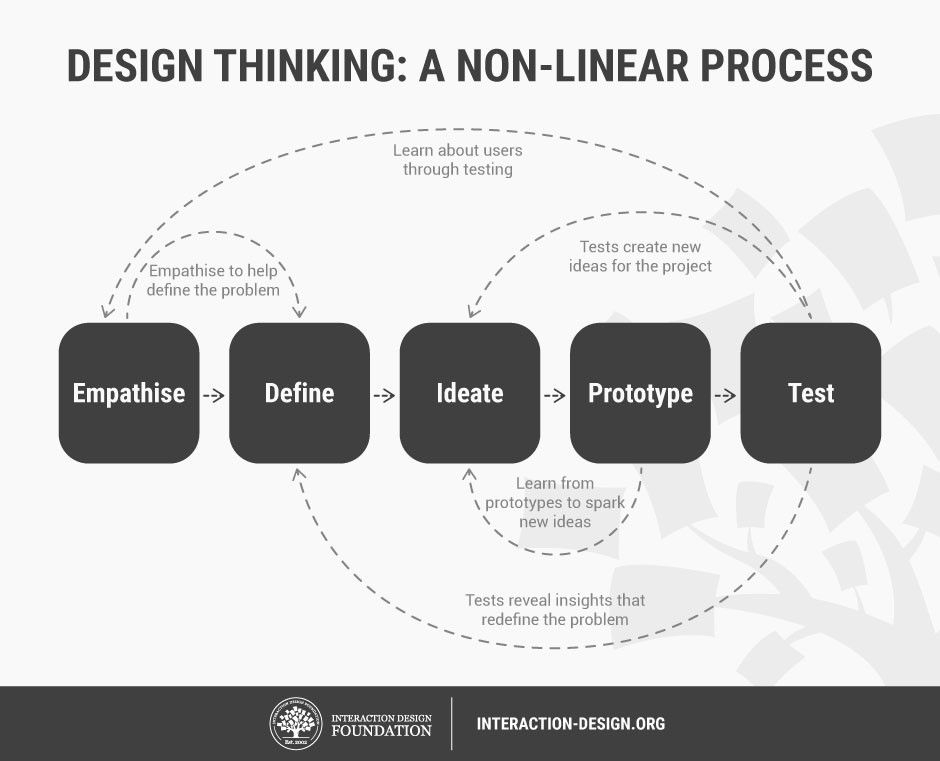
In the Design Thinking process, the Ideation stage often follows the first two stages, which are the Empathise stage and Define stage. There is a significant overlap between the Define and Ideation stages of a typical Design Thinking process. Interpreting information and defining the problem(s) and ideation both drive the generation of problem solutions. This overlap is represented in the types of methods design teams employ during these two stages. For example, Bodystorm and “How Might We” questions are often used in both of these stages.
Ideation Will Help You:
Ask the right questions and innovate.
Step beyond the obvious solutions and therefore increase the innovation potential of your solution.
Bring together perspectives and strengths of team members.
Uncover unexpected areas of innovation.
Create volume and variety in your innovation options.
Get obvious solutions out of your heads, and drive your team beyond them.
Ideation Methods to Spark Innovative Ideas
There are hundreds of ideation methods. Some methods are merely renamed or slightly adapted versions of more foundational techniques. Here you’ll get brief overview of some of the best methods:
Brainstorm
Mindmap
Analogies
Provocation
Movement
Bodystorm
Gamestorming
Crowdstorm
Co-Creation Workshops
Prototype
Creative Pause
Active Facilitation
Although many of us may have previously participated in a Brainstorm session, it is not always easy to facilitate a truly fruitful ideation session, which may be the reason why many of us have had negative experiences in the past. However, Ideation sessions can indeed be fun and exciting, but they demand a lot of preparation and team member concentration in order to be fruitful. To sit the team down with a blank piece of paper and ask them to come up with ideas will likely result in failure. Likewise, to have everyone shout out their own ideas is likely to result in failure.
People need guidance, inspiration and activities, in a physical and cognitive manner, in order to get the process started. Ideation is a creative and concentrated process; those involved should be provided with an environment that facilitates free, open, and the non-judgemental sharing of ideas.
In Ideation sessions, it’s important to create the right type of environment to help create a creative work culture with a curious, courageous, and concentrated atmosphere. Instead of using a boardroom with the CEO sitting at the head of the table, Design Thinking and Ideation sessions require a space in which everyone is equal. The Ideation room must have sufficient space for people to feel comfortable, but the atmosphere shouldn't be sterile, and team members shouldn't have to shout in order to be heard. You should also designate someone to take down contributors' ideas and draw/write them on the whiteboard/wall/poster. If the process begins to slow down and people seem to be running into a dead-end, the facilitator should impose constraints, such as: "what if there was no top-level navigation bar?" or "How-might-we go about the task if we were 8 years old?" Alternatively, you might want to set targets, such as filling a brainstorming sheet within ten minutes. To start understanding what it takes to facilitate a successful Ideation session, we’ll take a closer look at the best Brainstorming rules.
Brainstorming Rules
 Author/Copyright holder: Teo Yu Siang and Interaction Design Foundation. Copyright terms and licence: CC BY-NC-SA 3.0
At its most basic level, a Brainstorm session involves sprouting related points from a central idea. Brainstorming is one of the primary methods employed during the Ideation stage of a typical Design Thinking process. Brainstorming is a great way to generate many ideas by leveraging the collective thinking of the group, engaging with each other, listening, and building on other ideas. This method involves focusing on one problem or challenge at a time, while team members build on each other’s responses and ideas with the aim of generating as many potential solutions as possible. These can then be refined and narrowed down to the best solution(s). Participants must then select the best, the most practical, or the most innovative ideas from the options they’ve come up with.
We’ve summarised the best practices and brainstorming rules from the Institute of Design at Stanford (d.school) and the successful design company, IDEO who celebrates Design Thinking.
Set a time limit
Start with a problem statement, point of view, possible questions, a plan, or a goal and stay focused on the topic: Identify the core subject or the main aim of the exercise. For example, what are you trying to achieve? Are you trying to improve a certain feature? Are you focusing on ways to improve the overall experience? Condense the main issue into a problem statement and condense it into a short “How Might We” sentence. You may even be able to synthesise this into single word. Your ideas should always branch off from this central headline.
Stay on Topic: It is easy to veer off and take lots of different directions during brainstorming sessions, especially when you are trying to be open-minded and unconstrained in your efforts to come up with ideas. It is important that members stay on topic. Focus is essential; otherwise, the process can become confusing, or ideas can become muddled and cross between solutions for other problems. Every effort should be made by the facilitator to keep members on the central theme and goal. You might even want to designate a particular brainstormer to maintain the thread and prevent team members veering off course.
Defer judgement or criticism, including non-verbal: The brainstorming environment is not the time to argue or for questioning other members’ ideas; each member has a responsibility to foster relations that advance the session. For this reason, judgement comes later so rather than blocking an idea, you and your other team members are encouraged to come up with your own ideas that sprout off from those provided by the other members of your team.
Encourage weird, wacky and wild ideas: Once again, as brainstorming is a creative activity, each member should try to encourage other members and create an environment in which they feel comfortable verbalising their ideas. Free thinking may produce some ideas that are wide off the mark, but brainstorming is about drawing up as many ideas as possible which are then whittled down until the best possible option remains.
Aim for quantity: Brainstorming is effectively a creative exercise, in which design thinkers are encouraged to let their imaginations run wild. The emphasis is on quantity, rather than quality at this stage.
Build on each others' ideas: One idea typically leads on from another; by considering the thoughts, opinions, and ideas of other team members during the brainstorming session, new insights and perspectives can be achieved, which then inform one's own ideas. Thus, the team will continue to build ideas which hopefully become progressively more refined and targeted towards the central issue.
Be visual: The physical act of writing something down or drawing an image in order to bring an idea to life can help people think up new ideas or view the same ideas in a different way. The brainstorming session is more likely to evolve if team members visualize and bring ideas to life rather than rely on discussion alone.
One conversation at a time: Design thinkers (or brainstormers) should focus on one point or conversation at a time so as not to muddy their thinking and lose sight of the thread or current objective.
Advance Your Career With This Free Template for “Brainstorming Rules”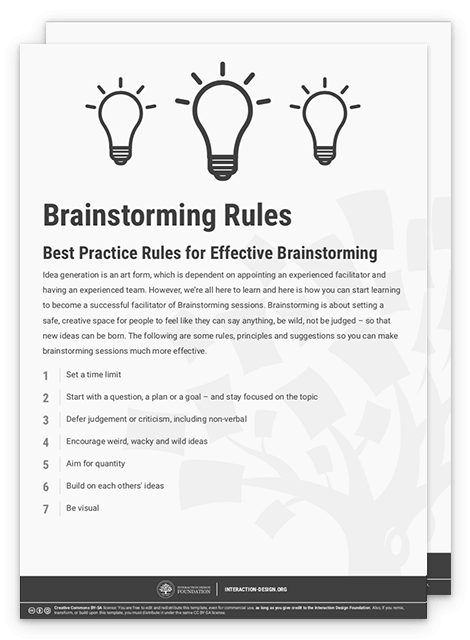
Ideation Methods to Select Ideas
Once the Ideation session is complete, the ideas must be collected, categorized, refined, and narrowed down, so the team is able to select the best solutions, ideas, and strategies from a shortlist. These methods can help you select the best idea at the end of an Ideation session:
Post-it Voting or Dot Voting.
Four Categories Method
Bingo Selection
Idea Affinity Maps
Now Wow How Matrix
Six Thinking Hats
Lean Startup Machine Idea Validation Board
Idea Selection Criteria
In the following section, we’ll provide you with a brief introduction to some of the best methods.
Post-it Voting or Dot Voting
 Author/Copyright holder: Teo Yu Siang and Interaction Design Foundation. Copyright terms and license: CC BY-NC-SA 3.0
In post-it voting, all members are given a number of votes (three to four should do) in order to choose their favorite ideas. Ideas that are generated in the Ideation sessions are written down on individual post-its, and members can vote by using stickers or a marker to make a dot on the post-it note corresponding to the ideas they like. This process allows every member to have an equal say in choosing from the shortlisted ideas.
Four Categories Method
 Author/Copyright holder: Teo Yu Siang and Interaction Design Foundation. Copyright terms and license: CC BY-NC-SA 3.0
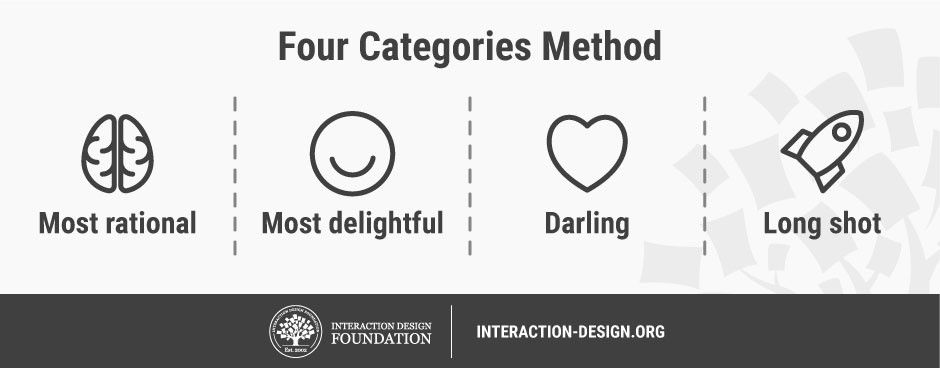
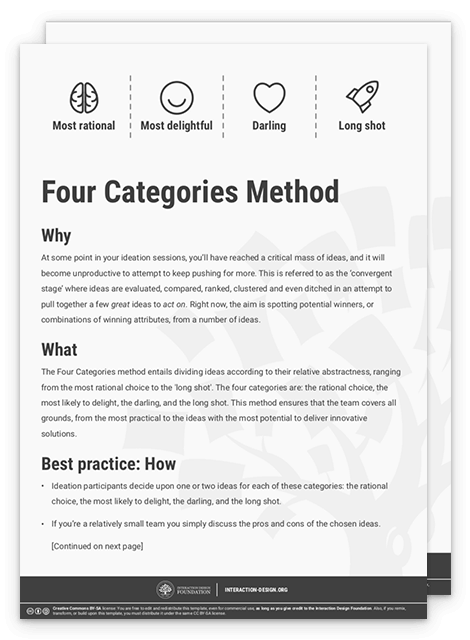
The four categories method involves dividing ideas according to their relative abstractness, ranging from the most rational choice to the 'long shot' choice. The four categories are the rational choice, the most likely to delight, the darling, and the long shot. Members then decide upon one or two ideas for each of these categories. This method ensures that the team covers all grounds, from the most practical to those ideas with the most potential to deliver innovative solutions.
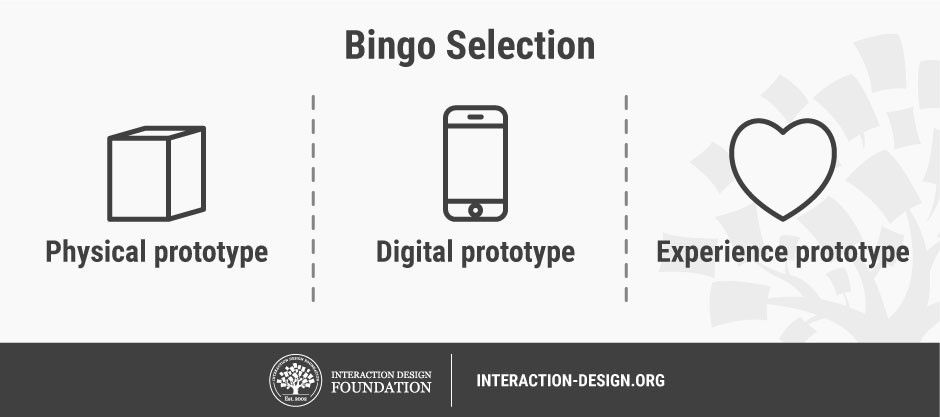
Bingo Selection
 Author/Copyright holder: Teo Yu Siang and Interaction Design Foundation. Copyright terms and license: CC BY-NC-SA 3.0
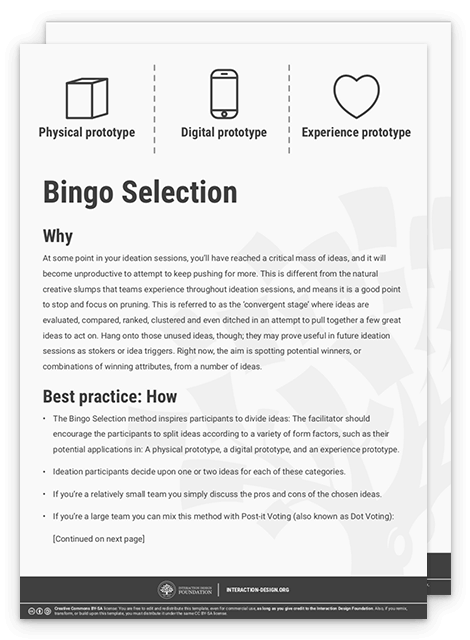
Similarly, the Bingo selection method inspires members to divide ideas. However, in this method, contributors are encouraged to split ideas according to a variety of form factors, such as their potential application in a physical prototype, a digital prototype, and an experience prototype.
The Take Away
Ideation is often the most exciting stage in a Design Thinking project because almost unrestrained free thinking can occur within the given field. In the Ideation stage, the aim is to generate a large number of ideas — ideas that potentially inspire newer, better ideas — which the team can then filter and narrow down into the best, most practical, or most innovative ones. There are many great methods that can help the design team during the Ideation sessions.
References & Where to Learn More
Course: “Design Thinking - The Ultimate Guide”.
IDEO U: Brainstorming.
d.school: “How might we” questions.
d.school, An Introduction to Design Thinking PROCESS GUIDE.
Hero Image: Author/Copyright holder: Adriadne. Copyright terms and license: CC0