Ideation is at the heart of the Design Thinking process. There are literally hundreds of ideation techniques, for example brainstorming, sketching, SCAMPER, and prototyping. Some techniques are merely renamed or slightly adapted versions of more foundational techniques. Here you’ll get an overview of the best techniques as well as when and why to use them.
“Ideation is the mode of the design process in which you concentrate on idea generation. Mentally it represents a process of “going wide” in terms of concepts and outcomes. Ideation provides both the fuel and also the source material for building prototypes and getting innovative solutions into the hands of your users.”
– d.school, An Introduction to Design Thinking PROCESS GUIDE
How to Ideate
You ideate by combining your conscious and unconscious mind. You combine your rational thoughts with your imagination. The following techniques are the most essential techniques, which can help you and your team ideate:
The Most Essential Ideation Techniques: Which Ideation Techniques Should You Choose?
Due to the nature of ideation, it is extremely important to make use of techniques that match the type of ideas you're trying to generate. The techniques you choose will also need to match the needs of the ideation team, their states of creative productivity and their experience in ideation sessions.Here is an overview of the most essential ideation techniques:
Brainstorm
During a Brainstorm session, you leverage the synergy of the group to reach new ideas by building on others’ ideas. Ideas are blended to create one good idea as indicated by the slogan “1+1=3”. Participants should be able to discuss their ideas freely without fear of criticism. You should create an environment where all participants embrace wild ideas and misunderstanding, and which will allow you to reach further than you could by simply thinking logically about a problem.
Braindump
Braindump is very similar to Brainstorm, however it’s done individually. The participants write down their ideas on post-it notes and share their ideas later with the group.
Brainwrite
Brainwriting is also very similar to a Brainstorm session. However, the participants write down their ideas on paper and, after a few minutes, they pass on their own piece of paper to another participant who’ll then elaborate on the first person’s ideas and so forth. Another few minutes later, the individual participants will again pass their papers on to someone else and so the process continues. After about 15 minutes, you will collect the papers and post them for instant discussion.
 Author/Copyright holder: Marco Arment. Copyright terms and licence: CC BY 2.0
Brainwriting is very similar to a Brainstorm session. However, the participants write down their ideas and then after a few minutes they pass on their own paper to another participant who’ll then elaborate on the first person’s ideas and so forth.
Brainwalk
Brainwalk is similar to Brainwriting. However, instead of passing around the paper, the participants walk around in the room and continuously find new “ideation stations” where they can elaborate on other participants’ ideas.
Worst Possible Idea
Worst Possible Idea is a highly effective method that you can use to get the creative juices flowing and help those who are not so confident in expressing themselves by flipping the brainstorm on its head. It’s a lot of fun too. Instead of going for good ideas and putting the pressure on, call for the worst possible ideas your team can come up with. Doing this relieves any anxiety and self-confidence issues and allows people to be more playful and adventurous, as they know their ideas are most certainly not going to be scrutinised for missing the mark. It's way easier to say, “hey, no that's not bad enough” than the opposite. A great variation of this called the bad ideas method encourages you to generate a large quantity of bad ideas.
Challenge Assumptions
Take a step back from the challenge you're tackling and ask some important questions about the assumptions you have about the product, service, or situation where you're trying to innovate. It is particularly effective to challenge assumptions when you are stuck in current thinking paradigms or have run out of ideas. Therefore, it is good for re-booting a flagging session. Are the characteristics we take for granted about these things really crucial aspects, or are they just so because we've all become accustomed to them?
Mindmap
Mindmapping is a graphical technique in which participants build a web of relationships. To get started with the simplest form of mindmapping, the participants write a problem statement or key phrase in the middle of the page. Then, they write solutions and ideas that comes to their mind on the very same page. After that, participants connect their solutions and ideas by curves or lines to its minor or major (previous or following) fact or idea.
Sketch or Sketchstorm
Throughout ideation sessions, a valuable exercise is to express ideas and potential solutions in the form of diagrams and rough sketches instead of merely in words. Visuals have a way of provoking further ideas and providing a wider lens of thinking. The idea with sketching out ideas is not to develop beautiful drawings worthy of framing and mounting on the wall. The sketches should be as simple and rough as possible with just enough detail to convey meaning. This also helps preventing people from becoming attached to their little works of art.
You can rely on sketching, a proven design tool, to help you explore your design space more fully, and avoid the pitfalls of focusing on suboptimal design choices ahead of time. More particularly, sketches can assist you in the design process by helping you to think more openly and creatively about your ideas. They can help you create abundant ideas without worrying about their quality. Sketches will help you invent and explore concepts by being able to record ideas quickly. Sketches will make it easier for you to discuss, critique, and share your ideas with others. That’s why sketches are a great tool to help you and your team to choose which ideas are worth pursuing.
 Author/Copyright holder: Jen Gallardo. Copyright terms and licence: CC BY-NC-ND 2.0
Sketches should be as simple and rough as possible with just enough detail to convey meaning.
Storyboard
Stories are a key medium for communication, learning, and exploring. Storyboarding is all about developing a visual story relating to the problem, design, or solution which you want to explain or explore. Storyboarding can help you bring a situation to life, it can show what happens over time, and explore the dynamics of a situation. You can use storyboarding after having empathised with people in order to better understand their lives. You can draw out their stories. Storyboards can help you represent information you gain during research. Create scenarios consisting of pictures and quotes from users. If you are developing ideas, you may then seek to play with different scenarios to see where they go. Develop a coherent storyline with actors and a plot. Try to build tension and include unexpected surprises in your story. Evoke emotions and show struggle and by the end learning and solving the tensions and leaving the user satisfied.
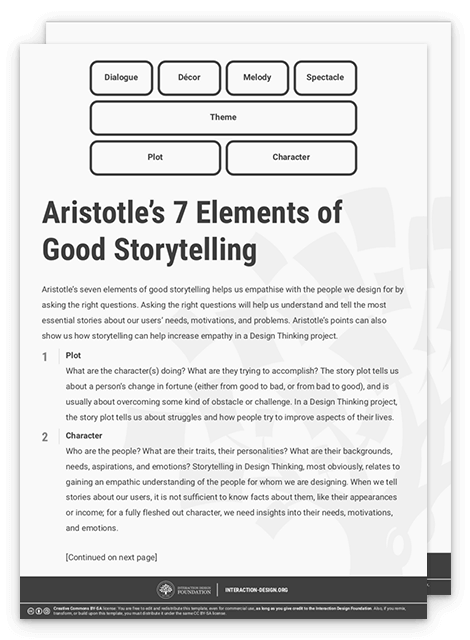
When you’re creating your storyboard you can seek inspiration in the method called “Aristotle’s seven elements of good storytelling” which you can download, print and use as your guide.
Advance Your Career With This Free Template
for “Aristotle's 7 Elements of Good Storytelling”
Bodystorm
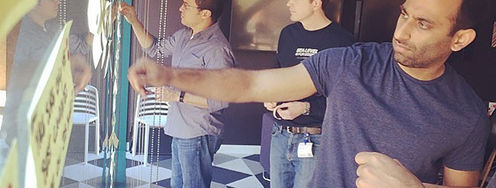
Bodystorming is a technique in which participants physically act out situations they are trying to innovate within. It may involve expressing solutions to ideas through physical activity, or enacting some of the problem scenarios that we are attempting to solve. Physically acting out processes, scenarios and events helps get the ideation team physically involved instead of theorising about the problems. It combines aspects of empathy, brainstorming, and prototyping into one exercise with increased energy and movement, which helps stimulate higher energy and more meaningful experiences.
Bodystorming may include setting up the entire ideation space with props and artifacts, to recreate some semblance of the real environment in order to test out various scenarios and see how this may change the situation. The process may also include setting up various steps in a customer's journey.
Analogies
Storytellers, journalists, artists, leaders and all kinds of other creative professions have relied on creating analogies as a powerful tool for communicating and sparking ideas. An analogy is a comparison between two things for instance a comparison of a heart and a pump. We communicate using analogies all the time as they allow us to express our idea or to explain complex matters in an understandable and motivating way.
Provocation
Provocation is a lateral thinking technique, which challenges the status quo and allows you to explore new realities to extreme degrees. Lateral thinking distances itself from the classic method for problem solving where we work out the solution step-by-step from the given data.
Creativity is all about journeying through stimuli with a possibly abstract or unseen destination in mind. The route of the journey is unknown and most often requires you to explore multiple paths in order to arrive at the unknown destination. Provocations provide this mechanism for injecting the unconventional into the thinking patterns and exploration process. Provocations do not themselves lead directly to a final solution in most cases, although they do provide the material from which the new idea may be formed.
SCAMPER
SCAMPER is a lateral ideation technique that utilises action verbs as stimuli. It helps us ask seven kinds of questions to come up with ideas either for improvements of existing products or for making a new product.
Movement
The movement technique will also help you if you’re blocked in your idea generation. You can use this technique to step around the roadblocks in your thinking. As the Provocation technique Movement will help you force your team to question the status quo, shock yourself and your team into a new reality. This is the perfect “what if?” tool. Lateral thinking techniques do not always immediately result in concrete or usable ideas, but create a wide array of thinking stimuli, which you can leverage for piecing together practical ideas. To make use of the stimuli generated, it requires movement, or what some refer to as insight or principle mining. This tool will help you spot themes, principles, useful attributes or trends in your thinking, which you can use to build up a more viable and realistic ideas.
Gamestorming
Gamestorming is a set of ideation and problem-solving methods that are purposely gamified in order to dramatically increase levels of engagement, energy, and collaboration during group sessions. It involves some of the methods we've already mentioned, while adding gamification.
A few examples of gamified ideation sessions include:
Fishbowl: An ideation session in which participants sit in two circles, one smaller and one larger surrounding the smaller one. Participants in the inner circle discuss their ideas and brainstorm while participants in the outer circle listen, observe, and document the ideas and conversation points without saying anything. This forces some to listen and others to engage in brainstorming.
The Anti-Problem: The idea is based on flipping the problem. In the Anti-Problem is the opposite of the real problem that needs to be solved. In this session you seek to solve the anti-problem. This may provide inspiration that you could not have gotten access to by focusing purely on the real challenge, though it may generate ideas which are still related to the problem space. The ideas you generate can then be re-flipped to bring them back into the realm of the real problem.
Cover Story: This involves using a template that forces participants to create a cover story, including main image, headline, quotes, and sidebars with associated facts etc. It is a good method for vision generation sessions and helps create a cohesive picture of a broad subject area using the primary characteristics.
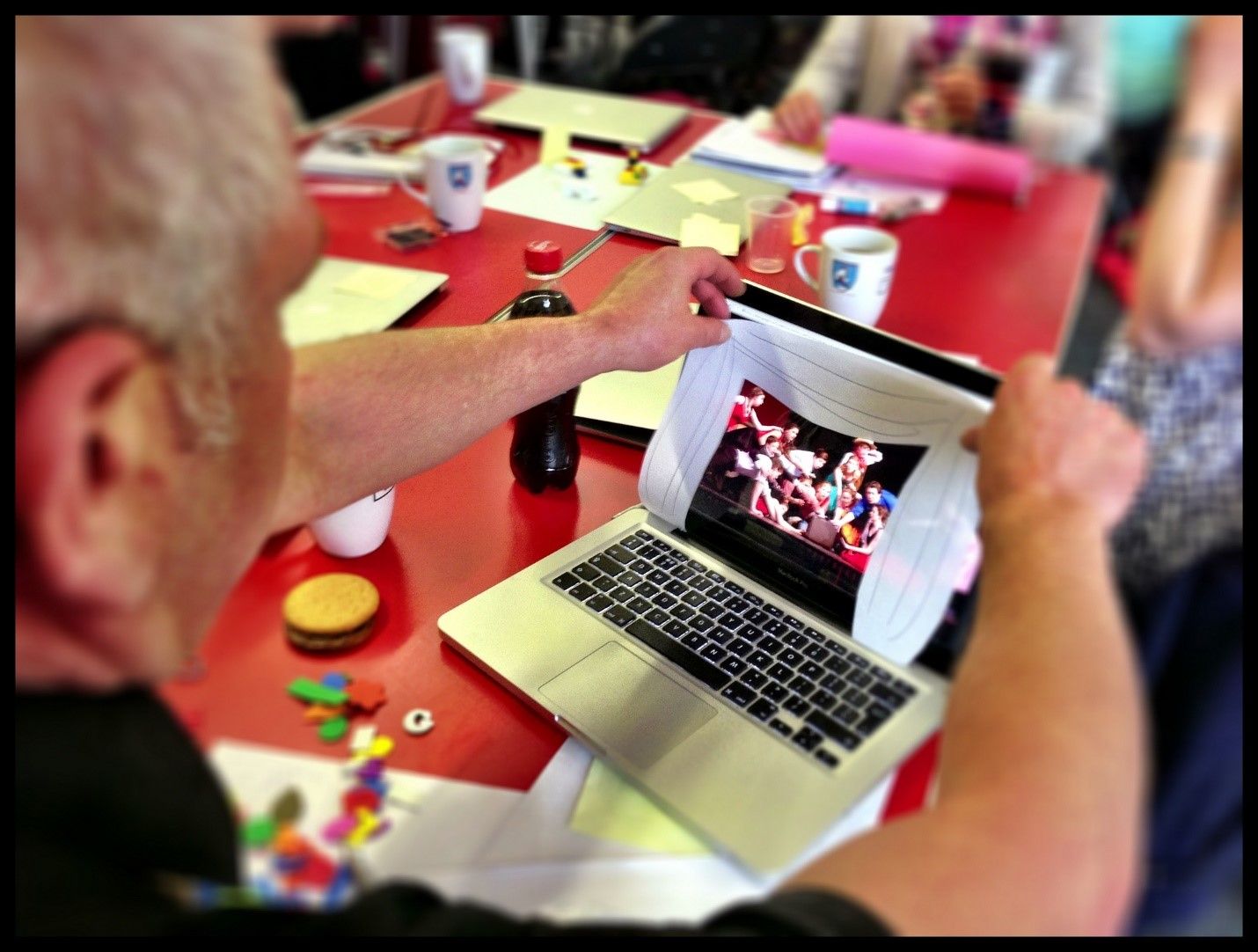 Author/Copyright holder: Ewan McIntosh. Copyright terms and licence: CC BY-NC 2.0
Cheatstorm
Cheatstorming is less about coming up with new ideas and more of an early ideation technique for taking existing pools of ideas and leveraging them as input or stimulus. Unlike other ideation methods where the bulk of ideas generated are discarded, cheatstorming is a bit like cognitive sustainability, reusing and not wasting previously ideated material.
Crowdstorm
Another storm to consider involves the target audience to generate or comment and approve generated ideas. Customer or user feedback is important at every stage of the process and involving them to pick and evaluate ideas can lead to identifying possible winners or losers, which the team might have missed due to blind spots. Social media, customer surveys, focus groups and co-design workshops are all methods of getting the crowd to share their thoughts on the generated ideas. This process may not provide an ultimate winner but it will reveal valuable insights that can assist in the daunting decision relating to which ideas to proceed with.
Co-Creation Workshops
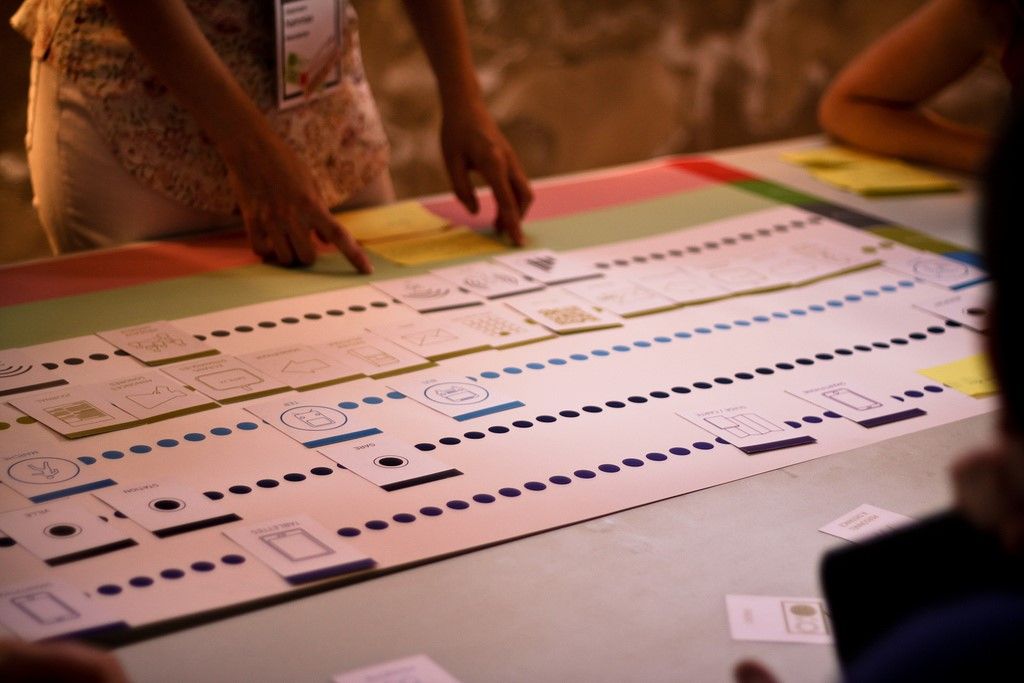 Author/Copyright holder: Swanny Mouton. Copyright terms and licence: CC BY-NC 2.0
There are times when combining customer or user empathy research, ideation, and prototyping might prove useful when rapidly combined.
There are times when combining customer or user empathy research, ideation and prototyping might prove useful when rapidly combined. Co-creation or Co-design workshops combine a number of Design Thinking methods over the course of a few hours to days or even weeks. They can be condensed into full day workshops and conducted a number of times at different locations in order to expedite findings and ideas from the target community. These sessions, if used as one-off workshops, usually follow a sequence that includes:
Prototype
Prototyping itself can be an ideation technique. When you create a physical object you need to make decisions and this encourages the generation of new ideas. You build to think.
Creative Pause
An important step in any ideation process or session is what Edward De Bono refers to in his book, Serious Creativity as the creative pause. When our neurons are firing away against a seemingly impenetrable brick wall challenge, we can easily get stuck into unconstructive thinking patterns. We become anchored to an early idea or stream of thought, or get caught up in negative thoughts surrounding the process. A creative pause gives us time to take a step back, reflect, extract ourselves from the traps we've cognitively set for ourselves, and re-approach the challenge with renewed freshness of the mind. We want proactive thinking to lead the way – not reactive thinking, which often has a negative orientated spin to it.
 Author/Copyright holder: tsaiproject. Copyright terms and licence: CC BY 2.0
Creative pauses help us to not get anchored to an early idea or stream of thought or get caught up in negative thoughts surrounding the process. A creative pause gives us time to take a step back, reflect, extract ourselves from the traps we've cognitively set for ourselves, and re-approach the challenge with renewed freshness of the mind.
The Take Away
Ideation is at the heart of the Design Thinking process. There are literally hundreds of ideation techniques. Here we’ve provided you with an overview of the best techniques as well as when and why to use them. Due to the nature of ideation, it is extremely important to make use of techniques that match the type of ideas you're trying to generate. The techniques you choose will also need to match those of the ideation team members, their states of creative productivity, and their experience with ideation sessions.
References and Where to Learn More
Hero Image: Author/Copyright holder: Braden Kowitz. Copyright terms and licence: CC BY-SA 2.0
Edward De Bono. Serious Creativity: Using the Power of Lateral Thinking to Create New Ideas, 1993
Gabriela Goldschmidt. Chapter 9 Visual Analogy- a Strategy for Design Reasoning and Learning
Dave Gray. Gamestorming: A Playbook for Innovators, Rulebreakers, and Changemakers, 2010