MatchDog Build Your Portfolio Project: Preliminary Analysis and Conceptual Model Definition

by Daniel Rosenberg • 7 min read

450 Shares

Project Brief

Review the full project brief for MatchDog.

You may draw ideas from the examples in the book regarding various MatchDog conceptual model options. The book intentionally scaffolds this project with examples and discussion within the framework layer chapters. However, you are the designer, and the CM should reflect your desired and optimized grammar. The CM is your idealized view that you communicate to the user, which may be different from the samples in the book. The Grammar chapter contains 5 sample user stories to get you started.

Goal of This Exercise

Because UX Magic is a dedicated deep dive on just the design portion of the product lifecycle, you will need to first take on the role of the Product Manager and User Researcher to generate additional requirements artifacts that will lead into the synthesis process to inform the entire project before focusing specifically on the GUI screen design.

Activities You’ll Perform in This Exercise

In this step, you’ll carry out a:

  • Functional analysis;

  • User story generation; and

  • Conceptual Model Definition.

Equipment You’ll Need in This Exercise

  • A computer with a word processor

  • Microsoft PowerPoint and/or Excel

  • Pen and paper, if you prefer to write your notes and analysis on paper

Preliminary Analysis to Generate Additional Requirements

  1. Review the MatchDog design brief. The brief enumerates the high-level functional requirements.

  2. Review the personas provided. They reflect the majority of user empathic needs categories.

  3. Step into the role of product manager and draft up to 50 user stories to complete the first UX synthesis step. Your input is the design brief, but you could also do your own user research with potential pet owners if you have time and resources.

  4. Convert your user stories to a conceptual grammar by abstracting (highlighting) the nouns, verbs and adjectives. This defines the candidate list for your objects, actions and attributes.

  5. Minimize the number of candidate objects by determining if they can be pivoted to become an attribute of some other object.

  6. Drop any object that smells like a UI design pattern (e.g., Calendar, Feed, Chart). These are not appropriate, and you would be starting the next phase prematurely if you kept any.

  7. Drop any non-transactional actions from the grammar.

  8. Make business/market policy assumptions for the organization. The exact decisions don’t matter, since this is not a real product. What does matter is that you gain experience in optimizing your design to support the marketing assumptions and business objectives you set in advance.

MatchDog: Conceptual Model Definition

Use your favorite spreadsheet to create the templates (or the ones provided in our template below) for the matrices and tables needed to define and refine your conceptual model. They should look similar to tables 4–7 in the book. Note: table 4, the starting point which is repeated below, is too sparse. Your desired target grammar density is similar to the version in table 5.
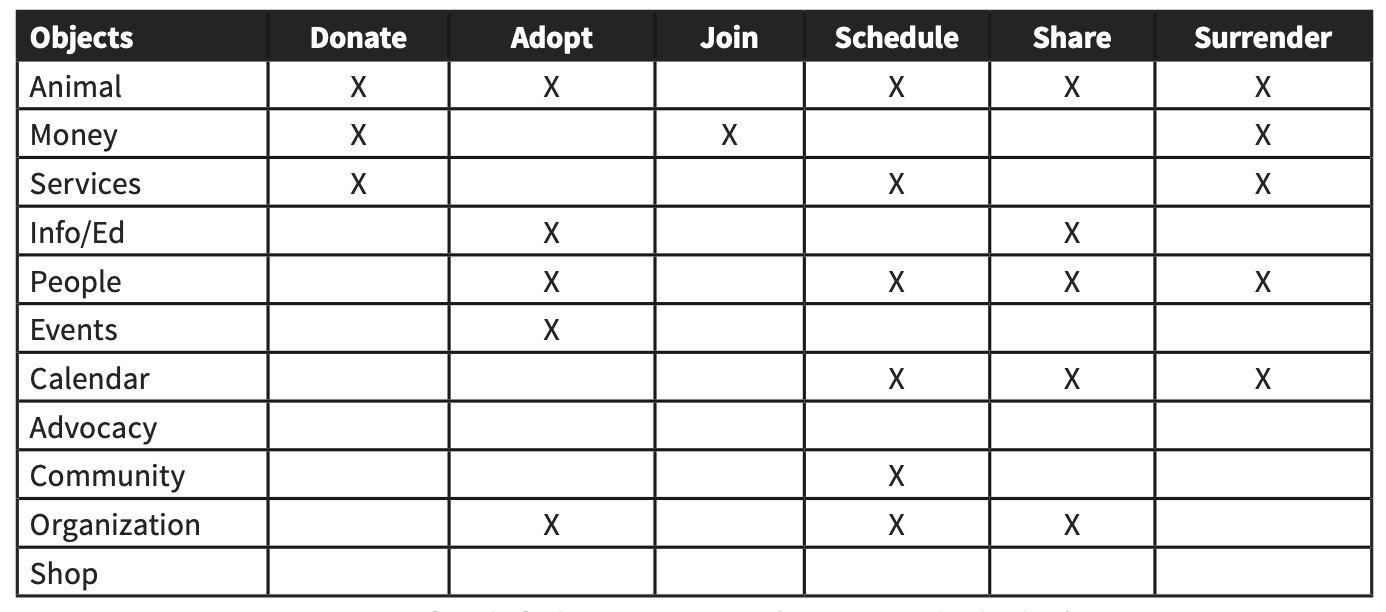
Table 4 from UX Magic: A first-draft Object-Action matrix (too sparse and redundant)

Table 5 from UX Magic: Compact Object-Action matrix
Advance Your Career With This Free Template for “Conceptual Model Templates”
Conceptual Model Templates
We respect your privacy
Get 1 powerful email each week: Design a life you love!

  1. Define your first draft Object-Action matrix.
    Iterate.
    Refine and compact until you achieve a high density. It should not be much bigger than the example shown in table 5.

  2. Make your own decision on the education dimension of the CM. You may refer to tables 11 and 12, which show how task prioritization can affect the conceptual model choices you make. There could be other solutions beyond the two variations shown in these tables.

  3. Try to create an equally dense alternative grammar (optional).

  4. Enumerate as many attributes as possible for each object in the final grammar. You will need to use your imagination because the brief does not include this level of data structure detail. You can learn all about dogs on the web if you don’t own one.

  5. Fill the UX strategy role and make the policy decisions regarding the rules for allowing a pet adoption and qualifying suitable owners.

  6. Create a prioritization matrix that balances the user, business model and UX strategy per the PM decisions you made in the prior steps.

It's important that you don’t start sketching! Try to do the complete CM definition and grammar layer abstractly based on syntax and semantics alone. If you need to sketch UX’s to think through a possible CM definition, you have not internalized this foundational step. You're trying to complete the assignment by reverse engineering. In 7 years of teaching this material in the classroom, we have observed that making this breakthrough to work at the abstract CM level is hardest for those with a background in graphic design and easier for those with a background in the social sciences. Lean on your right brain now; there will be lots of opportunity to leverage your left brain in framework layers 2 and 3. Framework layer 4 will require both left and right brain power.

When you believe your CM is as dense as possible, set it aside for the time being and read the next chapter regarding Visualization and selection of design patterns.

Wrap up This Exercise

Congratulations on completing this first step of the journey to becoming a certified UX Magician. This is by far the hardest step because it involves (for most students and practitioners) a new way of thinking about user experience design through the foundation of interaction semantics. You now have learned the first tool to minimize cognitive load and have taken the first step on the path to creating a UX design for the MatchDog client with the highest level of usability possible.

Author / Copyright holder: Teo Yu Siang and the Interaction Design Foundation. Copyright terms and license: CC BY-NC-SA 3.0

Learn More in This Course:

AI for Designers

15 days
12 % booked
View Course

What You Should Read Next

  • Read full article
    Stop the Generic Portfolio Trap! Design a Stand-Out Portfolio for Your UX/UI Niche - Article hero image
    Interaction Design Foundation logo

    Stop the Generic Portfolio Trap! Design a Stand-Out Portfolio for Your UX/UI Niche

    Your UX/UI portfolio is your ticket to your dream job, brief or client. It’s your opportunity to show off your expertise, creativity, and the tangible impact of your work. No matter your niche, your portfolio should be as innovative and polished as the projects it represents.Think of your portfolio

    Social shares
    278
    Published
    Read Article
  • Read full article
    Enter the World of Social VR - Article hero image
    Interaction Design Foundation logo

    Enter the World of Social VR

    Our metaverse is big—as in massive and expanding, to be more exact—and there’s plenty of room to trailblaze inside of all of that digital space, so if virtual reality (VR) can teleport, catapult, and integrate human users into brand-new worlds of excitement, discovery, and learning (which it can, by

    Social shares
    559
    Published
    Read Article
  • Read full article
    8 Talks by Women to Inspire UX Designers - Article hero image
    Interaction Design Foundation logo

    8 Talks by Women to Inspire UX Designers

    User Experience design, like so many other disciplines, has a lower representation of women as compared to men. Things are changing now, though. Slowly, but surely. From strategy to tactics and from ideas to actionable tips, here is a curated playlist of talks by, and stories of just some of the mos

    Social shares
    657
    Published
    Read Article
  • Read full article
    UX Storyboards: Ultimate Guide - Article hero image
    Interaction Design Foundation logo

    UX Storyboards: Ultimate Guide

    In user experience design, we use techniques like workshops and interviews to understand users. We turn our research into user stories and process flows. We use personas and wireframes to share our ideas with our teams.But it’s important to remember the real people we design for. We need to know wha

    Social shares
    780
    Published
    Read Article
  • Read full article
    Top 6 Tips to Make Your UX Portfolio Stand Out - Article hero image
    Interaction Design Foundation logo

    Top 6 Tips to Make Your UX Portfolio Stand Out

    Whether you’re a UX designer looking for your first UX job or a seasoned designer looking to further your career, your UX portfolio is arguably one of the most important projects you’ll work on. Your portfolio is the first touchpoint you have with the recruiters; it’s your chance to make an impactfu

    Social shares
    707
    Published
    Read Article
  • Read full article
    3 Reasons Why Accessible Design Is Good for All - Article hero image
    Interaction Design Foundation logo

    3 Reasons Why Accessible Design Is Good for All

    Most designers probably agree that accessibility matters: We want to create designs and interfaces that don’t exclude users with disabilities. There are plenty of obvious moral reasons that accessibility matters, but, unfortunately, accessibility considerations are often one of the first things to g

    Social shares
    767
    Published
    Read Article
  • Read full article
    Stop the Generic Portfolio Trap! Design a Stand-Out Portfolio for Your UX/UI Niche: UX Writing - Article hero image
    Interaction Design Foundation logo

    Stop the Generic Portfolio Trap! Design a Stand-Out Portfolio for Your UX/UI Niche: UX Writing

    A picture may be worth a thousand words, but in UX design the right words are priceless. UX writing guides users, simplifies complex concepts, encourages desired actions, and creates a sense of delight. But how do you demonstrate you can do all of these things? How do you get noticed by hiring manag

    Social shares
    425
    Published
    Read Article
  • Read full article
    Transform Your Creative Process with Design Thinking - Article hero image
    Interaction Design Foundation logo

    Transform Your Creative Process with Design Thinking

    Think about a new user experience (UX) design project at work that your team needs fresh ideas for—you want to create a winning digital product for your users, one that’s desirable, economically viable, and technologically feasible. To start with, you try to understand market trends and consumer beh

    Social shares
    531
    Published
    Read Article
  • Read full article
    Top 5 Customer Journey Mapping Tools (+ Templates) - Article hero image
    Interaction Design Foundation logo

    Top 5 Customer Journey Mapping Tools (+ Templates)

    As the digital world continues to change, you must know more about your customer's journey. Customer Journey maps help you see and analyze how customers interact with your brand. You can improve marketing strategies and customer experiences using them. Let's explore customer journey mapping tools an

    Social shares
    759
    Published
    Read Article
  • Read full article
    Rating Scales in UX Research: The Ultimate Guide - Article hero image
    Interaction Design Foundation logo

    Rating Scales in UX Research: The Ultimate Guide

    Picture this: you’re designing a new app or website and want to know how users feel about it, but you want a good way to get actionable insights from those feelings, fast. Feedback is vital—and the sooner you get it, the better—and that’s why something as direct and visual as a rating scale comes in

    Social shares
    885
    Published
    Read Article

Top Articles

Top Topic Definitions

Feel Stuck?
Want Better Job Options?

AI is replacing jobs everywhere, yet design jobs are booming with a projected 45% job growth. With design skills, you can create products and services people love. More love means more impact and greater salary potential.

At IxDF, we help you from your first course to your next job, all in one place.

See How Design Skills Turn Into Job Options
Privacy Settings
By using this site, you accept our Cookie Policy and Terms of Use.
Customize
Accept all

Be the One Who Inspires

People remember who shares great ideas.

Share on:

Academic Credibility — On Autopilot

Don't waste time googling citation formats. Just copy, paste and look legit in seconds.

Feel stuck? Want Freedom?

Get one powerful email each week, like 322,880 others.

Learn to design a life you love.

Next email in: