Time Management

Your constantly-updated definition of Time Management and collection of videos and articles.
Be a conversation starter: Share this page and inspire others!

105 Shares
Save

Get 1 Powerful Email Each Week

Join 313,907 subscribers.

What is Time Management?

Time management is a productivity skill that depends on organizing your time and then sticking to the schedule.

Time management depends upon higher-order brain regions to organize and plan out the task.

Time management is challenging and elusive for many creative people. Creative people are often perceived as being more likely to be late for a meeting or miss an upcoming project deadline. One theory explaining this behavioral tardiness draws upon the “flow” phenomenon: where you become so immersed in your expertise or art that time just stops!

There are a few tricks that can make learning time management more easy. Firstly, create a reasonable daily schedule. Next, make a calendar and share it with your co-workers, so they know what you are up to and when they can come over to speak. Finally, get into the habit of finishing projects before the deadline! Not only will you conquer time, but also your clients and team-members will love you for it.

Learn More About Time Management

Make learning as easy as watching Netflix: Learn more about Time Management by taking the online IxDF Course Creativity: Methods to Design Better Products and Services.

Why? Because design skills make you valuable. In any job. Any industry.

In This Course, You'll

  • Get excited to innovate and get creative, even when you feel blocked. Learn a repeatable creative approach that'll help you generate strong concepts on demand, break through when you're stuck, and turn your best ideas into solutions users love. In this course, design legend and author of the bestselling book "Human-Computer Interaction (HCI)," Professor Alan Dix, shows you why the best ideas come from a structured process and gives you the toolkit to do it yourself. The World Economic Forum ranks creative thinking among the top skills employers want in any profession, today and through 2030. Whether you're starting out, switching careers, or in a senior role and want a process you can rely on, you'll turn creativity from something that happens to you into something you can switch on. No creative background needed.

  • Make yourself invaluable by mastering a wide range of ideation methods so you never get stuck in one approach. To generate and explore new ideas, you'll apply Bad Ideas, Random Metaphors, and Arbitrary Constraints, and to refine and develop them, you'll apply Embrace Opposites, Multiple Classifications, and Teasing Apart, Piecing Together (TAPT). With Edward de Bono's Six Thinking Hats, you'll learn to guide a team to see a problem from every angle. You'll also learn to build an environment that nurtures creativity and to remove the hidden barriers that hold people back. You won't just have better ideas, you'll help everyone around you have them too. As AI churns out endless options, it's your timeless, human-centered design skills, like understanding people and what they actually need, that ensure your solutions are genuinely new and useful.

  • Gain confidence and credibility with a creative process that helps you be productive even under pressure. You'll learn to plan and time-manage your work so good ideas arrive when you need them, and apply proven strategies to beat procrastination, bias, and fixation. You'll keep momentum going with busywork, recognize when stepping back to let an idea incubate is the smartest move, and tackle big, messy "wicked problems" without stalling. When you hit a wall, you'll know whether to push through, switch to something else, or step away, instead of forcing it. And because your best ideas often arrive in the shower or on a walk, not at your desk, you'll learn simple ways to capture them before they slip away. The result is a process you can rely on, so you deliver strong work whether the spark comes on schedule or not.

  • Craft your personal portfolio with a piece that clearly captures your entire creative process. With optional, hands-on activities, you'll build a case study that shows how you ideate, from a ready-made persona and empathy map through to a fully developed concept. Downloadable templates let you apply your new skills immediately. You walk away able to show employers and clients what a polished mockup alone doesn't: how you actually approach and solve problems.

Learn From Industry Leaders

Master complex skills with proven best practices and toolkits directly from industry leaders. Meet your experts for this course:

  • Alan Dix: Author of the bestselling book "Human-Computer Interaction" and Director of the Computational Foundry at Swansea University.

  • Don Norman: Father of User Experience (UX) Design, author of the legendary book "The Design of Everyday Things," and co-founder of the Nielsen Norman Group.

Earn Industry-Recognized Certificates

Industry giants trust our courses to train their teams, and prestigious universities integrate our content into their curricula. Add your certificates to your LinkedIn profile, résumé, and job applications.

Our clients: IBM, Harvard University, University of Cambridge, NASA, Adobe, Stanford, Massachusetts Institute of Technology, LinkedIn
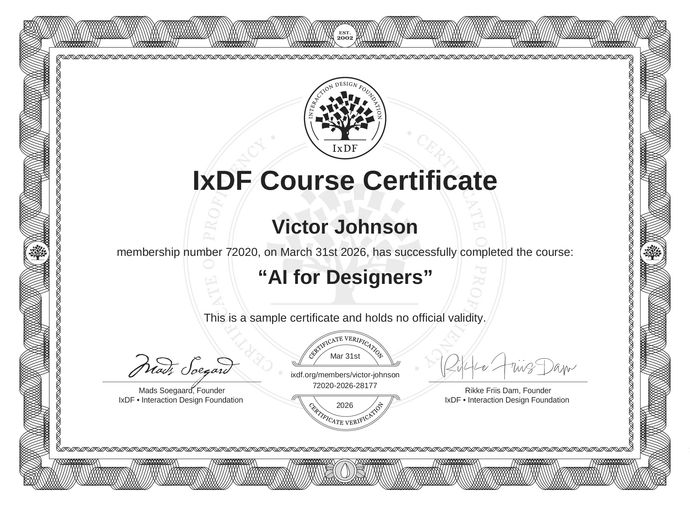
Course Certificate

All Free IxDF Articles on Time Management

Read full article
How to Plan for Creativity: Effective Time-Management Plans for Your Large-Scale Creative Projects - Article hero image

How to Plan for Creativity: Effective Time-Management Plans for Your Large-Scale Creative Projects

It’s a recipe for disaster if you simply add a step entitled "be creative" into a linear plan for a creative work project. Likewise, if you just wait for that heavenly spark of insight to come, you may be in for a not-so-great, long-drawn-out surprise. In this video, you’ll learn three best practice

Social shares
580
Published
Read Article

How to Plan for Creativity: Effective Time-Management Plans for Your Large-Scale Creative Projects

How to Plan for Creativity: Effective Time-Management Plans for Your Large-Scale Creative Projects

Transcript

It’s a recipe for disaster if you simply add a step entitled "be creative" into a linear plan for a creative work project. Likewise, if you just wait for that heavenly spark of insight to come, you may be in for a not-so-great, long-drawn-out surprise. In this video, you’ll learn three best practices on how to create high-gain and low-risk plans that are both open to creative insight and yet also guaranteed to produce useful results. We'll teach you ways to break down major high-risk creative work projects into smaller and tangible tasks which have the highest potential for high gains and low risks.

Professor and distinguished author Alan Dix talks about large-scale plans for creativity and innovation which demand weeks, months or perhaps even years. These large-scale plans are often attached to high risk, and you would most likely only set out to risk a lot if you had the opportunity for high gain. Naturally, putting so much into a grand plan usually means taking a gamble, as any plan that involves high risk and high gain includes a substantial possibility of failure. The good news is you can still go after big wins and have a better chance of getting them. In the video, you’ll learn three methods which will help you convert high-gain/high-risk into high-gain/low-risk activities and results.

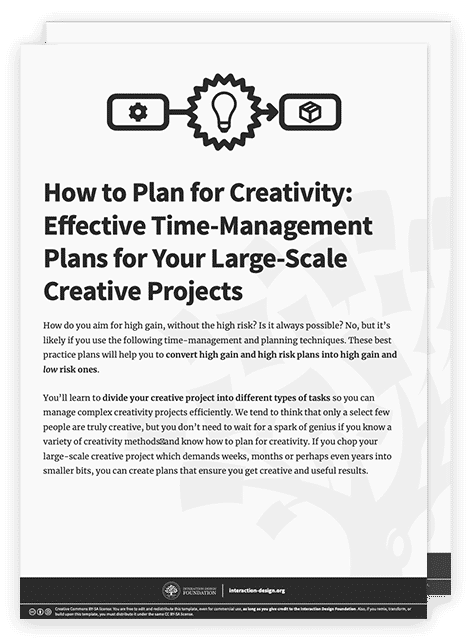
Want to get started right away? Then start using our three best practice methods in this comprehensive template.

Download our comprehensive step-by-step guide on how you can plan and time-manage large-scale creative projects.

Advance Your Career With This Free Template for “How to Plan for Creativity: Effective Time-Management Plans for Your Large-Scale Creative Projects”
How to Plan for Creativity: Effective Time-Management Plans for Your Large-Scale Creative Projects
Optional
Optional
We respect your privacy
Get 1 powerful email each week: Learn Design and AI From the Best.

39% of Today's Skills Will Change by 2030

The World Economic Forum expects 39% of today's skills to be transformed or become outdated by 2030.

The good news is that jobs in UX / UI design and AI are among the fastest-growing professions globally.

Build Skills That Keep You Relevant

Privacy Settings

By using this site, you accept our Cookie Policy and Terms of Use.
Customize
Accept all

Be the One Who Inspires

People remember who shares great ideas.

Share on:

Academic Credibility — On Autopilot

Don't waste time googling citation formats. Just copy, paste and look legit in seconds.