Your constantly-updated definition of Task Analysis and collection of videos and articles. Be a conversation starter: Share this page and inspire others!
Task analysis begins by defining any of the user’s problems as scenarios and concludes with creating a task flow that outlines the journey from problem to solution.
For example, when interviewing users who are interested in gardening and the designer realizes the majority of them have the problem of forgetting to water their plants every morning, the designer may include an alarm-feature in the final design to address this problem.
The designer’s goal is to keep the tasks as simple as possible and eliminate any unnecessary steps, keeping the process simple and straightforward.
Advance Your Career With This Free Template
for “How to Improve Your Design with Task Analysis”
Why? Because design skills make you valuable. In any job. Any industry.
In This Course, You'll
Get excited to discover what people truly need so you can create products and services they love. In this course, you'll be guided by industry experts, including renowned Professors Alan Dix and Ann Blandford. They'll teach you how to plan research, fit it into real-world design work, and translate raw findings into deliverables that influence design decisions. Whether you're transitioning into design or stepping into a senior role, this course builds your research toolkit with four essential qualitative techniques: semi-structured interviews, contextual inquiries, observational studies, and usability testing. All four are just as applicable to reducing abandoned carts in online shopping as to improving patient outcomes in healthcare. As AI speeds up research synthesis, your real advantage comes when you build timeless, human-centered design skills to frame the right research question, read between the lines of what users say and do, and translate your findings into insights stakeholders can understand and act on.
Make yourself invaluable when you can plan, conduct, and analyze research to discover who your users are, what they need, and what gets in their way. PwC found that customers will pay a 16% premium for great experiences, and great experiences start with knowing your users deeply. By the end of this course, you'll know which qualitative method to use based on the product development stage and how to prepare a comprehensive project plan. You'll write interview questions drawing on Kvale and Brinkmann's nine question types and analyze data through a six-step thematic analysis. Whichever method you use, you'll apply research ethics and obtain informed consent, avoid pressuring participants, and handle vulnerable populations with appropriate safeguards.
Gain confidence and credibility when you can prove the ROI of user research to decision-makers. You'll articulate research's three core purposes and translate them into the language of revenue, cost, and risk to secure resources for research work. You'll map stakeholders across business, engineering, and UX using Tomer Sharon's framework and conduct interviews to surface constraints, history, and expectations. To turn raw research into shared understanding among stakeholders, you'll learn to run a five-part workshop that produces well-framed How Might We questions and a team aligned on what to do next. And because words alone rarely move design forward, you'll produce affinity diagrams, empathy maps, and user journey maps that turn research data into something stakeholders can connect with and build on.
Craft your personal portfolio with optional hands-on projects and gain experience with user interviews, contextual inquiries, and observations. You'll translate your findings into concrete design deliverables that serve as visual artifacts in your case studies, ready to prove your research abilities to hiring managers. Plus, with ready-to-use templates like interview guides and customer journey maps, you'll implement your new skills immediately in your work.
Learn From Industry Leaders
Master complex skills with proven best practices and toolkits directly from industry leaders. Meet your experts for this course:
Frank Spillers: Service Designer and Founder and CEO of Experience Dynamics.
Ann Blandford: Professor of Human-Computer Interaction at University College London.
Alan Dix: Author of the bestselling book “Human-Computer Interaction” and Director of the Computational Foundry at Swansea University.
Earn Industry-Recognized Certificates
Industry giants trust our courses to train their teams, and prestigious universities integrate our content into their curricula. Add your certificates to your LinkedIn profile, résumé, and job applications.
One of the most important steps in the design thinking or human-centered design (HCD) methodology is to define the users' problems. This means to clearly identify and articulate problems in the UX so that you can later begin the ideation process (i.e., generate great ideas on how to solve said probl
Mental models are important in Human-Computer Interaction (HCI) and interaction design because they provide information about how users perceive the world and interact with products or services. Let’s explore this concept more closely.Mental models indicate what a user expects to happen based on exp
Design Scenarios - Communicating the Small Steps in the User Experience
Design scenarios are useful tools for communicating ideas about user actions. Mapping design scenarios also has the added benefit that it helps formalize ideas and to take creative approaches to those ideas. Most importantly of all, it will ensure that your designs are firmly rooted on terra firma a
Social shares
969
Published
Read Article
How to Improve Your UX Designs with Task Analysis
One of the most important steps in the design thinking or human-centered design (HCD) methodology is to define the users' problems. This means to clearly identify and articulate problems in the UX so that you can later begin the ideation process (i.e., generate great ideas on how to solve said problems). Task analysis is a simple exercise that UX designers can undertake during the definition of a problem, which can help identify opportunities to improve and generate some preliminary ideas as to how you might approach these challenges. Let's find out how.
Transcript
Transcript loading ...
Autoscroll
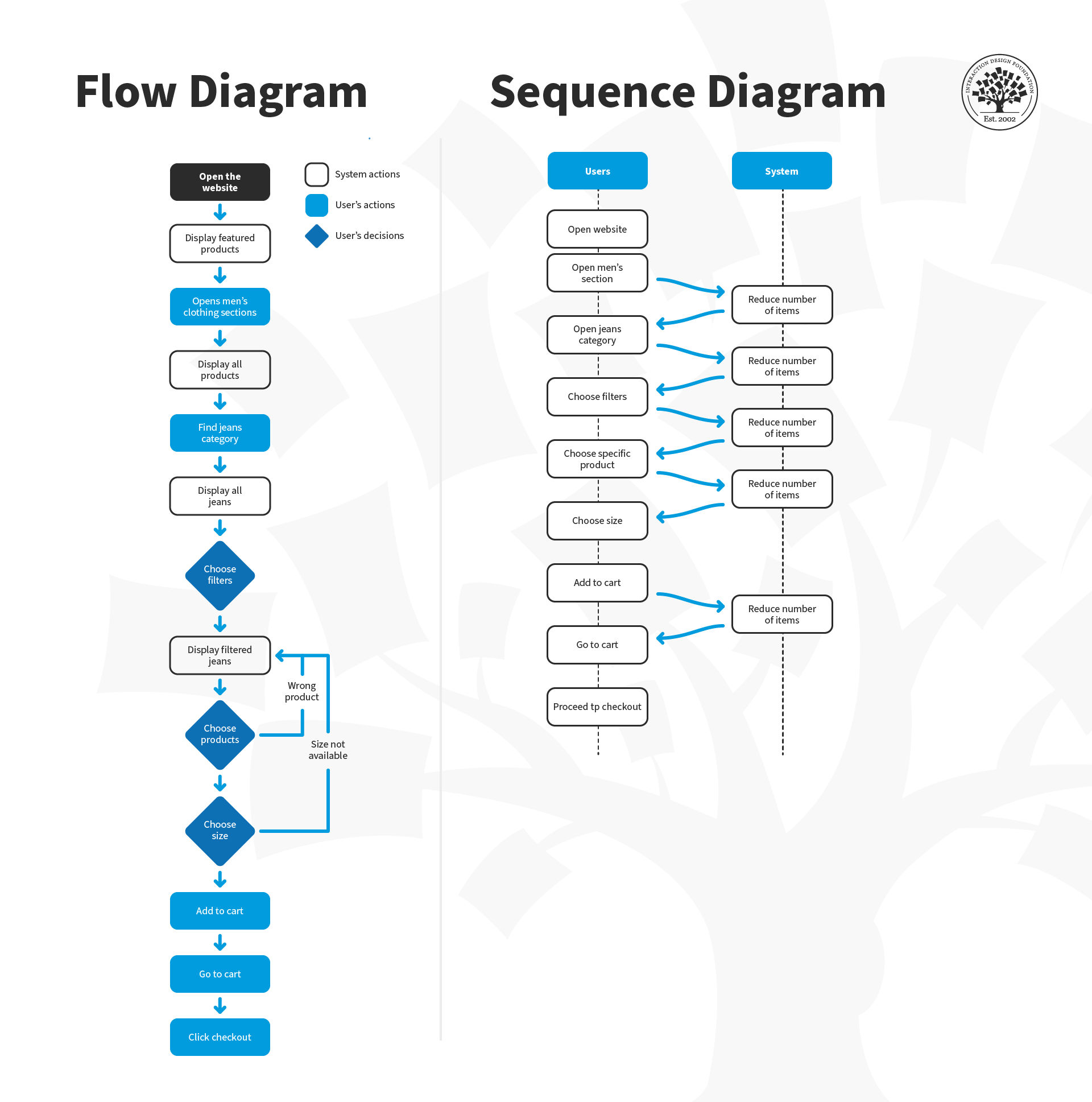
Task analysis is a method that helps you understand how users accomplish their goals and the steps they take to get there. This establishes their mental models and is crucial for task-oriented design. The most common output of a task analysis is a diagram that outlines the user's actions and the system's responses.
Designers can use this diagram to identify areas where additional support may be needed or to eliminate unnecessary steps. For example, designers may automate certain actions that users currently perform manually.
You can approach a task analysis activity from two main viewpoints:
Cognitive Task Analysis: Focuses on tasks that require decision-making, problem-solving, memory, attention and judgment.
How to Prepare for a Task Analysis
Usability experts agree that task analysis is an important activity where designers must understand the users and their environments, their goals and external factors that might influence the performance of the task. This means that you may have already engaged in user research, which provides you with outputs such as user personas, scenarios or storyboards. This data is essential for task analysis, as you will base your work on these outputs.
To ensure an effective task analysis process, it's essential to gather focused data during user research. Cognitive scientist and UX consultant Larry Marine suggests collecting five types of data during this phase:
Trigger: What initiates the task for the user?
Desired Outcome: How will users know they have successfully completed the task?
Base Knowledge: What will the users be expected to know when starting the task?
Required Knowledge: What do users already know before starting the task?
Artifacts: What resources or tools will users require during the task?
How to Conduct a Task Analysis
With your current information, you can sketch out how a user goes about their daily life by mapping out the sequence of activities required to achieve a goal. Before you start, it's important to have an overview of the process and its steps to prepare better.
Here is a step-by-step guide for conducting task analysis:
Identify the Task You Need to Analyze: Pick a persona and scenario for your user research and repeat the task analysis process for each of them. What is that user's goal and motivation to achieve said goal?
Break Down This Goal into Smaller Subtasks: A good rule of thumb is to aim for 4–8 subtasks – any more than this may indicate that the goal is too broad or abstract.
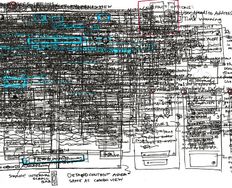
Draw a Layered Task Diagram of Each Subtask: You can use any notation you like for the diagram since there is no real standard here. Larry Marine shares some constructive advice on his notation, which you will examine below.
Write the Story: Ensure you accompany your diagram with a narrative that focuses on the whys.
Validate Your Analysis: Review the analysis with someone who wasn’t involved in the breakdown but knows the tasks well enough to check for consistency.
Pro Tip: Conduct a parallel task analysis with more than one person to undertake the process simultaneously so that you can compare and merge outputs into a final deliverable.
Larry Marine likes to annotate his task analysis diagrams using different colors in the various flows; for example, green represents users' actions, yellow is a step the system can do, purple represents tools or knowledge, and orange represents questions about the task.
Larry Marine suggests adding annotations to task analysis diagrams using a variety of colors that correspond to different flows. This technique helps him better visualize the user's journey and identify pain points or areas for improvement in the user experience.
A task analysis would probably have a greater proportion of "green" flows initially. A redesigned task would probably have fewer "green" and more "yellow" flows to show that you've really managed to off-load tasks from a user to a system, thus improving their overall experience to make their lives easier.
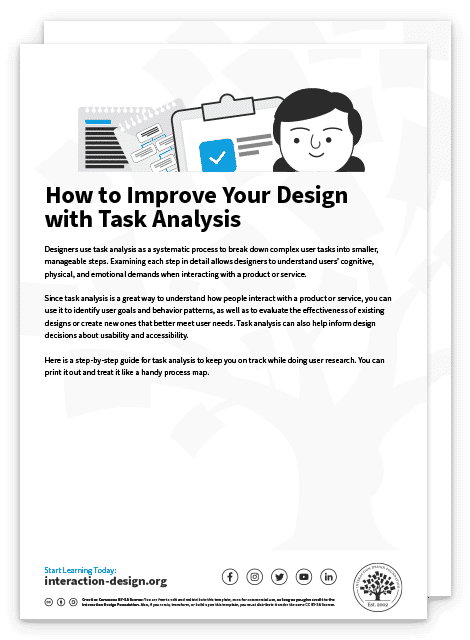
Download and share this guide on task analysis with your team to collaboratively visualize your user's journey and identify pain points.
Advance Your Career With This Free Template
for “How to Improve Your Design with Task Analysis”
The Take Away
Task analysis is a vital tool in a UX designer's skill set, as it helps designers understand how users complete tasks and identify areas for improvement. However, it's important to keep the user's perspective in mind and resist the temptation to generate your own interpretations of the problem or stick to design elements just for the sake of it.
To ensure that task analysis is effective, it should be backed by rigorous user research. Without data from user research, any efforts to proceed with task analysis will be blind and may not reflect actual user needs. Remember that task analysis is not a one-off process. Designers may need to repeat task analysis on their own designs later in the process.
Finally, task analysis requires time, resources, people, and budget like any other UX design activity. Balance these requirements carefully and engage in the process only if you have sufficient amounts of these elements.